MJF 3D Printing Guide
Everything you need to know about HP Multi Jet Fusion - materials, design rules, tolerance data, cost analysis, and the MJF vs SLS comparison.
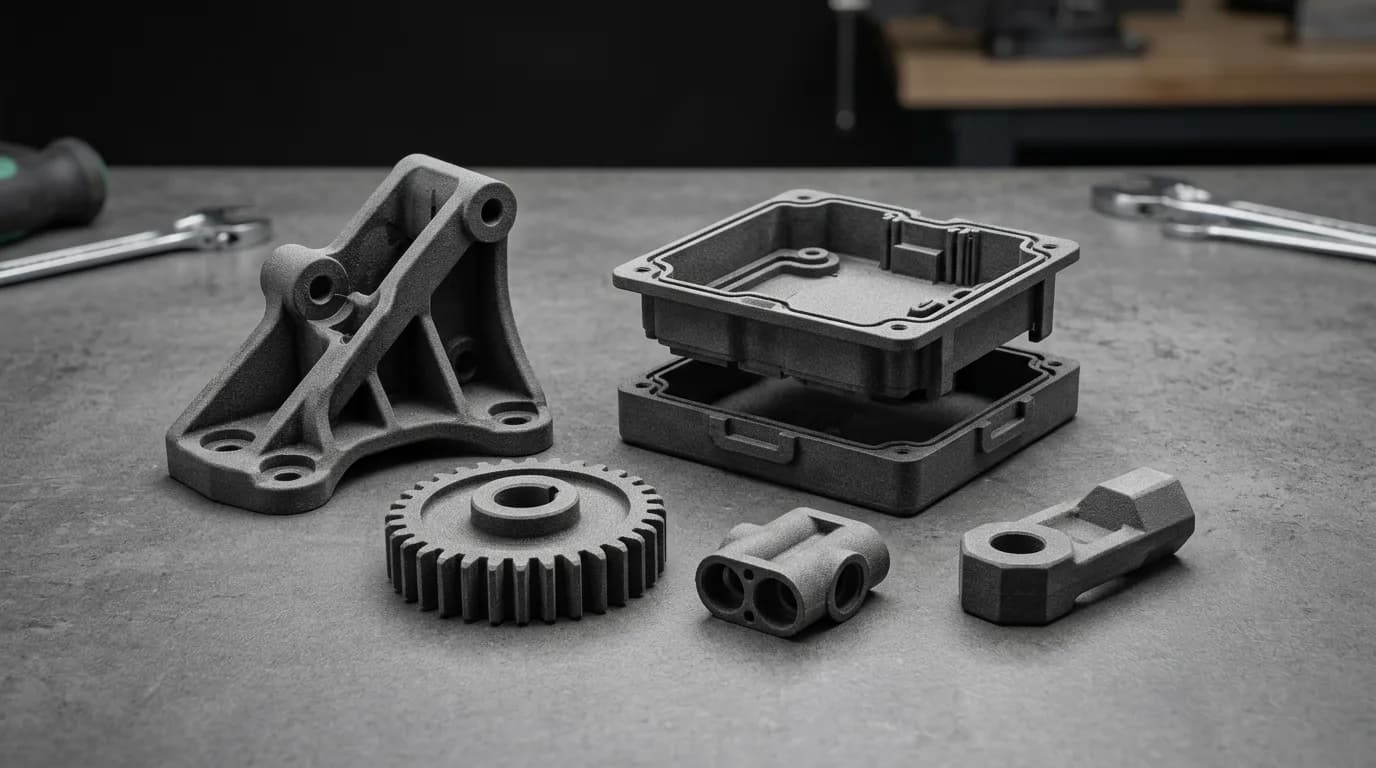
Why MJF Matters for Production
HP Multi Jet Fusion changed the economics of polymer additive manufacturing. Where SLS opened the door to functional nylon parts, MJF made them viable at production scale - 1.5–2× faster builds, more isotropic properties, and 20–40% lower per-part cost at volume. If you're evaluating AM for production nylon parts, MJF is likely your benchmark process.
How MJF Works - The Deep Dive
HP Multi Jet Fusion combines inkjet precision with infrared fusing to produce nylon parts faster and more isotropically than SLS.
Multi Jet Fusion (MJF) is HP's proprietary powder-bed fusion technology, commercially available since 2016. Unlike SLS (which uses a scanning laser), MJF uses a page-wide array of inkjet nozzles to deposit two chemical agents onto a nylon powder bed: Fusing agent: An IR-absorbing fluid (contains carbon black) deposited where the powder should melt. Detailing agent: A fusing-inhibitor deposited at part boundaries for sharp edges and fine detail. After agents are deposited, a high-power infrared lamp passes over the bed. Areas with fusing agent absorb the IR energy and melt; areas with detailing agent stay cool and remain powder. This layer-at-a-time process repeats until the build is complete.
Full-width inkjet array = speed
Unlike SLS (where a single laser rasters the cross-section), MJF's inkjet array spans the full bed width (~380 mm) and deposits both agents in a single pass. This makes build time nearly independent of part count - a full build plate takes the same time as one part.
Voxel-level control (1200 DPI)
MJF deposits agents at 1200 DPI resolution. The fusing agent controls melting, while the detailing agent sharpens boundaries. This dual-agent system produces sharper edges and finer features than the SLS laser spot (which has a Gaussian energy distribution).
Self-supporting powder bed
Like SLS, the surrounding unsintered powder supports the part during the build. No support structures are needed - parts can nest in 3D throughout the build volume for maximum packing density.
Thermal uniformity
The IR lamp fuses the entire layer surface simultaneously, creating more uniform thermal conditions than the SLS laser's raster pattern. This results in more isotropic mechanical properties - MJF parts are ~95% isotropic vs. ~85% for SLS.
Default color: gray/black
The carbon-black fusing agent gives MJF parts their characteristic gray color. Parts can be dyed (black, blue, red) in post-processing. White MJF is not available - if you need white or custom colors, use SLS with dyeable PA12 or FDM.
HP ecosystem
MJF is a closed ecosystem: machines (HP Jet Fusion 5200/5420W), materials, and software are all HP-controlled. This means consistent quality but limited material options compared to the broader SLS ecosystem.
Pro Tip
MJF's biggest advantage over SLS is throughput: a full HP 5200 build plate (~380 × 284 × 380 mm) can produce 100–300+ small parts in 12–18 hours. For production runs of nylon parts, MJF typically delivers 2–3× faster turnaround than SLS at the same or lower cost.
MJF Materials Guide
MJF materials are HP-controlled - fewer options than SLS, but each is production-validated for consistent mechanical properties.
HP's MJF portfolio has expanded steadily — the table below lists the most commonly specified materials, all production-validated with published mechanical property datasheets. HP's broader current catalog also includes PA 11 Gen2 (bio-based, higher reusability), PA 12 S (outdoor/UV), PA 12 FR (halogen-free flame retardant), polypropylene (PP), and ESD-safe print mode on the Jet Fusion 5600 Series. Confirm material availability with your production partner before finalizing specs.
| Material | Tensile (MPa) | Elongation (%) | HDT (°C) | Key Properties | Best For |
|---|---|---|---|---|---|
| PA12 (Nylon 12) | 48 | 20 | 175 | Workhorse - tough, good detail, consistent | Functional prototypes, enclosures, clips, brackets |
| PA11 (Nylon 11) | 46 | 30 | 180 | More ductile than PA12, bio-based (castor bean) | Impact-loaded parts, living hinges, orthotics |
| PA12-GB (Glass Bead) | 42 | 8 | 175 | 30% stiffer, better dimensional stability | Stiffness-critical housings, thermally stable parts |
| TPU (Flex) | 10–15 | 200–300 | - | Shore 88A, excellent energy return | Gaskets, seals, vibration dampers, midsoles |
| PA12 (color-ready) | 48 | 20 | 175 | Accepts vibrant dye colors (white base) | Consumer products, cosmetic parts requiring color |
Pro Tip
PA12 handles 80% of MJF applications. Use PA11 (or PA 11 Gen2 when available) when you need more ductility or impact resistance (e.g., snap-fits that will see repeated cycling). Use PA12-GB when dimensional stability and stiffness are more important than elongation. For outdoor/UV exposure consider PA 12 S, and for fluid-compatible or chemically resistant parts consider PP.
Design Guidelines (DFM)
MJF design rules overlap with SLS but include unique considerations for escape holes, nesting, and the detailing agent.
MJF shares many design rules with SLS (both are powder-bed processes using nylon), but the inkjet-based agent deposition adds unique capabilities and constraints. These guidelines assume HP PA12 at 0.08 mm layer height.
| Feature | Recommended | Minimum | Notes |
|---|---|---|---|
| Wall thickness | 0.7 mm | 0.5 mm | PA12-GB: min 0.8 mm (more brittle than PA12) |
| Escape holes (depowdering) | ≥4 mm dia. (×2 per cavity) | 3 mm | Trapped powder cannot be removed - parts will be heavy/weak |
| Min feature size | 0.5 mm | 0.3 mm | Detailing agent enables sharp edges down to 0.3 mm |
| Living hinges | 0.5 mm thick, ≥2 mm wide | 0.4 mm thick | PA11 preferred - 30% more elongation than PA12 |
| Snap-fit arms | 1.0 mm thickness | 0.7 mm | Design for 3–5% strain (PA12) or 5–8% (PA11) |
| Part-to-part clearance | 0.5 mm/side | 0.3 mm | For assemblies; trapped powder in tight gaps is hard to remove |
| Embossed/engraved text | 0.5 mm wide, 0.5 mm tall | 0.3 mm | MJF resolves text well due to detailing agent boundary control |
| Hole diameter | ≥1.5 mm | ≥1.0 mm | Small holes trap powder; add chamfer for easier cleaning |
| Max unsupported span | L/T ≤ 10:1 | L/T ≤ 8:1 | Span depends on length-to-thickness ratio, material, and orientation — not a fixed mm value. Larger ratios risk sag during thermal cooldown. |
| Nesting clearance | 2 mm between parts | 1.5 mm | Allows proper agent deposition and powder flow between parts |
Pro Tip
Nesting efficiency directly impacts your per-part cost. Design parts to pack efficiently in 3D - avoid large flat plates that waste build volume. A well-packed MJF build at 15–20% packing density lowers cost per part.
Tolerances & Accuracy
MJF achieves slightly tighter tolerances than SLS due to more uniform thermal processing and the precision of the detailing agent.
MJF dimensional accuracy benefits from two factors: the detailing agent creates sharper boundaries than the SLS laser's Gaussian profile, and the uniform IR fusing creates more consistent shrinkage than point-by-point laser sintering.
| Metric | MJF (HP 5200) | SLS (EOS P396) | Notes |
|---|---|---|---|
| Standard tolerance | ±0.008″ (±0.20 mm) | ±0.010″ (±0.25 mm) | MJF ~20% tighter on average |
| Best achievable | ±0.004″ (±0.10 mm) | ±0.005″ (±0.13 mm) | Small features, well-calibrated |
| Surface finish (as-built) | 100–250 Ra µin (2.5–6.3 µm) | 125–300 Ra µin (3.2–7.6 µm) | MJF slightly smoother due to finer effective resolution |
| Surface finish (bead blasted) | 50–100 Ra µin | 50–125 Ra µin | Post-processing narrows the gap |
| Isotropy (XY vs Z strength) | ~95% | ~85% | MJF's uniform fusing produces more consistent properties |
| Min layer height | 0.08 mm (fixed) | 0.06–0.12 mm | SLS has adjustable layers; MJF is fixed at 80 µm |
| Shrinkage | 2.5–3.0% (PA12) | 3.0–3.8% (PA12) | MJF shrinkage is more uniform and predictable |
Predictable shrinkage
MJF's uniform thermal processing means shrinkage is consistent across the build volume. Service bureaus calibrate shrinkage compensation factors that hold build-to-build. SLS shrinkage varies more with part position in the build chamber.
Edge sharpness advantage
The detailing agent creates a thermal barrier at part boundaries, producing sharper edges and more defined small features than SLS. This is visible on text, thin ribs, and fine geometric details.
Z-axis accuracy
MJF's fixed 80 µm layer height means Z dimensions resolve in 0.08 mm increments. For features requiring finer Z resolution, SLS at 0.06 mm layers may be preferable (though the accuracy benefit is marginal).
Pro Tip
MJF's more predictable shrinkage makes it easier to hit tolerances consistently across production runs. If you're producing 100+ identical parts and need part-to-part consistency, MJF typically outperforms SLS on dimensional repeatability.
Cost Analysis
MJF and SLS have similar per-part costs at low volumes, but MJF's throughput advantage makes it 20–40% cheaper at production volumes.
MJF cost is driven by machine time and material consumption - but because MJF builds entire layers simultaneously (vs. SLS raster scanning), a packed build plate costs significantly less per part. The economic advantage of MJF scales with volume and packing efficiency.
| Cost Component | MJF (HP 5200) | SLS (EOS P396) | Notes |
|---|---|---|---|
| Machine rate | $20–50/hr | $25–60/hr | Similar rates; MJF faster per build = lower cost/part |
| Material (PA12) | $50–90/kg | $50–100/kg | HP materials are competitive; refresh ratio is similar |
| Build time (full plate) | 12–18 hours | 18–30 hours | MJF 1.5–2× faster for same build volume |
| Post-processing | $5–12/part | $5–15/part | Both need depowdering and bead blasting |
| Est. cost (1 part) | $25–65 | $30–80 | Similar at low volumes |
| Est. cost (50 parts) | $12–30/ea | $15–40/ea | MJF wins on throughput at volume |
| Est. cost (200+ parts) | $8–20/ea | $12–30/ea | MJF 20–40% cheaper due to packing efficiency |
Packing density is the #1 cost lever
A well-packed MJF build (15–20% packing density) can fit 200–500+ small parts in a single run. At $25–40/hr machine rate over 15 hours, that's $0.08–0.30/part in machine time. Packing efficiency drives MJF's production economics.
Break-even vs. SLS
At 1–10 parts, MJF and SLS are priced similarly from service bureaus. At 50+ parts, MJF's throughput advantage delivers 15–25% savings. At 200+ parts, MJF can be 30–40% cheaper per part.
Break-even vs. injection molding
MJF is cheaper than injection molding below ~5,000–10,000 units (depending on part complexity). Above that, injection molding's lower per-part cost outweighs the tooling investment ($5K–$50K). For bridge production, MJF fills the gap.
Pro Tip
When quoting MJF production runs, ask your service bureau about packing density optimization. Some vendors will co-pack your parts with other orders to maximize build density - this can reduce your per-part cost by 20–30% compared to dedicated builds.
MJF vs SLS - Head to Head
The most common question in powder-bed polymer AM: should I choose MJF or SLS? Here's the definitive comparison.
MJF and SLS produce similar nylon parts from similar materials - the differences are in throughput, isotropy, material breadth, and cost at volume. Here's the engineering comparison:
| Factor | Choose MJF When… | Choose SLS When… |
|---|---|---|
| Volume (50+ parts) | You need 50–5,000 nylon parts and MJF's higher throughput matters | Volume is low (<50) and turnaround isn't critical |
| Isotropy | Z-axis strength consistency matters (~95%) | Slight anisotropy (~85%) is acceptable for your loads |
| Material range | PA12, PA11, PA12-GB, or TPU meets your needs | You need glass-filled (GF), carbon-filled (CF), PP, or FR nylon |
| Surface finish | Smoother as-built finish is preferred | Finish after bead blast is acceptable (both are similar post-process) |
| Dimensional stability | Tight tolerances on production runs | Larger build volumes needed (550 × 550 × 750 mm on EOS P 770) |
| Color | Gray/black default is acceptable (or dye post-process) | You need white parts or specific colors without dyeing |
| Part size | Parts fit within 380 × 284 × 380 mm | Parts exceed MJF build volume |
| Cost sensitivity | Per-part cost matters at volume | Budget for low-volume prototyping is flexible |
Pro Tip
For functional nylon prototypes (1–20 parts), MJF and SLS are interchangeable - pick whichever your service bureau has available first. For production runs (100+ parts), MJF's throughput advantage typically delivers 20–40% cost savings over SLS.
Applications & Use Cases
MJF dominates production-grade nylon parts - where SLS pioneered the path, MJF delivers at scale.
Bridge production (100–10,000 units)
MJF fills the gap between prototyping and injection molding tooling. Produce production-grade nylon parts without $10K–$50K tooling investment. Iterate the design between production runs at zero tooling cost.
Automotive interior components
Dashboard clips, cable guides, air duct connectors, and other under-hood/interior plastic parts. BMW, Volkswagen, and Ford use MJF for low-volume production and spare parts.
Consumer electronics housings
MJF PA12 housings with snap-fits, bosses, and thin walls. Production-representative quality for beta testing and limited market launches. Surface can be dyed and finished to near-injection-mold appearance.
Medical devices & orthotics
Custom orthotics, prosthetic sockets, and surgical planning models. PA11 (biocompatible, ductile) is particularly suited for patient-contact devices. Each unit can be patient-specific at no additional tooling cost.
Functional prototyping
Engineering-grade nylon parts for fit, form, and function testing. Snap-fits, living hinges, and threaded bosses all work in MJF PA12/PA11. Faster turnaround than SLS for urgent prototype needs.
Spare parts & aftermarket
Print-on-demand replacement parts for automotive, industrial, and consumer equipment. Digital inventory replaces physical warehousing - print the part when it's needed, not before.
Pro Tip
MJF's sweet spot is 100–5,000 unit production runs in nylon. Below 100, the cost premium over FDM may not be justified unless you need isotropic strength or no support marks. Above 5,000, start evaluating injection molding.
Common Mistakes
These MJF-specific mistakes increase cost, delay delivery, or produce parts that fail inspection.
Not designing escape holes for trapped powder
MJF builds are encased in unsintered powder. Any internal cavity without an escape hole will trap powder permanently - the part will be heavier than expected and may fail mechanically. Add ≥4 mm holes to every enclosed volume.
Ignoring packing efficiency in production
MJF cost per part drops dramatically with packing density. A single large part in a full build volume wastes 90% of the available capacity. Design parts that nest efficiently, or work with your service bureau to co-pack with other orders.
Assuming MJF and SLS parts are identical
MJF PA12 and SLS PA12 have similar but not identical properties. MJF parts are more isotropic (~95% vs ~85%) but slightly less elongation at break in some orientations. Always validate mechanical requirements with MJF-specific datasheets.
Specifying tight tolerances without post-machining
MJF standard tolerance is ±0.008″ (±0.20 mm). For any feature tighter than ±0.005″, plan for secondary CNC machining. Calling out ±0.001″ on an MJF drawing will result in either a rejected quote or an expensive hybrid workflow.
Expecting white or custom colors without dyeing
MJF parts are inherently gray due to the carbon-black fusing agent. White parts are not possible with standard MJF. For custom colors, budget for a dyeing step in post-processing (+$1–3/part) or use HP's color-ready PA12 for brighter dye uptake.
Not accounting for moisture absorption
PA12 absorbs 0.8–1.2% moisture by weight over time, which slightly reduces stiffness and increases ductility. For dimensionally critical applications, specify "dry-as-molded" testing conditions or seal parts with moisture-barrier coating.
Pro Tip
When transitioning from MJF prototyping to MJF production, request a First Article Inspection (FAI) report from your service bureau. Measure critical dimensions on 3–5 sample parts to validate that tolerances, surface finish, and mechanical properties meet your spec before committing to a full production run.
Frequently Asked Questions
Need MJF Production Parts?
Upload your CAD file for a free quote typically within one business day. MakerStage supports MJF nylon parts with engineer-reviewed DFM feedback and production-oriented quality requirements.
Get MJF Quote