Surface Finishes Explained
Surface finish is what the customer sees and what the environment attacks. Ra roughness, anodizing, powder coating, plating, passivation, and electropolishing — this guide explains each finish type, when to use it, how it affects cost, and how to specify it on your drawing.
Why surface finish is referenced on every other MakerStage guide
Surface finish appears in the CNC machining guide (as-machined Ra), the sheet metal guide (powder coat, anodize), the GD&T guide (surface finish symbols), and the tolerances guide (finish vs. cost). This page is the central reference that ties them all together. Bookmark it — you will come back to it every time you specify a finish on a drawing.
What Is Surface Finish (Ra)?
Surface finish quantifies the roughness of a machined or finished surface. The most common parameter is Ra (arithmetic average roughness) per ISO 21920-2 — the mean deviation of the surface profile from the centerline, measured in microinches (µin.) or micrometers (µm). Lower Ra = smoother surface. Ra is measured with a profilometer (contact or optical) and is the number you write in the surface finish symbol on your drawing.
Ra Reference Table — Process vs. Achievable Finish
| Ra (µin.) | Ra (µm) | Typical Process | Application | Relative Cost |
|---|---|---|---|---|
| 250 | 6.3 | Rough machining, sawing | Non-functional hidden surfaces | 1× |
| 125 | 3.2 | Standard CNC milling | General as-machined default | 1× |
| 63 | 1.6 | Fine milling, standard turning | Mating surfaces, bearing housings | 1.2–1.5× |
| 32 | 0.8 | Fine turning, finish milling | O-ring grooves, sealing faces | 1.5–2× |
| 16 | 0.4 | Grinding, fine boring | Precision bearing journals | 2–3× |
| 8 | 0.2 | Lapping, honing, polishing | Optical, gauge faces | 3–5× |
| 4 | 0.1 | Superfinishing, electropolishing | Medical implants, mirror finish | 5–10× |
As-Machined Finishes
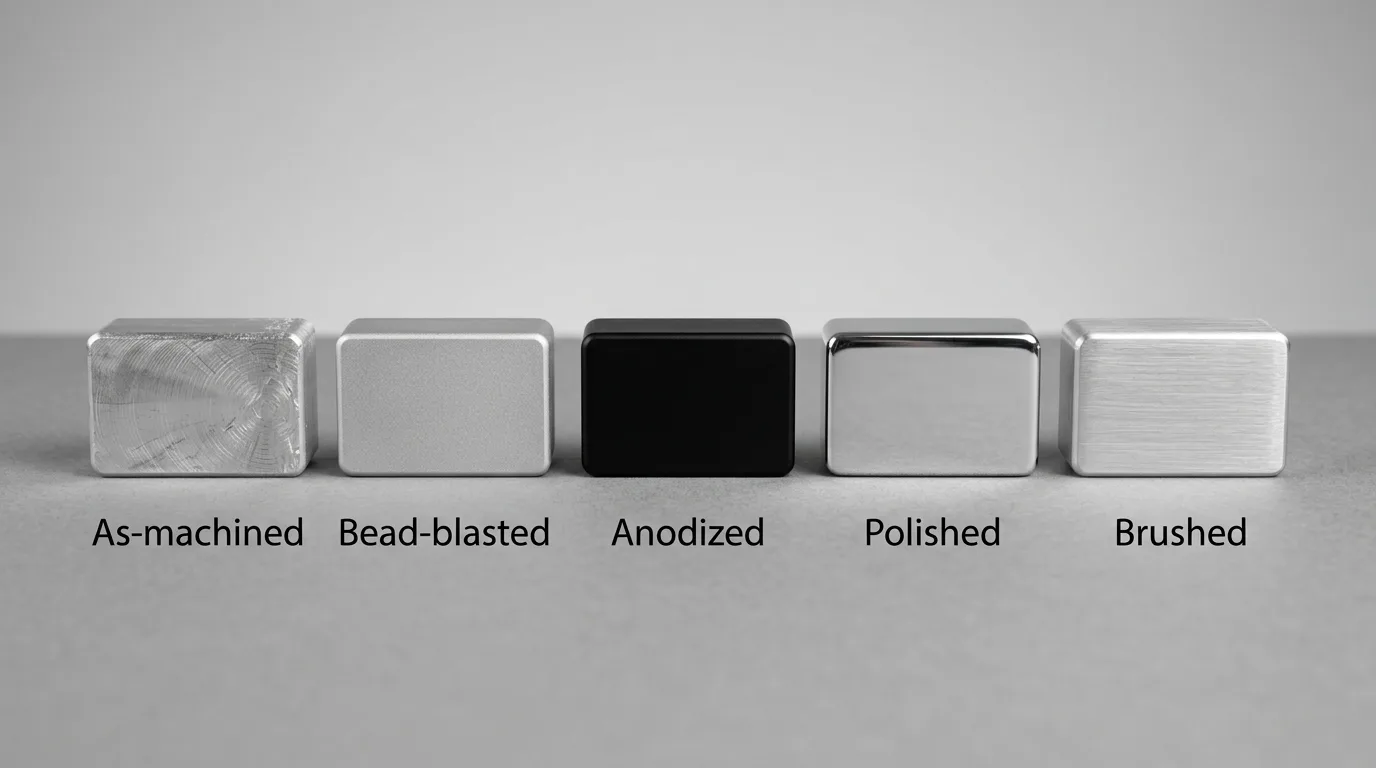
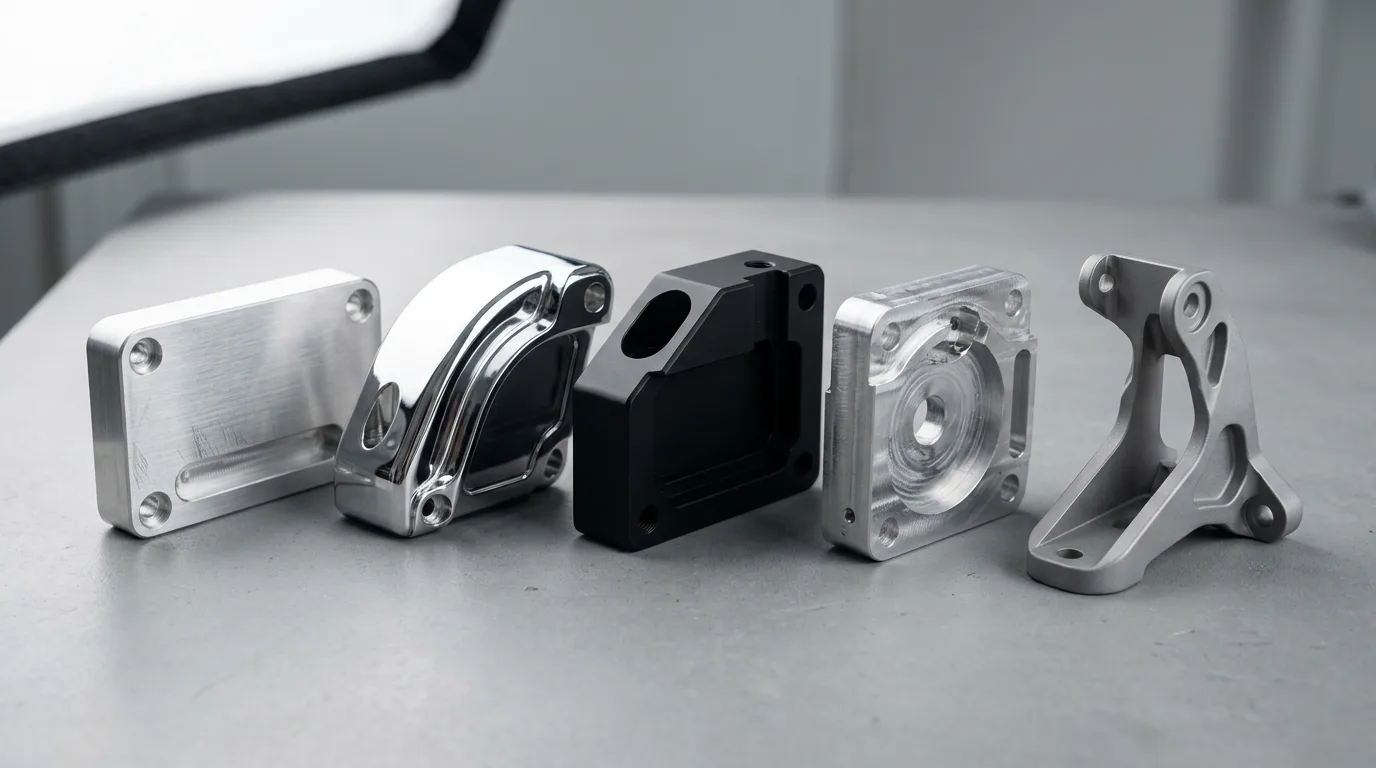
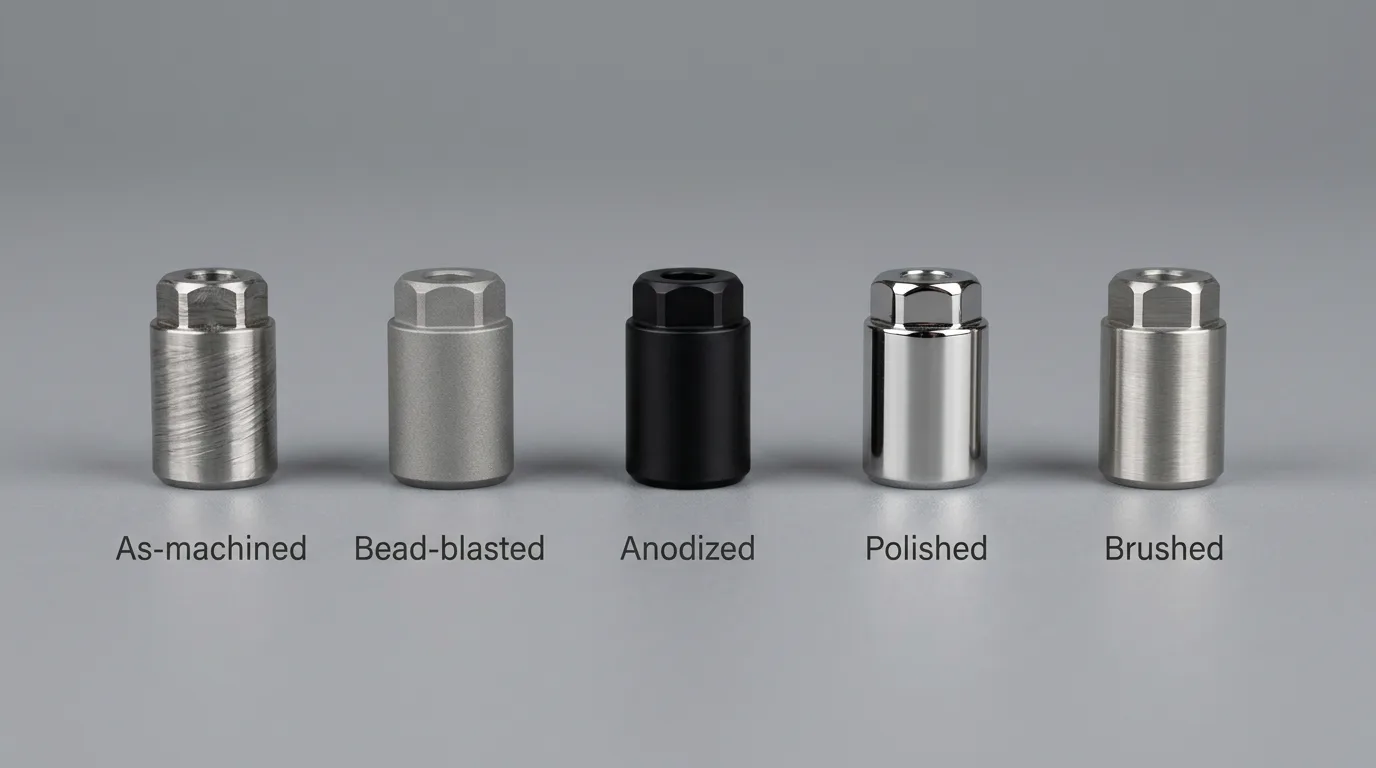
The finish left by the cutting tool with no secondary processing. This is the baseline — every other finish adds cost and lead time on top of this.
CNC milling: Ra 63–125 µin. (1.6–3.2 µm)
The standard as-machined finish from a carbide end mill at normal feeds/speeds. Tool marks (cusps) are visible under magnification. Acceptable for most non-cosmetic, non-sealing surfaces. This is the finish you get if your drawing does not call out a specific Ra value.
CNC turning: Ra 32–63 µin. (0.8–1.6 µm)
Turning naturally produces a finer finish than milling because the tool is in continuous contact with the rotating workpiece. Standard turned finishes are suitable for bearing housings, O-ring grooves, and mating bores without additional finishing.
Grinding: Ra 4–16 µin. (0.1–0.4 µm)
Surface grinding, cylindrical grinding, or centerless grinding produces the finest as-machined finishes. Used for bearing journals, precision bores, gauge surfaces, and any feature requiring Ra ≤16 µin. (≤0.4 µm). Adds a secondary operation after rough CNC machining.
Wire EDM: Ra 8–32 µin. (0.2–0.8 µm)
Wire EDM achieves fine finishes through multiple skim passes (rough cut + 2–3 finish passes). The finish improves with each pass but at the cost of additional machine time. A single rough cut yields Ra ~125 µin. (~3.2 µm); three skim passes bring it to Ra 8–16 µin. (0.2–0.4 µm).
Mechanical Finishes
Mechanical finishes use physical media (beads, grit, abrasives) to alter the surface texture without chemical processes.
Bead Blasting
Glass bead or aluminum oxide media propelled at the surface to create a uniform matte texture. Hides tool marks and fingerprints. Specify media type and mesh: "glass bead, 80–120 mesh, uniform matte." Often used as a pre-treatment before anodizing. Ra typically 63–250 µin. (1.6–6.3 µm) depending on media and pressure.
Tumble / Vibratory Deburring
Parts are placed in a drum or vibratory bowl with ceramic or plastic media. The media abrades edges and surfaces, removing burrs, rounding corners, and producing a uniform satin finish. Economical for high volumes. Specify "tumble deburr, break all edges 0.005–0.015 in. (0.13–0.38 mm)."
Brushing (Scotch-Brite)
Abrasive pad or belt produces a directional linear grain pattern on flat surfaces. Common for stainless steel panels, appliance fronts, and architectural metalwork. Specify grain direction relative to a datum: "#4 satin finish, grain parallel to long edge." Typical Ra 16–63 µin. (0.4–1.6 µm).
Anodizing (Type I, II, III)
Anodizing is an electrochemical process that grows a hard oxide layer on the surface of aluminum, titanium, and magnesium parts. It is most commonly specified for CNC-machined and sheet metal aluminum components, but is also used on titanium and magnesium for corrosion and wear resistance.
| Type | Thickness | Hardness | Colors | Standard | Typical Use |
|---|---|---|---|---|---|
| Type I (Chromic Acid) | 0.02–0.1 mil (0.5–2.5 µm) | Minimal hardness increase | Clear / gray only | MIL-A-8625 Type I | High-performance, fatigue-critical parts, paint adhesion primer |
| Type II (Decorative) | 0.3–1.0 mil (8–25 µm) | ~40 HRC equivalent | Clear, black, blue, red, gold, custom | MIL-A-8625 Type II | Consumer electronics, enclosures, panels |
| Type III (Hardcoat) | 1.0–3.0 mil (25–75 µm) | 60–70 HRC equivalent | Natural dark gray/black (limited dye options) | MIL-A-8625 Type III | Wear surfaces, slides, rails, actuator bodies |
Dimensional impact
Type III hardcoat grows approximately 50% into the base metal and 50% outward. A 2.0-mil hardcoat adds ~1.0 mil (0.001 in. / 0.025 mm) to each surface. On a bore with ±0.001 in. (±0.025 mm) tolerance, this matters — either machine the bore 0.002 in. (0.05 mm) oversize before anodizing, or mask the bore to prevent coating. Call this out on your drawing: “MASK BORE B PER SPEC” or “MACHINE TO FINISH SIZE AFTER ANODIZE.”
Chemical & Electrochemical Finishes
Passivation
Acid bath (citric or nitric per ASTM A967 or AMS 2700) removes free iron from stainless steel surfaces and restores the chromium oxide passive layer. Does not change dimensions or surface finish. Required for medical, food-contact, and marine stainless parts. Specify: "PASSIVATE PER ASTM A967, CITRIC ACID METHOD."
Electropolishing
Electrochemical process that removes 0.0002–0.001 in. (0.005–0.025 mm / 5–25 µm) from the surface, preferentially dissolving peaks and smoothing the micro-profile to Ra 4–16 µin. (0.1–0.4 µm). Improves corrosion resistance beyond passivation and produces a bright, reflective finish. Specify: "ELECTROPOLISH PER ASTM B912, REMOVE 0.0005 in. (0.013 mm) MINIMUM."
Chromate Conversion (Alodine / Chem Film)
Chemical coating on aluminum that provides corrosion resistance and serves as a primer for paint adhesion. Adds negligible thickness (<0.0001 in. / <0.003 mm). Available as clear (Class 3) or gold/iridescent (Class 1A per MIL-DTL-5541). Does not affect dimensions. Often used on aluminum parts that will be painted or powder coated.
Black Oxide
Chemical conversion coating on carbon steel and stainless steel that produces a dark black appearance. Adds negligible thickness (<0.0001 in. / <0.003 mm) and provides mild corrosion resistance (typically supplemented with oil or wax). Specify: "BLACK OXIDE PER MIL-DTL-13924, CLASS 1." Commonly used on fasteners, tooling, and firearms components.
Plating
Plating deposits a thin metal layer onto the part surface through electrochemical (electroplating) or chemical (electroless) processes.
Zinc Plating
Sacrificial corrosion protection for carbon steel. 0.2–0.5 mil (5–12 µm) zinc layer with optional chromate conversion (clear, yellow, or black). Per ASTM B633. The most economical plating for steel parts.
Nickel Plating (Electroless)
Uniform nickel-phosphorus coating regardless of part geometry (no "dog bones" at edges). Adds corrosion and wear resistance. Typical thickness: 0.3–1.0 mil. Per MIL-C-26074 or ASTM B733. Used on complex geometries where electroplating would be non-uniform.
Chrome Plating (Hard Chrome)
Hard chromium electroplate (1–10 mil) for extreme wear resistance. Used on hydraulic cylinder rods, piston rings, and bearing surfaces. Per SAE-AMS-QQ-C-320 (formerly QQ-C-320). Note: hexavalent chrome is increasingly restricted (REACH, RoHS) — specify trivalent chrome alternatives where regulations apply.
Organic Coatings
Powder Coating
Electrostatically applied dry powder cured at 350–400°F (175–200°C). Produces a durable, uniform, scratch-resistant coat in any RAL color. Thickness: 2–4 mil (50–100 µm). Widely used for enclosures, brackets, and outdoor hardware. Cannot be applied to plastics or materials that cannot withstand the cure temperature.
Wet Paint (Spray)
Liquid paint applied by spray gun. Available in virtually any color, gloss level, and specialty formulation (high-temp, anti-static, conductive). Thinner than powder coat (0.5–2 mil typical). Used when powder coat cure temperature is too high, when very thin coats are needed, or for touch-up and small quantities.
E-Coat (Electrocoat)
The part is submerged in a paint bath and an electrical current deposits a uniform coating into every recess and cavity. Typical thickness: 0.6–1.2 mil. Used for high-volume automotive and appliance parts where uniform coverage of complex geometry is required. Primer coat only — typically followed by a topcoat for cosmetic parts.
Finish Comparison Table
| Finish | Compatible Metals | Thickness Added | Corrosion Protection | Wear Resistance | Colors | Cost/Part |
|---|---|---|---|---|---|---|
| Type II Anodize | Aluminum | 0.3–1.0 mil | Moderate | Low–moderate | Many (dye) | $2–$8 |
| Type III Hardcoat | Aluminum | 1.0–3.0 mil | High | High (60–70 HRC) | Dark gray/black | $5–$15 |
| Passivation | Stainless steel | None | Moderate (restores passive layer) | None | None (no change) | $1–$5 |
| Electropolish | Stainless steel | Removes 0.0002–0.001 in. (0.005–0.025 mm) | High | None | Mirror bright | $5–$25 |
| Powder Coat | Steel, aluminum | 2–4 mil | High | Moderate | Any RAL color | $3–$12 |
| Zinc Plating | Carbon steel | 0.2–0.5 mil | Moderate (sacrificial) | Low | Clear/yellow/black | $0.50–$3 |
| Electroless Nickel | Most metals | 0.3–1.0 mil | High | Moderate–high | Silver/gray | $3–$10 |
| Hard Chrome | Most metals | 1–10 mil | High | Very high | Chrome silver | $5–$20 |
| Chromate Conv. | Aluminum | <0.0001 in. (<0.003 mm) | Low–moderate | None | Clear/gold | $1–$3 |
| Black Oxide | Steel | <0.0001 in. (<0.003 mm) | Low (needs oil) | None | Black | $0.50–$3 |
How to Specify Surface Finish on Your Drawing
A properly specified finish eliminates RFIs and ensures the finisher delivers what you expect. Here is exactly what to include.
Ra callout on the drawing surface
Place the surface finish symbol (per ASME Y14.36 or ISO 1302) on surfaces where roughness matters functionally. Write the maximum Ra value: e.g., "32" for 32 µin. (0.8 µm) Ra. Surfaces without a callout default to the general note (typically "125 µin. / 3.2 µm Ra UOS").
Finish callout in general notes
Specify the secondary finish with full detail: "FINISH: TYPE II ANODIZE, BLACK, PER MIL-A-8625 TYPE II CLASS 2, 0.7 MIL NOM." Include: finish type, color, specification standard, and thickness. Missing any element creates ambiguity.
Masking requirements
If certain features must remain uncoated (threads, press-fit bores, mating surfaces), call out masking: "MASK THREADS AND BORE B PRIOR TO ANODIZE." Without this note, the finisher coats everything — and you get anodize build-up in your press-fit bore.
Pre-finish and post-finish dimensions
For coatings that add meaningful thickness (Type III anodize, hard chrome, powder coat), specify whether dimensions on the drawing are before or after coating. Standard practice: dimensions are after coating unless noted. If machining to a tight tolerance, note: "DIMENSION APPLIES AFTER COATING" or "MACHINE BORE TO 0.502 in. (12.75 mm) BEFORE ANODIZE."
Frequently Asked Questions
What does Ra mean and how is it measured?
What is the difference between Type II and Type III anodizing?
When should I specify passivation vs. electropolishing?
How does surface finish affect part cost?
How do I call out a surface finish on my engineering drawing?
Can I anodize all aluminum alloys?
How does powder coating work?
Is powder coating more durable than paint?
Related Resources
Need Parts with a Specific Finish?
Upload your drawing with finish callouts. MakerStage quotes machining and finishing together — anodize, powder coat, plating, passivation, and more.
Get Surface Finish Quote