Acetal, POM & Delrin: The Complete Engineer's Guide
Widely considered the most machinable engineering plastic you're probably underusing. Properties, grade selection, CNC rules, and application matrix — all in one place.
Acetal Is the Default Engineering Plastic for Precision Sliding Parts.
If your part slides, rotates, or needs to hold a tight tolerance in a humid environment, acetal (POM) should be your first material candidate — not nylon, not polycarbonate. It absorbs virtually no moisture, machines like a dream, and delivers consistent dimensional stability that most other engineering plastics cannot match at room temperature. This guide covers everything you need to specify it correctly.
What Is Acetal (POM)?
If you're specifying plastics for precision mechanical parts, acetal (POM) should be the first material on your shortlist — here's why.
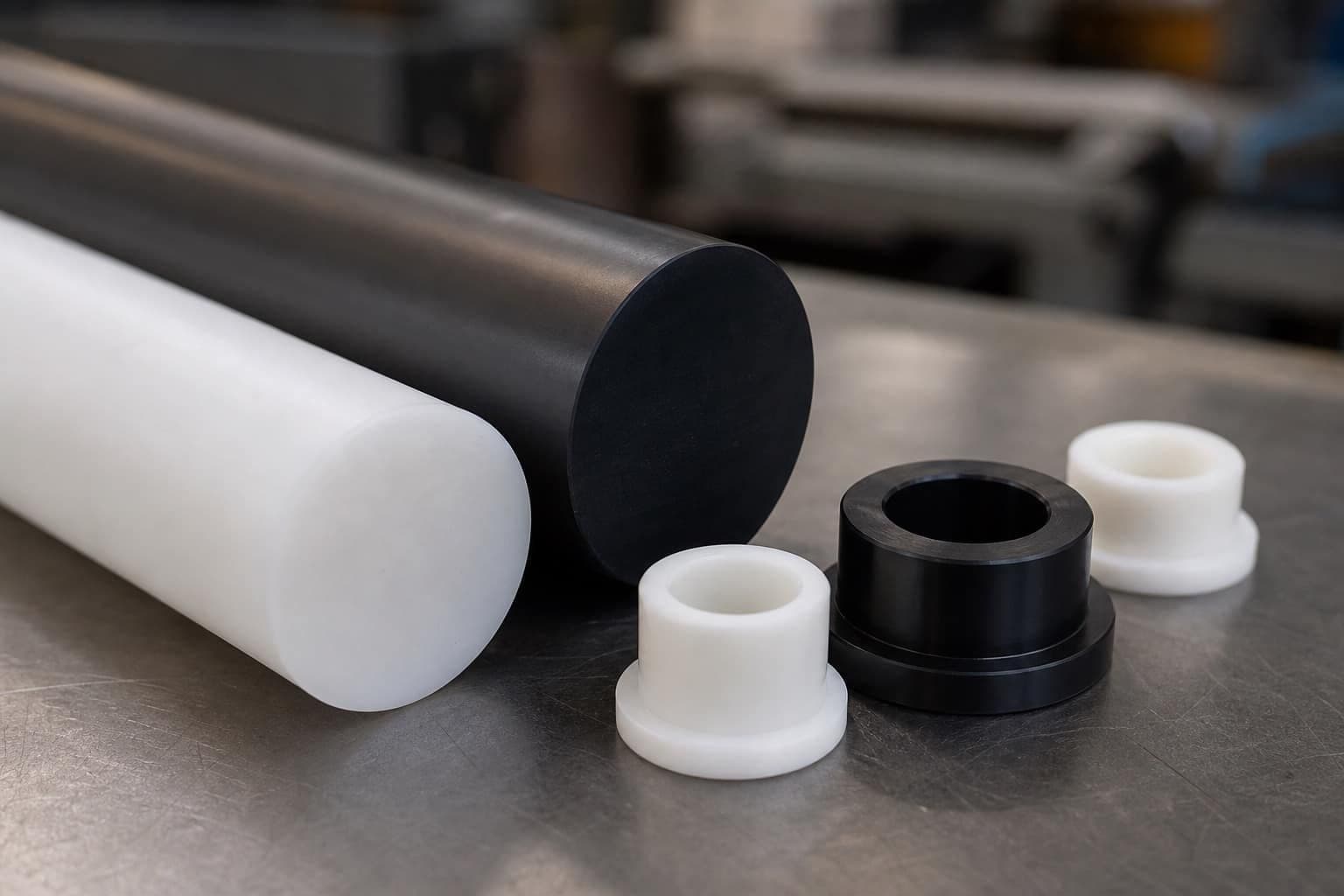
Acetal is a semi-crystalline (partially ordered molecular structure that gives it high stiffness and chemical resistance) thermoplastic built from repeating oxymethylene (–CH₂–O–) units. The formal IUPAC name is polyoxymethylene (POM). It belongs to the polyacetal family and is one of the strongest, stiffest, and most dimensionally stable commodity engineering plastics available.
Trade Names and Generics
The original acetal homopolymer; most engineers use "Delrin" generically
Celanese copolymer grade; good chemical resistance and no centerline porosity
BASF equivalent copolymer; widely available in rod and plate stock
Generic stock — specify homopolymer or copolymer grade explicitly on drawings
Why Engineers Choose Acetal
What Acetal Cannot Do
POM is susceptible to strong acids and oxidizing agents — it degrades rapidly in concentrated nitric, sulfuric, and hydrochloric acid. It also has poor UV resistance for outdoor long-term exposure without stabilizers, and softens above 100°C (212°F) continuous service temperature. For elevated-temperature applications above 120°C (248°F), PEEK or PPS are the correct upgrade path.
Acetal Grades: Homopolymer vs. Copolymer
When you call out acetal on a drawing, specifying homopolymer or copolymer is not optional — the wrong choice risks centerline porosity or unnecessary cost.
The first decision in acetal specification is homopolymer (POM-H) or copolymer (POM-C). The structural difference is fundamental, not superficial, and drives real performance differences in thick sections and chemically aggressive environments.
| Property | POM-H (Homopolymer) | POM-C (Copolymer) | Notes |
|---|---|---|---|
| Trade name example | Delrin® 150 (Celanese) | Celcon® M90, Ultraform® | Equivalent generics available from multiple suppliers |
| Tensile strength (UTS) | 72–76 MPa (10.4–11.0 ksi) | 60–66 MPa (8.7–9.6 ksi) | POM-H ~15% stronger in tension |
| Flexural modulus | 2,900 MPa | 2,550 MPa | POM-H stiffer — better for load-bearing precision parts |
| Hardness (Rockwell M) | M80 | M76–M80 | Essentially equivalent for most applications |
| Centerline porosity | Present in sections >25 mm | None | POM-H solidifies from outside in; cores can form voids in thick rod |
| Thermal stability | Good | Better | POM-C more resistant to thermal oxidative degradation — longer service life at elevated temps |
| Chemical resistance | Good | Better | POM-C copolymer backbone more resistant to alkalis and some organic solvents |
| Machinability | Excellent | Excellent | Essentially identical — both machine very well |
| FDA/food contact | Yes (natural grade) | Yes (natural grade) | Both available in FDA-compliant natural grades; verify specific grade |
| Typical stock form | Rod, plate, sheet | Rod, plate, sheet | Both widely available; POM-H slightly more common in the US market |
Which Grade to Specify by Default
For most CNC machined parts under 25 mm (1 in) diameter or thickness, specify POM-H (Delrin homopolymer) — the slightly higher tensile strength and modulus give you a small design margin. For parts machined from rod or plate stock over 25 mm, or for parts in chemically aggressive or elevated-temperature environments, switch to POM-C (copolymer) to avoid centerline porosity and improve thermal stability. Read the full comparison in our Delrin vs. Acetal Copolymer guide.
Full Mechanical Properties Reference
Before you finalize wall thicknesses or bearing loads in your design, confirm the actual numbers — datasheet values vary by grade and condition.
All values for unfilled acetal at 23°C (73°F), per ASTM D638, D790, D256, and D785 unless noted. Properties degrade with temperature — see thermal section below.
| Property | POM-H (Delrin 150) | POM-C (Copolymer) | Test Method |
|---|---|---|---|
| Density | 1.42 g/cm³ | 1.41 g/cm³ | ASTM D792 |
| Tensile Strength (UTS) | 72–76 MPa (10.4–11.0 ksi) | 60–66 MPa (8.7–9.6 ksi) | ASTM D638 |
| Tensile Modulus (Young's) | 2,600–3,200 MPa (377–464 ksi) | 2,500–2,900 MPa (363–421 ksi) | ASTM D638 |
| Elongation at Break | 40–75% | 60–75% | ASTM D638 |
| Flexural Strength | 98 MPa (14.2 ksi) | 89 MPa (12.9 ksi) | ASTM D790 |
| Flexural Modulus | 2,900 MPa (420 ksi) | 2,550 MPa (370 ksi) | ASTM D790 |
| Izod Impact (notched) | 75–130 J/m | 65–100 J/m | ASTM D256 |
| Hardness (Rockwell M) | M80 | M76–M80 | ASTM D785 |
| Hardness (Shore D) | D80 | D80 | ASTM D2240 |
| Compressive Strength | 127 MPa (18.4 ksi) | 110 MPa (16 ksi) | ASTM D695 |
| Coefficient of Friction (vs steel, dry) | 0.20–0.35 | 0.25–0.35 | ASTM D1894 |
| Wear (Taber, H18, 1 kg) | 6–12 mg/1000 cycles | 8–14 mg/1000 cycles | ASTM D1044 |
| Moisture Absorption (24 hr) | 0.25% | 0.22% | ASTM D570 |
| Moisture Absorption (equilibrium) | 0.90% | 0.80% | ASTM D570 |
| Thermal Conductivity | 0.31 W/m·K | 0.31 W/m·K | ASTM C177 |
| CTE | 110 µm/m·°C | 110 µm/m·°C | ASTM D696 |
| Continuous Service Temp | 90–100°C (194–212°F) | 90–100°C (194–212°F) | UL 746B |
| Melting Point | 175°C (347°F) | 165°C (329°F) | DSC |
| Dielectric Strength | 19.7 kV/mm | 19.7 kV/mm | ASTM D149 |
| Volume Resistivity | >10¹⁵ Ω·cm | >10¹⁵ Ω·cm | ASTM D257 |
Chemical Resistance
If your part contacts any fluid beyond clean water or light oil, verify acetal's chemical compatibility before committing — POM fails catastrophically in strong acids.
Acetal has good chemical resistance to many fuels, lubricants, and solvents — but is attacked by strong acids and oxidizing agents. Know what your part will contact before specifying POM.
| Chemical / Environment | Resistance | Notes |
|---|---|---|
| Aliphatic hydrocarbons (gasoline, diesel) | Excellent | Stable — POM used extensively in fuel system components |
| Alcohols (methanol, ethanol, isopropanol) | Good to Excellent | Slight swelling possible with methanol at elevated temperature |
| Mineral oils and greases | Excellent | No attack — POM commonly used with petroleum lubricants |
| Hydraulic fluids (mineral-based) | Excellent | Widely used in hydraulic sealing and valve components |
| Water (deionized or tap, room temp) | Excellent | Minimal moisture absorption; excellent dimensional stability |
| Mild detergents | Good | Acceptable for repeated wash-down service |
| Dilute acids (pH > 4) | Fair | Some degradation over time — test in application conditions |
| Concentrated mineral acids (HCl, H₂SO₄, HNO₃) | Poor — avoid | Rapid degradation; POM is not suitable for strong acid contact |
| Alkalis (NaOH, KOH) | Fair (POM-C better) | POM-H more sensitive than POM-C copolymer to strong alkalis |
| Oxidizing agents (bleach, H₂O₂ >3%) | Poor — avoid | Oxidative chain scission; use PVDF or PTFE for oxidizer contact |
| Aromatic solvents (toluene, xylene) | Fair | Slight swelling at elevated temperature; acceptable short-term contact |
| Ketones (MEK, acetone) | Fair | Slight swelling; generally acceptable for intermittent contact at room temp |
| Chlorinated solvents (methylene chloride, TCE) | Fair to Poor | Some attack possible at elevated temperatures; test before use |
| UV / outdoor weathering | Poor (unstabilized) | UV stabilized grades available; unfilled POM yellows and embrittles outdoors |
CNC Machinability
If you're quoting CNC plastic parts, acetal's machinability directly translates to lower cycle times, tighter tolerances, and reduced per-part cost.
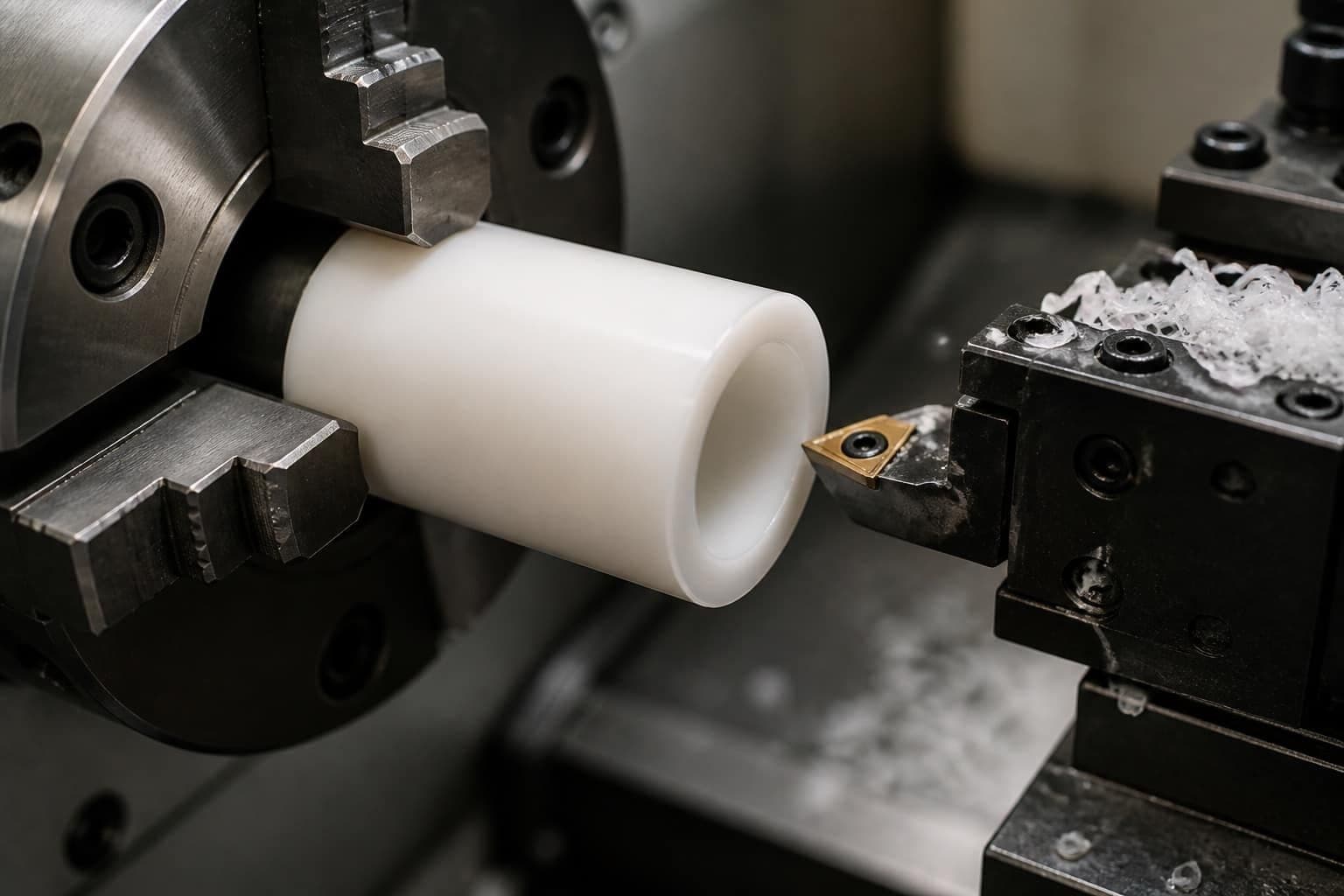
Acetal is widely considered the most machinable engineering plastic. It behaves more like aluminum than soft metal from a chip-making standpoint — and tolerances achievable rival those of aluminum alloys.
Turning (Lathe)
- Surface speed: 300–600 SFM (90–180 m/min) with uncoated carbide
- Feed rate: 0.003–0.010 in/rev (0.08–0.25 mm/rev) for finishing passes
- Depth of cut: 0.050–0.150 in roughing; 0.005–0.020 in finishing
- Sharp tools critical — dull tools generate heat and cause melting at the cutting edge
- Dry cutting preferred; compressed air for chip clearing on deep bores
- OD tolerances ±0.001 in readily achievable on good lathe setups
Milling (3-axis and 5-axis)
- Spindle speed: 6,000–12,000 RPM with 1/2 in 2-flute carbide end mill
- Feed rate: 100–200 in/min at 0.010–0.020 in per tooth
- Shallow axial DOC (0.5× diameter) to avoid tool deflection and melting
- Climb milling preferred for surface finish quality
- No coolant needed for most operations; flood coolant can be used for deep pockets
- Thin walls (< 0.060 in) require careful fixturing — POM deflects under clamping
CNC Acetal Quote Review Before Production
MakerStage machines acetal (POM/Delrin) in both homopolymer and copolymer grades. The quote review can flag thin walls, tight-tolerance features that may need special tooling, and grade-substitution questions before production starts.
Get an Acetal CNC QuoteApplication Matrix
Before you lock your material selection, cross-check your application against this matrix — it covers where acetal excels and where it doesn't.
Acetal excels in dry sliding, precision-tolerance, and dimensionally stable applications. Use this matrix to confirm fit-for-purpose before specifying.
| Application | Verdict | Rationale |
|---|---|---|
| Plastic gears (low-to-medium load) | ✓ Excellent | Natural lubricity, fatigue resistance, and dimensional stability make POM the default plastic gear material |
| Bushings and sleeve bearings (dry) | ✓ Excellent | Low friction coefficient (0.20–0.35 vs steel), good wear resistance, holds bore dimensions in humidity |
| Cam followers and rollers | ✓ Excellent | Resists wear and deformation under rolling contact; good for intermittent-duty applications |
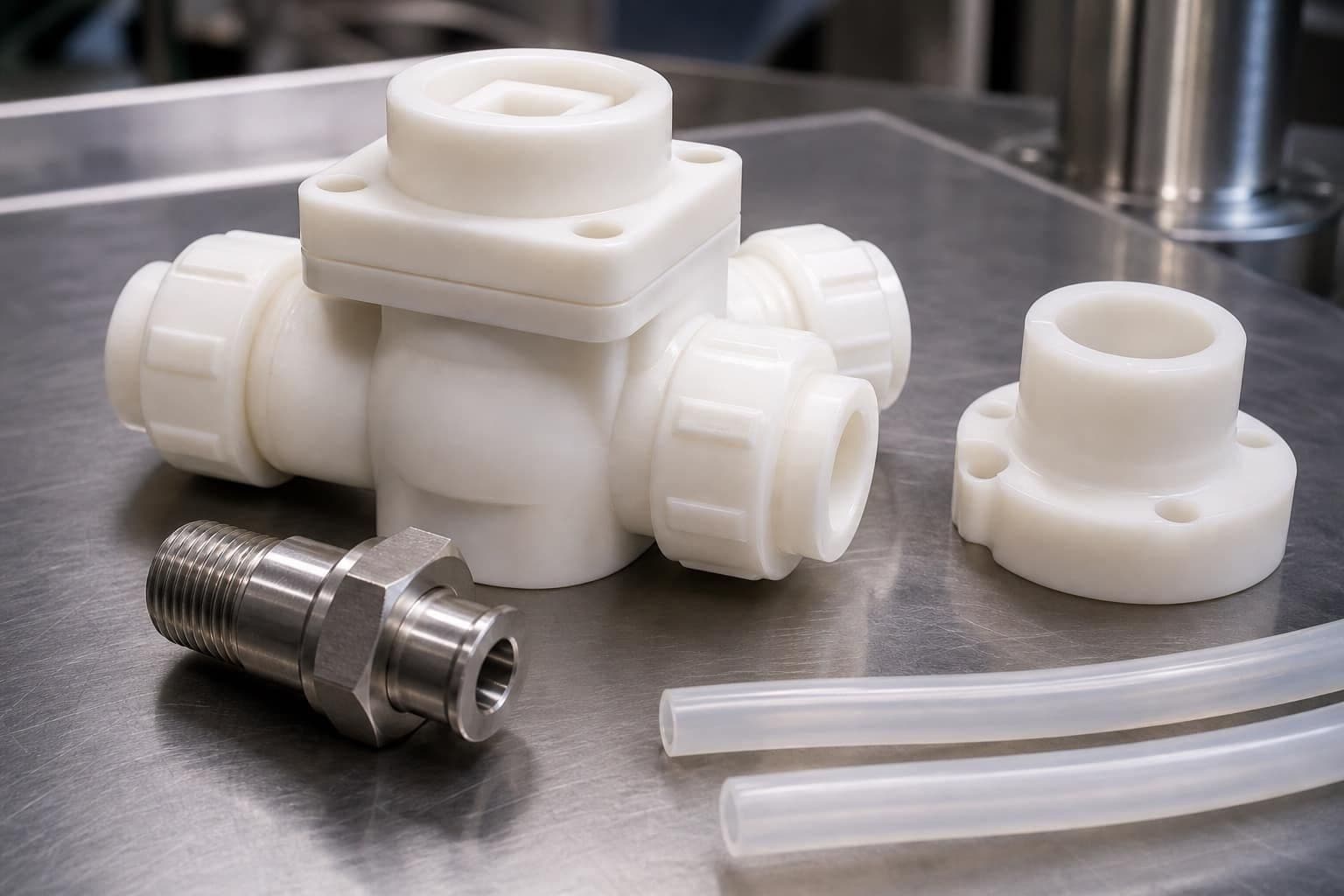
| Valve bodies and pump components | ✓ Good | Chemical resistance to fuels, oils, and mild fluids; verify against specific fluid contact list |
| Food contact parts (natural grade) | ✓ Good (verify grade) | FDA 21 CFR 177.2470 compliance for natural grades; black grades not always food-safe |
| Medical device components | ✓ Good (verify grade) | USP Class VI compliant grades available; excellent sterilization resistance to EtO |
| Precision jigs and fixtures | ✓ Good | Dimensional stability in humidity better than nylon; used for precision gauge fixtures and locating pins |
| Electrical insulation (low voltage) | ✓ Good | Excellent dielectric properties; common in connector housings and electrical standoffs |
| High-temperature applications (>120°C / 248°F) | ✗ Avoid | POM softens above 100°C (212°F) continuous; upgrade to PEEK, PPS, or PTFE for elevated-temperature use |
| Strong acid contact (pH < 4) | ✗ Avoid | Rapid degradation in strong mineral acids; use PVDF or PTFE for acid-contact applications |
| Outdoor UV-exposed parts (long-term) | ✗ Avoid (unfilled) | UV-stabilized grades required; standard unfilled POM yellows and embrittles over months outdoors |
| High-impact shock loading | ✗ Marginal | POM notched Izod is moderate; nylon or polycarbonate better for severe repeated impact |
Explore the Full Acetal / POM / Delrin Content Series
- Delrin vs. Acetal Copolymer: Homopolymer vs. Copolymer Compared — when POM-H beats POM-C and vice versa.
- Acetal vs. Nylon: Which Engineering Plastic to Choose — moisture absorption, machinability, and application split.
- Acetal vs. PEEK: When Is PEEK Worth the Cost Premium? — temperature limits, chemical resistance, and cost analysis.
- CNC Machining Acetal (POM/Delrin): Speeds, Feeds, and Design Rules — full machining guide with DFM checklist.
- Acetal CNC Tolerances: What's Achievable — turned OD, bored ID, flatness, thread classes.
- Acetal Filled Grades: PTFE, Glass, Carbon Compared — specialty grades for gears, bearings, and high-wear applications.
- Acetal Plastic Gears: Design Rules and Material Guide — module selection, PV limits, POM-on-steel pairing.
- Acetal Bushings and Bearings: Low-Friction Design Guide — clearance fits, PV limits, shaft surface finish requirements.
- FDA-Grade Acetal for Food and Medical Applications — FDA 21 CFR 177.2470, USP Class VI, and sterilization compatibility.
- Acetal vs. UHMW Polyethylene: Stiffness, Wear, and Application Split — when UHMW's abrasion resistance outweighs acetal's stiffness.
- Acetal vs. Polycarbonate: Lubricity vs. Impact and Transparency — choosing between low-friction precision and high-impact clarity.
Frequently Asked Questions
Related Resources
Ready to Machine Your Acetal Part?
Upload your CAD file to compare acetal POM and Delrin machining options. The quote review can confirm homopolymer, copolymer, and filled-grade fit before production.
Get an Acetal Quote