DMLS Copper 3D Printing Guide
GRCop-42, CuCrZr, and pure copper. Process challenges, green laser vs. IR, achievable conductivity, and the geometry complexity threshold that makes DMLS copper worth the cost.
DMLS Copper: High Cost, High Justification Threshold
DMLS copper is not a replacement for CNC machining. It is an enabling technology for geometries that cannot exist any other way — conformal cooling channels that follow a mold surface, integrated internal manifolds, complex induction coil geometries, multi-turn hollow conductors. If a CNC machine can reach it, CNC copper will be faster, cheaper, and more conductive. This guide gives you the data to make that decision correctly: process challenges, available materials, achievable properties, design rules for DMLS copper, and a direct CNC vs. DMLS comparison framework.
Why Copper Is Challenging for DMLS
Two material properties make copper the most difficult common metal for laser powder bed fusion.
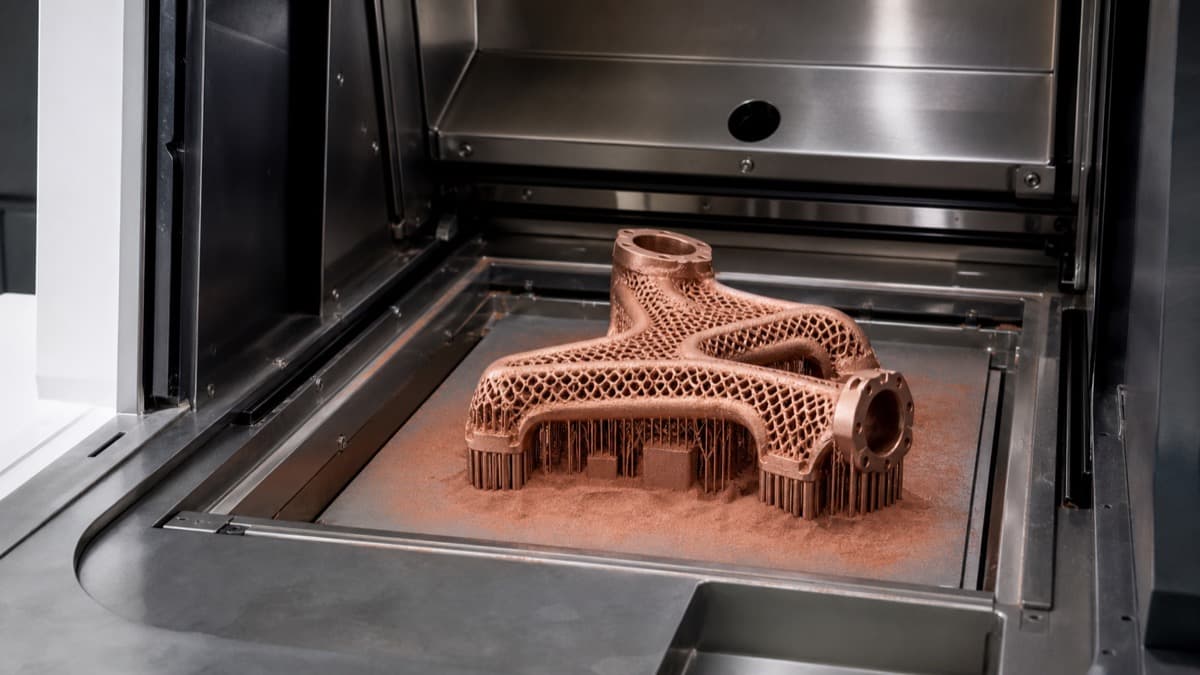
High Laser Reflectivity at IR Wavelength
- •Standard DMLS fiber lasers: 1064 nm (near-infrared)
- •Pure copper absorbs only ~2–5% of 1064 nm light
- •Reflected laser energy can damage machine optics
- •Result: insufficient energy to form a stable melt pool
- •Defects: high porosity, balling, spattering, lack-of-fusion
- •Workaround: extreme laser power (≥500 W), slow scan speed
This is the fundamental challenge. IR fiber laser machines can process copper, but with dramatically reduced process windows and significantly higher energy input than steel or titanium. Many machine manufacturers void warranties when processing copper on IR systems.
Very High Thermal Conductivity
- •Copper: 385–391 W/m·K thermal conductivity
- •Compare to 316L SS: 16 W/m·K — 24× lower
- •Heat dissipates rapidly away from melt pool
- •Melt pool cools faster, requiring higher energy input
- •Steep thermal gradients cause residual stress cracking
- •Part distortion is higher than in steel or titanium DMLS
Even on green laser machines (which solve the absorption problem), high thermal conductivity still requires careful parameter development. Preheating the build plate to 200–400°C (392–752°F) is common practice to reduce thermal gradients and residual stress.
Green Laser DMLS — The Solution
- •Green laser wavelength: 515 nm
- •Pure copper absorbs ~35–45% of 515 nm (vs. ~5% at 1064 nm)
- •Dramatically wider process window — far fewer defects
- •Achievable density: 99.0–99.5% theoretical
- •Conductivity: 95–98% IACS (vs. 85–92% on IR machines)
- •Machines: Trumpf TruPrint (green), Aconity3D AconityMIDI+
Green laser DMLS copper produces near-wrought properties and is now commercially available from select service bureaus. Material cost is the same; machine time is similar. The primary constraint is the limited number of green laser machines globally — expect longer lead times and higher per-part cost than IR copper or CNC machined copper.
Post-Processing Requirements
- •All DMLS copper parts require stress relief anneal post-build
- •HIP (Hot Isostatic Pressing) optional for IR copper to close porosity
- •CNC post-machining for precision interfaces: ±0.025 mm
- •Surface finishing for electrical contact surfaces (electropolish)
- •Electroless nickel or silver plating for oxidation protection
Unlike stainless steel DMLS parts that can often be used as-built, copper DMLS parts almost always require post-processing. Budget for stress relief, support removal, and CNC machining of critical surfaces.
Available DMLS Copper Materials
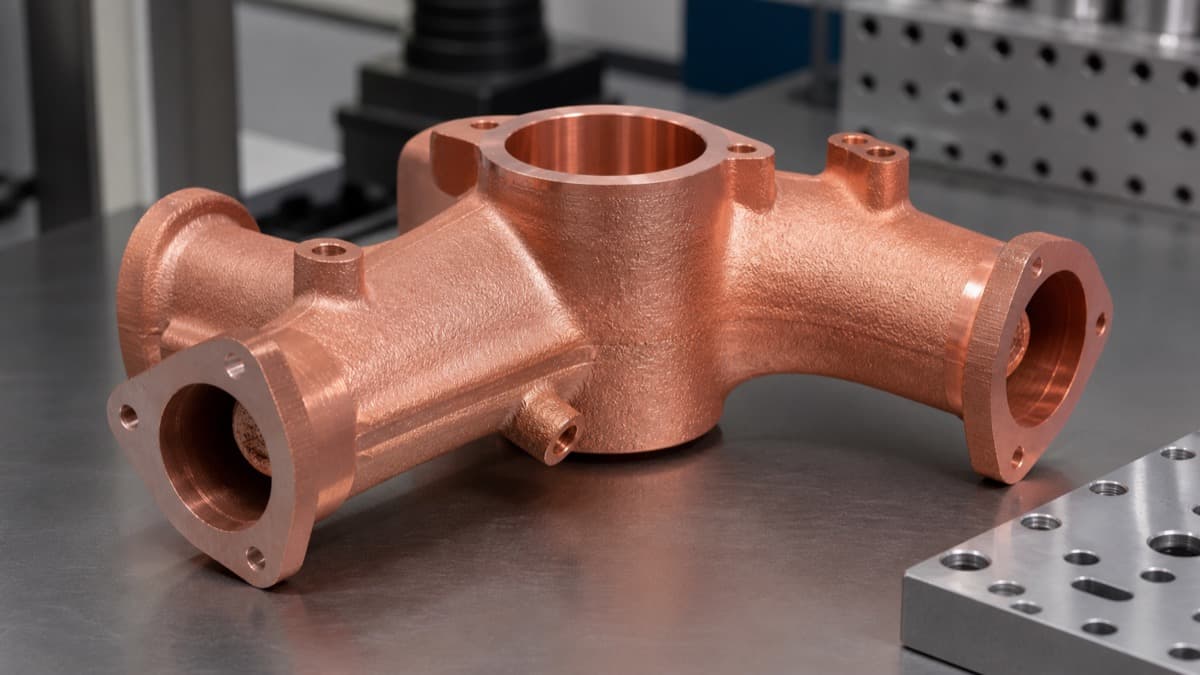
| Material | Composition | Conductivity (IACS) | Yield Strength (condition-dependent; verify as-built vs. heat-treated) | Best For |
|---|---|---|---|---|
| Pure Cu (Green Laser) | ≥99.9% Cu | 95–98% | 50–100 MPa | Maximum conductivity, induction coils, electrical components |
| Pure Cu (IR Laser) | ≥99.9% Cu | 85–92% | 50–100 MPa | Complex cooling channels where conductivity secondary to geometry |
| GRCop-42 (Cu-4Cr-2Nb) | ~94% Cu, 4% Cr, 2% Nb (wt%) | ~85% | 200–250 MPa | High-temp heat exchangers, high-cycle thermal fatigue applications |
| CuCrZr | ~97% Cu, 0.5–1.5% Cr, 0.05–0.25% Zr | 80–85% (aged) | 300–350 MPa (aged) | Mold tooling inserts, high-strength thermal management |
| CuNi2SiCr (AMPCO 940) | ~95% Cu, 1.8% Ni, 0.6% Si, 0.2% Cr | 30–40% | 500–600 MPa (aged) | High-strength structural copper with moderate conductivity |
DMLS Copper Quoting at MakerStage
MakerStage offers DMLS and Metal FFF (e.g., Markforged Metal X) for copper alloys. Upload your CAD for a free DFM review — we'll flag printability issues and quote DMLS or CNC based on your geometry.
Get a DMLS Copper Quote with Free DFM ReviewDMLS vs. Wrought Copper — Property Comparison
| Property | Wrought C110 (CNC) | DMLS Pure Cu (IR) | DMLS Pure Cu (Green) | DMLS GRCop-42 |
|---|---|---|---|---|
| Electrical conductivity | 100% IACS | 85–92% IACS | 95–98% IACS | ~85% IACS |
| Thermal conductivity | 388 W/m·K | 300–350 W/m·K | 370–385 W/m·K | ~280 W/m·K |
| Density (% theoretical) | 100% | 95–98% | 99–99.5% | 98–99% |
| UTS | 220–310 MPa (O60–H04) | 150–220 MPa | 200–250 MPa | 280–350 MPa |
| Yield strength | 70–250 MPa (O60–H04) | 50–100 MPa | 100–180 MPa | 200–250 MPa |
| Elongation | 14% | 5–15% | 10–25% | 10–20% |
| Surface finish (as-built) | Ra 0.8–3.2 µm | Ra 10–25 µm | Ra 8–20 µm | Ra 10–25 µm |
| Dimensional accuracy | ±0.001–0.005 in | ±0.008–0.020 in | ±0.008–0.015 in | ±0.008–0.020 in |
DMLS Copper Design Rules
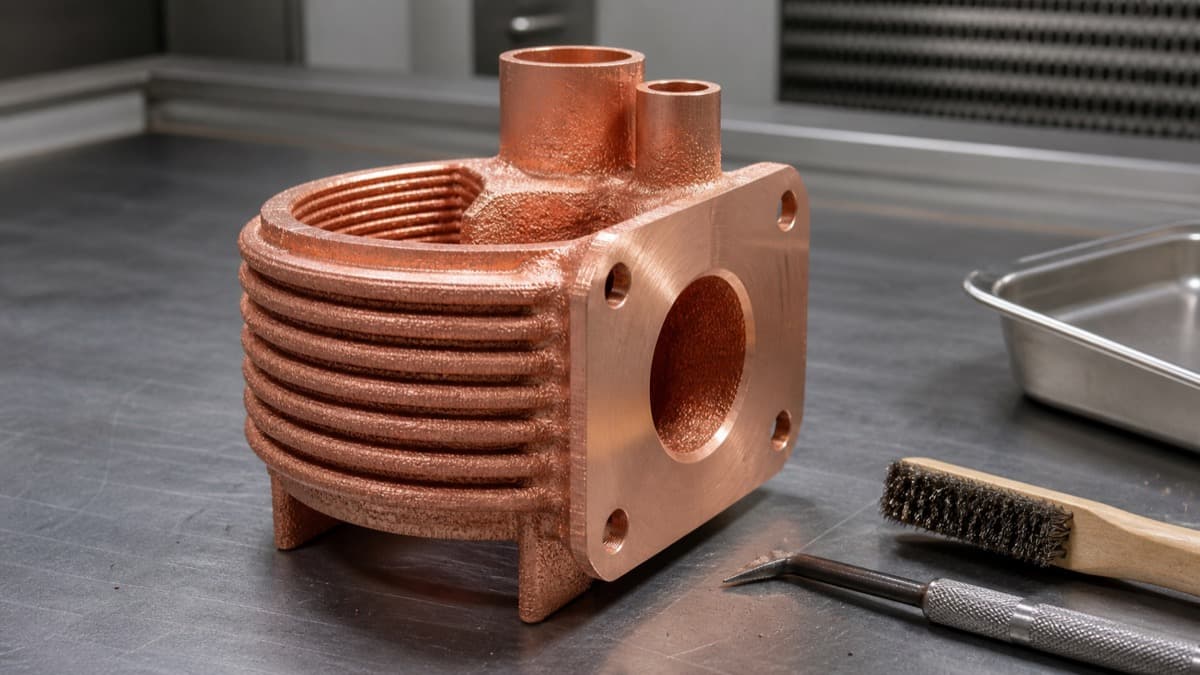
Internal Channel Design
Wall Thickness and Features
Support Strategy
Post-Processing Plan
CNC vs. DMLS Copper — Decision Framework
Use CNC Machined Copper When:
- Geometry is accessible to 3-axis or 5-axis CNC tooling
- Maximum electrical conductivity (100% IACS) is required
- Surface finish below Ra 3.2 µm is required without extensive post-processing
- Tolerances tighter than ±0.05 mm are required on most features
- Lead time and cost are primary drivers
- Part quantity > 10 units (CNC amortization advantage)
- Material must be C101 or C110 with mill certification
Use DMLS Copper When:
- Part has internal channels or voids impossible to machine or braze
- Conformal cooling channels must follow a complex mold or tool surface
- Part count reduction eliminates brazing joints (leak risk)
- Complex induction coil geometry with integrated water cooling
- Topology-optimized lattice structure for thermal management
- High-temperature service needs GRCop-42 strength-conductivity balance
- One-off prototypes of complex assemblies to validate concept before tooling
| Factor | CNC Machined Copper | DMLS Copper |
|---|---|---|
| Electrical conductivity | 100% IACS (C110) | 85–98% IACS (laser dependent) |
| Internal channels | Gun-drill only; straight paths | Fully complex; curved and branching |
| Dimensional accuracy | ±0.001–0.005 in | ±0.008–0.020 in as-built; ±0.001 in post-machined |
| Surface finish | Ra 0.8–3.2 µm (as-machined) | Ra 10–25 µm as-built; Ra 1.6 µm post-machined |
| Lead time (1–5 pcs) | 3–5 days | 7–14 days + post-processing |
| Cost (1–5 pcs) | Moderate | High (2–5× vs. CNC for same volume) |
| Material options | C101, C110, C260, C360, and all wrought alloys | Pure Cu, GRCop-42, CuCrZr, CuNi2SiCr |
| Post-processing | Minimal (deburr, plate) | Stress relief, support removal, often CNC finish |
Frequently Asked Questions
Ready to Print or Machine Your Copper Part?
Upload your CAD for a free DFM review. We'll quote DMLS or CNC copper based on geometry and conductivity requirements.
Get Free Quote Fast