CNC Design Guidelines for Machined Parts
CNC machined part geometry directly controls machining time, tooling cost, and achievable tolerances. Designing walls thinner than 0.040 in. (1.0 mm), pockets deeper than 3× width, or threads smaller than #4-40 UNC adds cost and increases scrap risk. This guide provides the specific dimensions, ratios, and material-specific limits you need to design parts that machine efficiently on the first attempt.
Part Geometry Drives 60–80% of CNC Machining Cost
Material accounts for 20–40% of a typical CNC part cost. The remaining 60–80% is machining time and is driven entirely by geometry. Every feature that requires a smaller tool, a slower feed, or a specialty cutter adds cycle time. The guidelines in this article target the six feature categories that cause the most cost escalation: wall thickness, pocket depth, corner radii, threads, holes, and undercuts.
Thin Walls
Walls under 0.040 in. (1.0 mm) require reduced feeds, multiple finishing passes, and risk chatter marks that reject parts.
Deep Pockets
Pockets beyond 3:1 depth-to-width force extended-reach tooling with slower feeds and lower surface finish quality.
Small Threads
Threads below #4-40 UNC (M3) break taps at higher rates, requiring manual intervention and cycle-time penalties.
Wall Thickness Guidelines by Material
Wall thickness determines how aggressively the machine can cut without deflecting the workpiece. Thin, unsupported walls vibrate under cutting forces, producing chatter marks and dimensional errors. The controlling parameter is the height-to-thickness (H/t) ratio, not thickness alone.
Recommended Minimum Wall Thickness by Material
| Material | Achievable Min. | Recommended Min. | Max H/t | Notes |
|---|---|---|---|---|
| Aluminum (6061-T6, 7075-T6) | 0.020 in. (0.5 mm) | 0.040 in. (1.0 mm) | 4:1 | Machines well; deflection is the constraint |
| Carbon steel (1018, 4140) | 0.020 in. (0.5 mm) | 0.040 in. (1.0 mm) | 4:1 | Higher stiffness than Al, but higher cutting forces |
| Stainless steel (303, 304, 316L) | 0.030 in. (0.8 mm) | 0.050 in. (1.3 mm) | 3:1 | Work-hardening limits aggressive finishing |
| Titanium (Ti-6Al-4V) | 0.030 in. (0.8 mm) | 0.060 in. (1.5 mm) | 3:1 | Low thermal conductivity; heat builds in thin walls |
| Acetal (Delrin / POM) | 0.040 in. (1.0 mm) | 0.060 in. (1.5 mm) | 8:1 | Flexible; needs sharp tools and light DOC |
| Nylon (PA6, PA66) | 0.040 in. (1.0 mm) | 0.060 in. (1.5 mm) | 8:1 | Absorbs moisture, so dimensions shift after machining |
Design Tips for Thin Walls
- Add temporary support ribs connecting thin walls to the workpiece body. Machine them away in the final pass.
- Reduce depth of cut per pass to under 1× the wall thickness. This limits deflection forces during cutting.
- Use climb milling with high spindle speeds and light radial engagement. This keeps cutting forces pushing the wall into the solid body rather than pulling it away.
- Walls taller than 15× thickness are not practical for standard CNC. Consider sheet metal or fabricated assemblies for tall, thin features.
Pocket and Cavity Design Rules
Pockets are the most common CNC feature and also the most common source of unnecessary cost. Pocket depth, corner radius, and floor finish are all constrained by the endmill's length, diameter, and nose geometry. Designing within these limits avoids specialty tooling and keeps cycle times low.
Pocket Depth Rules
- Standard limit: Depth ≤ 3× the narrowest pocket width. This matches standard-length endmills (flute length ≈ 3× diameter).
- Extended reach: Depth up to 6× width is achievable with reduced-neck or long-reach endmills, but expect 30–50% longer cycle times and rougher surface finish (typical Ra 63–125 μin. / 1.6–3.2 μm vs. Ra 32–63 μin. / 0.8–1.6 μm standard).
- Beyond 6:1: Consider machining from both sides, EDM, or redesigning as an assembly.
- Floor corner: The floor-to-wall geometry depends on tool profile. Square endmills leave a near-sharp corner with only the tool's edge prep; corner-radius or ball tools leave a deliberate radius. Call out a floor radius only when function requires it.
Standard Endmill Sizes
Designing pocket widths and corner radii to match standard endmill diameters eliminates custom tooling charges.
| Endmill Dia. | Corner Radius | Max Depth (3:1) |
|---|---|---|
| 1/8 in. (3.2 mm) | 0.063 in. (1.6 mm) | 0.375 in. (9.5 mm) |
| 3/16 in. (4.8 mm) | 0.094 in. (2.4 mm) | 0.563 in. (14.3 mm) |
| 1/4 in. (6.4 mm) | 0.125 in. (3.2 mm) | 0.750 in. (19.1 mm) |
| 3/8 in. (9.5 mm) | 0.188 in. (4.8 mm) | 1.125 in. (28.6 mm) |
| 1/2 in. (12.7 mm) | 0.250 in. (6.4 mm) | 1.500 in. (38.1 mm) |
| 3/4 in. (19.1 mm) | 0.375 in. (9.5 mm) | 2.250 in. (57.2 mm) |
Internal Corner Radii and Edge Breaks
A rotating endmill cannot produce a perfectly sharp internal corner, so the minimum internal radius equals the tool radius. Specifying a radius smaller than the available tool forces the shop to use a smaller endmill with more passes, or to switch to EDM. Either option multiplies cost.
Corner Radius Rules
- Minimum R = endmill radius (D/2). A 1/4 in. endmill produces a 0.125 in. (3.2 mm) corner radius. This is a hard physical limit.
- Use R = 130% of tool radius for cleaner cuts. Oversizing the radius lets the tool sweep through corners without full-width engagement, reducing chatter and extending tool life.
- Corner R ≥ 1/3 of pocket depth as a general rule. A 1.5 in. deep pocket should have a corner radius of at least 0.500 in. (12.7 mm).
- External corners can be left sharp; the tool path naturally produces them. Call out "break sharp edges 0.005–0.015 in. (0.13–0.38 mm)" for handling safety.
When You Need Sharp Internal Corners
If a mating part requires a sharp internal corner (common with rectangular inserts or keyways), use one of these approaches:
- Relief notch (dog bone): Add a small circular relief at each corner. The notch extends past the corner, allowing a square mating part to seat fully.
- Broaching: A secondary operation that cuts square corners. Adds cost and lead time.
- Wire EDM: Produces sharp corners in through-features. Typical Ra 16–32 μin. (0.4–0.8 μm). Adds 1–3 days and significant cost.
Thread Design Rules for CNC Parts
Tapped holes are among the most failure-prone CNC features. A broken tap lodged in a part usually scraps it. Designing threads with appropriate engagement depth, blind-hole clearance, and minimum sizes dramatically reduces scrap rates and keeps cycle times consistent.
Thread Engagement Depth by Material
| Material | Engagement Depth | Example (1/4-20 UNC) | Rationale |
|---|---|---|---|
| Aluminum (6061-T6) | 1.5× nominal dia. (2.0× conservative) | 0.375 in. (9.5 mm) | 1.5× is typical in 6061-T6; use up to 2.0× for soft joints or high-cycle service |
| Carbon steel (4140) | 1.0× nominal dia. | 0.250 in. (6.4 mm) | High shear strength; 1.0× is typically sufficient |
| Stainless steel (316L) | 1.0× nominal dia. | 0.250 in. (6.4 mm) | 304/316L are typically 1.0×; increase toward 1.25× for 303 or cyclic loading |
| Acetal (Delrin) | 2.0–2.5× nominal dia. | 0.500–0.625 in. (12.7–15.9 mm) | Low shear strength; consider Heli-Coil inserts for repeated assembly |
Thread Design Best Practices
- Minimum thread size: #4-40 UNC (M3×0.5 metric) for production reliability. #2-56 (M2×0.4) is achievable but expect higher tap breakage rates and longer cycle times.
- Blind-hole clearance: Add extra drill depth below the required full threads to accommodate the drill point and tap chamfer. Use a relief groove only when full threads must run close to a shoulder or to the bottom of the threaded zone.
- Prefer through-tapped holes when possible. They allow through-chip evacuation and simplify thread depth control.
- Thread-forming taps (roll taps) in aluminum and soft steels produce stronger threads with no chips. Specify 75% thread engagement (not 100%) to reduce tap load.
- Beyond 3× diameter engagement: diminishing returns. Pull-out strength gains are minimal past 2.5× engagement, but tap breakage risk increases with depth.
Hole Design, Fillets, and Undercut Rules
Holes, fillets, and undercuts are secondary features that often drive disproportionate cost. Standard drilled holes are inexpensive; flat-bottom holes, deep bores, and undercuts escalate rapidly because they require specialty tooling or additional operations.
Hole Design Guidelines
| Feature | Guideline | Cost Impact |
|---|---|---|
| Standard drilled hole | Depth ≤ 4× diameter with standard twist drills | Baseline |
| Deep hole (peck drilling) | Depth 4–10× diameter; peck cycle clears chips | +20–40% cycle time |
| Gun-drilled hole | Depth up to 40× diameter; specialty equipment | +100–300% (outsourced) |
| Through-hole | Preferred over blind; chip evacuation and tolerance | No premium vs. standard |
| Flat-bottom hole | Requires endmill instead of drill; small fillet at bottom | +15–25% |
| Reamed hole (tight tolerance) | Typically ±0.0005 in. (±0.013 mm); H7 fit class | +10–20% (reaming pass) |
| Minimum hole diameter | 0.040 in. (1.0 mm) recommended; 0.020 in. (0.5 mm) achievable | Small drills break frequently |
Undercut Guidelines
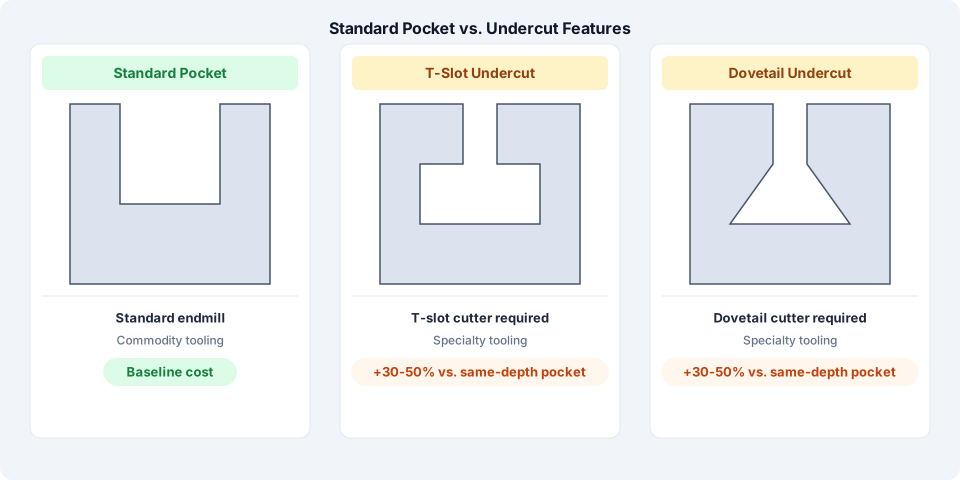
Undercuts are features where the tool must reach beneath an overhanging surface: T-slots, dovetails, O-ring grooves, and internal snap-fit features. They require specialty cutters (T-slot cutters, lollipop cutters, or dovetail cutters) and typically add 30–50% to the machining cost of the affected feature.
CNC Design Guidelines: Quick Reference
All guidelines in one table. Bookmark this section for quick checks during design reviews.
| Feature | Recommended Limit | Achievable Limit | Cost Impact if Exceeded |
|---|---|---|---|
| Wall thickness (metals) | ≥ 0.040 in. (1.0 mm) | 0.020 in. (0.5 mm) | Reduced feeds, extra passes, chatter risk |
| Wall thickness (plastics) | ≥ 0.060 in. (1.5 mm) | 0.040 in. (1.0 mm) | Deflection, dimensional instability |
| Wall H/t ratio (metals) | ≤ 4:1 | ≤ 15:1 (with support ribs) | Chatter, scrap, custom workholding |
| Pocket depth / width | ≤ 3:1 | ≤ 6:1 (extended tooling) | +30–50% cycle time |
| Internal corner radius | ≥ 1/3 pocket depth | = endmill radius (D/2) | Smaller tools, more passes, chatter |
| Thread size (minimum) | #4-40 / M3×0.5 | #2-56 / M2×0.4 | Higher tap breakage rate |
| Thread engagement (Al) | 1.5× nominal dia. | 2× nominal dia. (conservative) | Diminishing returns past ~2× |
| Hole depth (drilled) | ≤ 4× diameter | ≤ 10× (peck); 40× (gun drill) | +20–40% (peck); outsourced (gun) |
| Minimum hole diameter | 0.040 in. (1.0 mm) | 0.020 in. (0.5 mm) | Frequent drill breakage |
| Undercuts | Avoid (redesign as assembly) | T-slot / dovetail cutters | +30–50% per feature |
| Edge break (external) | 0.005–0.015 in. (0.13–0.38 mm) | Sharp if needed | Minimal: standard practice |
Get Quote-Stage CNC Design Feedback
Upload your CAD files to start an engineer-reviewed quote. Our team can flag wall thickness, corner radius, and thread issues during quote review so you can resolve them before machining begins.
Start Design Quote ReviewFrequently Asked Questions
Related Resources
Ready to Machine Your Design?
Upload your CAD files to start a quote review. Our team can check wall thickness, pocket geometry, and thread specifications during quoting so the design is easier to manufacture before release.
Start CNC Quote Review