Thread Design for CNC Parts: Engagement, Inserts & Callouts
Thread design for CNC machined parts comes down to three decisions: which standard (UNC, UNF, metric ISO), how deep to engage by material, and whether to tap directly or install inserts. Get these right and your parts assemble on the first try. Get them wrong and you strip threads, break taps, or pay 2–3× more than necessary.
Thread Standards: Which System and When
Most threading problems start with picking the wrong standard. In the US, Unified Inch (UNC/UNF) per ASME B1.1 is still the default for most commercial hardware. Metric ISO threads per ISO 261/262 dominate European and Asian supply chains, and are increasingly common in US robotics and medical device work. JIS B 0205 is dimensionally identical to ISO metric, so parts designed for the Japanese market are interchangeable.
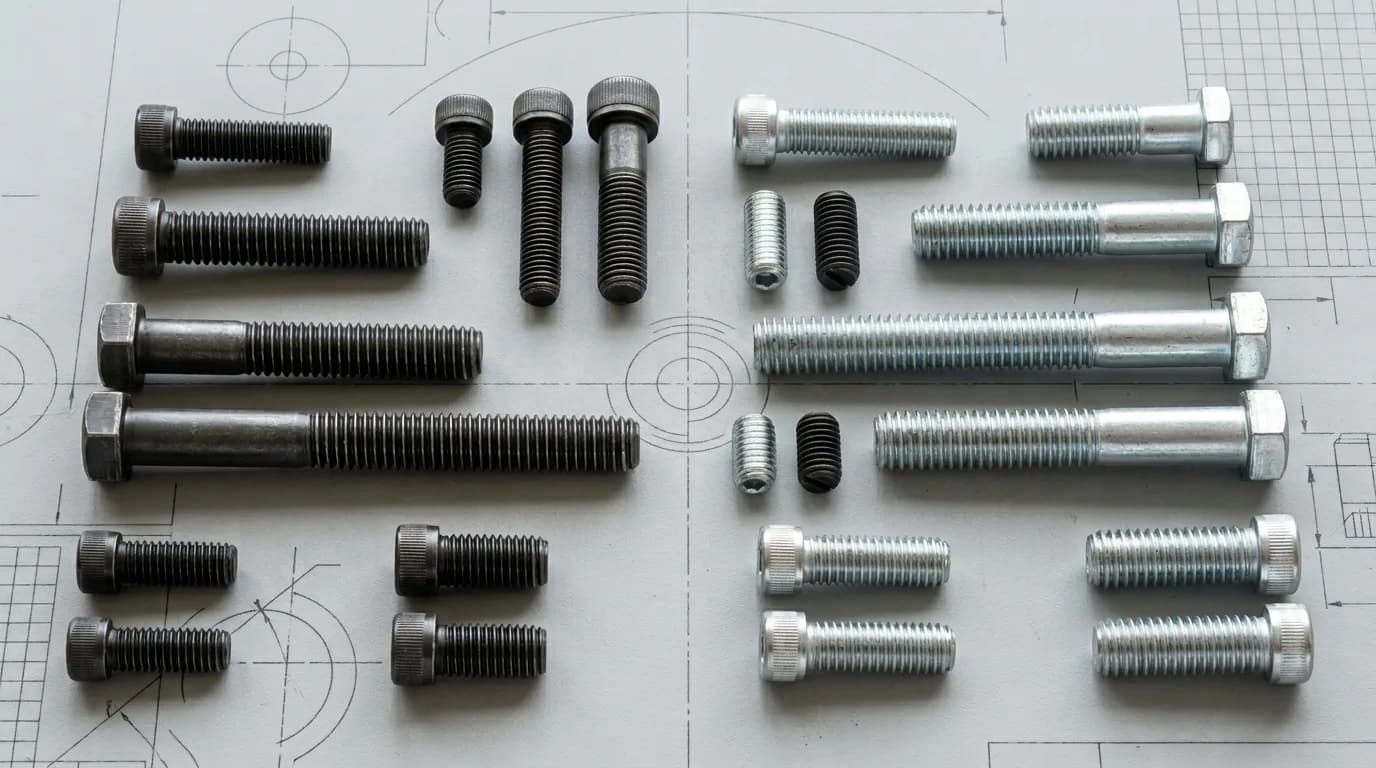
| Standard | Governing Spec | Pitch Type | Typical Use | Callout Example | Regional Prevalence |
|---|---|---|---|---|---|
| UNC | ASME B1.1 | Coarse | General fastening, default for US hardware | 1/4-20 UNC-2B | US, Canada |
| UNF | ASME B1.1 | Fine | Vibration-prone joints, thin walls, fine adjustment | 1/4-28 UNF-2B | US |
| Metric ISO (coarse) | ISO 261 / JIS B 0205 | Coarse | General fastening, global default | M6 × 1.0 - 6H | EU, Asia, global |
| Metric ISO (fine) | ISO 261 / JIS B 0205 | Fine | High-strength joints, precision adjustment | M6 × 0.75 - 6H | EU, Asia |
| ACME | ASME B1.5 | Trapezoidal | Lead screws, power transmission | 1/2-10 ACME-2G | US |
| Trapezoidal (Tr) | ISO 2904 / DIN 103 | Trapezoidal | EU equivalent of ACME | Tr 12 × 3 | EU |
| NPT | ASME B1.20.1 | Tapered | US pipe connections (sealing by interference) | 1/4-18 NPT | US |
| BSPP (G) | ISO 228 / DIN 259 | Parallel | EU pipe connections (sealing by O-ring/gasket) | G 1/4 | EU, Asia |
| BSPT (R/Rc) | ISO 7 / JIS B 0203 | Tapered | EU/Asia tapered pipe (similar function to NPT) | R 1/4 | EU, Asia |
NPT vs BSPP: Not interchangeable
NPT is tapered (seals by thread interference + sealant). BSPP is parallel (seals by O-ring or gasket on a flat face). They have different thread angles (60° vs 55°) and different pitches at the same nominal size. Mating an NPT fitting into a BSPP port will cross-thread and leak. If your product ships to both US and EU markets, call out the port standard explicitly on the drawing and consider SAE straight thread O-ring boss (SAE J1926) as a universal alternative.
Direct Tapping vs Thread Inserts: Decision Framework
Direct tapping is the cheapest option when it works. It is a single operation, no extra hardware. But in soft metals, plastics, or high-cycle assemblies, tapped threads strip. The question isn't “should I use inserts?” It's “what's the failure cost if I don't?”
Direct Tapping
- Lowest cost per hole ($0.50–$1.00 typical)
- Single operation with no extra hardware or installation
- Reliable multi-cycle threads in materials ≥25 HRC (steels, stainless, Ti)
- Works in softer metals (aluminum, brass) for low-cycle applications, and it is viable when ≤5–10 assembly cycles are expected
- Thread degradation in soft metals after repeated assembly (<10 cycles in 6061-T6 for M3 and smaller)
- Tap breakage risk in blind holes and hard materials
Wire Thread Inserts (Helicoil)
- Achieves steel-class thread strength in soft metals
- Handles 100+ assembly/disassembly cycles
- Repairs stripped threads in existing parts
- Adds $0.50–$1.50 per hole (insert + installation)
- Requires oversized tap drill (larger hole in the part)
Keyserts / Solid Inserts
- Highest pull-out and torque resistance
- Locks in place with keys that prevent rotation
- Most expensive option ($2.00–$5.00 per hole installed)
- Requires specific counterbore geometry
Heat-Set Inserts (Plastics)
- Brass knurled insert melted into thermoplastic
- Reliable threads in acetal, nylon, ABS, polycarbonate
- Handles M3+ fasteners with repeated assembly
- Requires controlled installation temperature and pressure
| Method | Best For | Material Constraint | Typical Cost/Hole | Assembly Cycles |
|---|---|---|---|---|
| Direct tap | Any material; multi-cycle durability in ≥25 HRC | Any (limit cycles in soft metals) | $0.50–$1.00 | 5–10 (soft metals), 50+ (≥25 HRC) |
| Helicoil (wire) | Soft metals, field service | Any machinable metal | $1.00–$2.50 | 100+ |
| Keysert (solid) | High-load, vibration, thin walls | Any machinable metal | $2.00–$5.00 | 500+ |
| Heat-set insert | Thermoplastics (CNC or molded) | Thermoplastics only | $0.30–$1.00 | 50+ |
Blind Holes vs Through Holes for Threads
Through holes are the default. They cost less, break fewer taps, and produce more consistent threads. Use blind holes only when part geometry forces them.
Why Through Holes Are Preferred
- Chip evacuation: Spiral-point (gun) taps push chips forward and out the bottom. No chip packing, no re-cutting.
- Lower tap breakage: No bottoming risk. The tap passes through cleanly with consistent torque.
- Higher usable engagement: Through holes avoid the blind-hole tap-lead dead zone, so more of the drilled depth becomes functional thread.
- 20–30% cheaper: No peck-tapping cycles, faster cycle time, longer tap life.
When You Must Use Blind Holes
- Backside is a sealing surface (O-ring face, gasket interface)
- Hole would break through into an adjacent cavity or fluid channel
- Fastener would protrude into a mating component's envelope
- Cosmetic requirement on the opposite face (no visible hole)
Blind Hole Depth Formula
Drill depth = thread engagement + tap lead (2–3 pitches) + clearance (0.060 in. / 1.5 mm typical) + drill point (for 118° standard: 0.3 × drill diameter).
Example: 1/4-20 UNC in 6061-T6 Al, 1.5D engagement = 0.375 in. (9.5 mm). Tap lead = 2 × 0.050 in. (1.27 mm) = 0.100 in. (2.54 mm). Clearance = 0.060 in. (1.5 mm). Drill point = 0.3 × 0.201 in. (5.11 mm) = 0.060 in. (1.5 mm). Total drill depth = 0.595 in. (15.1 mm).
Always call out both thread depth and drill depth on the drawing. They are different numbers.
Thread Engagement Depth by Material
Engagement depth determines whether the bolt fails before the threads strip, which is the correct failure mode. Too shallow and you strip threads under load. Too deep and you waste machining time and increase blind-hole risk. The right depth depends on the parent material's shear strength relative to the fastener's tensile strength.
| Material | Engagement (× nominal ∅) | Example: 1/4-20 UNC | Notes |
|---|---|---|---|
| 4140 / 4340 alloy steel | 1.0D | 0.250 in. (6.4 mm) | High shear strength; bolt fails first at 1.0D |
| 303 stainless steel | 1.0–1.25D | 0.250–0.312 in. (6.4–7.9 mm) | Free-machining sulfur inclusions improve chip control but reduce corrosion margin; use 1.25D for cyclic service |
| 304 / 316L stainless | 1.0D | 0.250 in. (6.4 mm) | Austenitic; work-hardens during tapping, so use sharp taps |
| 17-4 PH stainless (H900) | 1.0D | 0.250 in. (6.4 mm) | Precipitation-hardened; shear strength exceeds most bolt grades |
| 6061-T6 aluminum | 1.5D | 0.375 in. (9.5 mm) | Typical for robotics housings; consider inserts for M3 and smaller |
| 7075-T6 aluminum | 1.25–1.5D | 0.312–0.375 in. (7.9–9.5 mm) | Higher shear strength than 6061; 1.25D often sufficient |
| Ti-6Al-4V (Grade 5) | 1.0–1.5D | 0.250–0.375 in. (6.4–9.5 mm) | Thread milling preferred over tapping to prevent galling; see titanium threading guide |
| Acetal (POM / Delrin) | 2.0–2.5D | 0.500–0.625 in. (12.7–15.9 mm) | Coarse pitch only; fine pitch strips easily. Consider heat-set inserts for M4+. |
| Nylon (PA6 / PA66) | 2.0–2.5D | 0.500–0.625 in. (12.7–15.9 mm) | Moisture absorption weakens threads over time; inserts strongly recommended for structural fastening |
| Polycarbonate (PC) | 2.0D | 0.500 in. (12.7 mm) | Notch-sensitive, so chamfer all thread entries to prevent stress cracking |
When to Go Deeper vs When to Use Inserts
If engagement depth exceeds 2.0D and the hole is blind, you're fighting diminishing returns. The last few threads carry almost no load (load distribution is non-linear, with the first 3–5 threads carrying ~80% of the clamp force). At that point, a Helicoil at 1.5D engagement is cheaper, more reliable, and produces a shallower hole.
Quote Threaded Parts with Order-Stage DFM
Upload your CAD file for an engineer-reviewed quote. After order confirmation, our team can review thread callouts, engagement depths, and hole specifications before production starts.
Upload CAD for QuoteThread Relief Grooves, Runout & Entry Chamfers
Thread relief grooves, proper runout zones, and entry chamfers are the details that separate drawings that work from drawings that cause phone calls from your machinist. They're especially critical on external threads cut by single-point tooling on a lathe.

Thread Relief Grooves
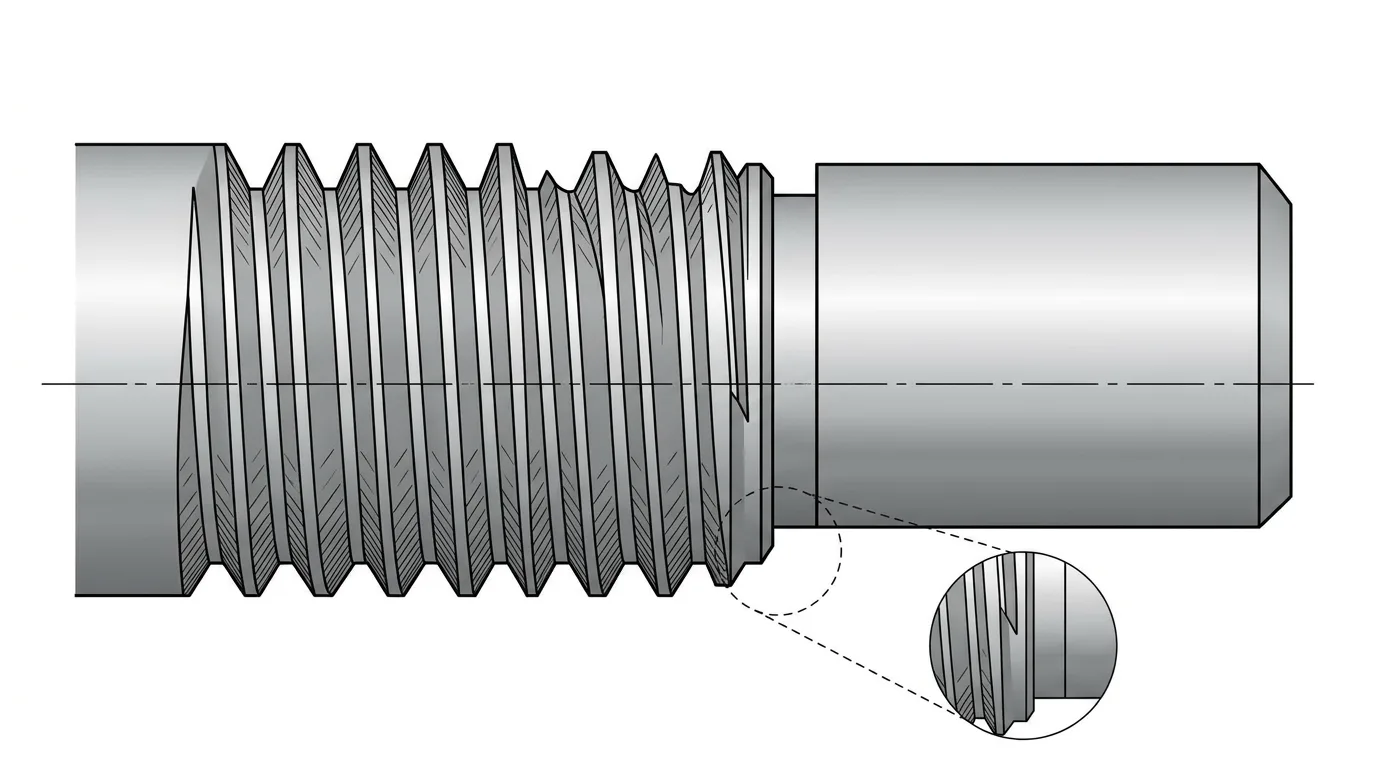
Required on external threads that run to a shoulder. The groove gives the threading tool a clean exit zone and ensures the mating nut can seat fully against the shoulder face.
- Width: 2–3 pitch lengths (per ASME B1.1). For 1/4-20 UNC: pitch = 1/20 TPI = 0.050 in., so groove width = 2 × 0.050 in. = 0.100 in. (2.5 mm).
- Depth: To the minor diameter of the thread. For 1/4-20: groove OD ≈ 0.189 in. (4.8 mm).
- Corner radius: 0.010–0.015 in. (0.25–0.38 mm) typical. Sharp corners create stress risers.
Entry Chamfers
A 45° × 1 pitch chamfer at the start of both internal and external threads is standard practice. It guides the mating fastener onto the thread and prevents cross-threading during assembly.
- Internal (tapped hole): 45° × 1P countersink at the hole entry. Most taps create this automatically if you pre-chamfer the hole.
- External (shaft): 45° × 1P chamfer on the leading edge. Critical for blind assembly or automated fastening.
- Plastics: Use a 30° chamfer instead of 45°. Gentler engagement reduces stress concentration in notch-sensitive materials like polycarbonate.
Skip the Relief When You Can
If you can add 3 pitches of unthreaded clearance between the last thread and the shoulder (so the thread doesn't need to run all the way to the face), you can eliminate the relief groove entirely. This saves a secondary machining operation and simplifies the drawing. Many early-career engineers add thread reliefs by default. Evaluate whether your nut actually needs to seat against that shoulder before specifying one.
Thread Callouts on Engineering Drawings
A thread callout must be unambiguous. The machinist should never have to guess the standard, pitch, class of fit, or depth. Here's how to write them correctly per ASME Y14.6 (US) and ISO 6410 (EU/global).
Unified Inch: Internal
1/4-20 UNC-2B
- 1/4
- : nominal diameter (0.250 in. / 6.35 mm)
- 20
- : threads per inch
- UNC
- : Unified National Coarse
- 2B
- : class 2 fit, internal (B)
Metric ISO: Internal
M6 × 1.0 - 6H
- M6
- : metric, 6 mm nominal ∅
- 1.0
- : pitch in mm (omit if coarse: “M6 - 6H”)
- 6H
- : tolerance grade 6, position H (internal)
JIS B 0205 uses identical notation.
Pipe Threads: US vs EU
1/4-18 NPT
US tapered: seals by thread interference
G 1/4 (BSPP)
EU parallel: seals by O-ring or gasket
R 1/4 / Rc 1/4 (BSPT)
EU/Asia tapered: ISO 7 / JIS B 0203
Class of Fit Quick Reference
| US Class (ASME B1.1) | Approx. ISO Fit Mapping | Fit Description | When to Use |
|---|---|---|---|
| 1A / 1B | ~8g / 7H (approx.) | Loose: maximum allowance | Quick assembly, dirty/coated threads |
| 2A / 2B ★ | 6g / 6H (common pair) | General purpose: default for commercial fasteners | 90%+ of all CNC threaded features |
| 3A / 3B | ~4g6g / 4H5H (fit intent) | Tight: no allowance | Precision assemblies, zero-backlash joints; adds 30–50% threading cost |
These are fit-intent mappings between ASME and ISO thread classes, not one-to-one substitutions. Validate final class selection against ASME B1.1 or ISO 965 for release drawings.
Common Thread Callout Mistakes
Always specify: "1/4-20 UNC-2B" not "1/4-20 UNC." Without a class, the machinist defaults to 2B, which is usually fine, but ambiguity causes RFQ delays and inspection disputes.
Write the full standard name. "1/4 pipe thread" is ambiguous if the part ships internationally. Specify "1/4-18 NPT" or "G 1/4 per ISO 228."
Call out both thread depth and drill depth: "1/4-20 UNC-2B ↧ 0.375 THRD DEPTH, 0.595 DRILL DEPTH." Two separate dimensions.
Fine pitch (UNF / ISO fine) increases tap breakage risk, requires tighter hole tolerance, and costs 15–25% more. Use coarse unless vibration, thin walls, or adjustment precision demands it.
What Drives Threading Cost Up (and How to Keep It Down)
Threading is rarely the dominant cost driver on a CNC part, but poorly specified threads can double the per-hole cost without adding functional value. Here's what matters.
Cost Escalators
- Blind holes: +20–30% vs through holes (peck-tapping cycles, spiral-flute taps)
- Fine pitch: +15–25% (tighter hole tolerance, higher tap breakage)
- Thread milling: +50–100% vs tapping (but required for hard materials and large threads)
- Hard materials (Ti, Inconel): +100–200% (specialty taps, TiCN/TiAlN coating, slower feeds)
- Class 3B fit: +30–50% (tighter manufacturing tolerance, 100% thread gage inspection)
- Non-standard sizes: Custom taps, longer lead times, no off-the-shelf fasteners
- Helicoil/insert installation: +$0.50–$1.50 per hole
Cost Reducers
- Standard coarse-pitch sizes: M4, M5, M6, M8, 1/4-20, 5/16-18, 3/8-16: off-the-shelf taps, cheap hardware
- Through holes whenever possible: Gun taps, fast cycles, low breakage
- Class 2B (default): No inspection surcharge, standard manufacturing tolerance
- Consistent thread sizes across the part: Fewer tool changes = faster cycle time
- Accessible hole locations: Threads in deep pockets or near obstructions require longer taps and specialized tooling
- Form taps for soft metals: Roll-form taps (no chips) in aluminum and brass are faster and produce stronger threads than cut taps
The 80/20 Rule for Thread Cost
On most parts, standardizing all threads to 2–3 coarse pitch sizes (e.g., M5 and M8, or 1/4-20 and 3/8-16) eliminates 80% of thread-related cost premium. The machinist changes the tap once instead of four times, uses off-the-shelf tooling, and runs proven cycle parameters. Save the exotic threads for the one feature that actually needs them.
Frequently Asked Questions
Related Resources
Ready to Get Your Threaded Parts Right the First Time?
Upload your CAD files and engineering drawings for an engineer-reviewed quote. After order confirmation, DFM can cover thread callouts, engagement depth, and insert specifications before production starts.
Get Threaded Part Quote