Copper 101 (OFHC) Complete Guide
UNS C10100, 99.99% Cu minimum, 101% IACS. The oxygen-free grade specified when hydrogen embrittlement is a genuine risk.
When You Need C101: Exactly One Reason
Copper 101 (OFHC) is not a “premium” version of C110 — it is an insurance policy against hydrogen embrittlement. If your copper part will be brazed, welded, or used in a hydrogen-containing atmosphere above ~700°F (~370°C), C101 is required. If it will not, C110 delivers essentially identical properties at lower cost. This guide gives you the data on C101: composition, properties, machinability, applications, and the drawing callout format to prevent substitution.
Composition and Standards
| Element / Property | Specification | Notes |
|---|---|---|
| Copper (Cu) | ≥99.99% min | Highest purity commercial grade — all other elements are trace |
| Oxygen (O) | ≤0.0005% (5 ppm) | The defining property — no Cu₂O inclusions in microstructure |
| Silver (Ag) | ≤0.0025% | Trace; does not affect conductivity at this level |
| All other elements | ≤0.0065% total | Per ASTM B170 cathode quality limits |
| UNS designation | C10100 | Unified Numbering System |
| European equivalent | EN CW009A (OF-Cu) | DIN / EN standard designation |
| ASTM rod/bar | ASTM B187 | Rod, bar, and shapes |
| ASTM sheet/strip | ASTM B152 | Sheet, strip, plate, and rolled bar |
| ASTM cathode | ASTM B170 | Melt stock cathode grade |
| Common tempers | O61 (Annealed), H02 (Half-Hard), H04 (Hard) | H02 is standard for CNC bar stock |
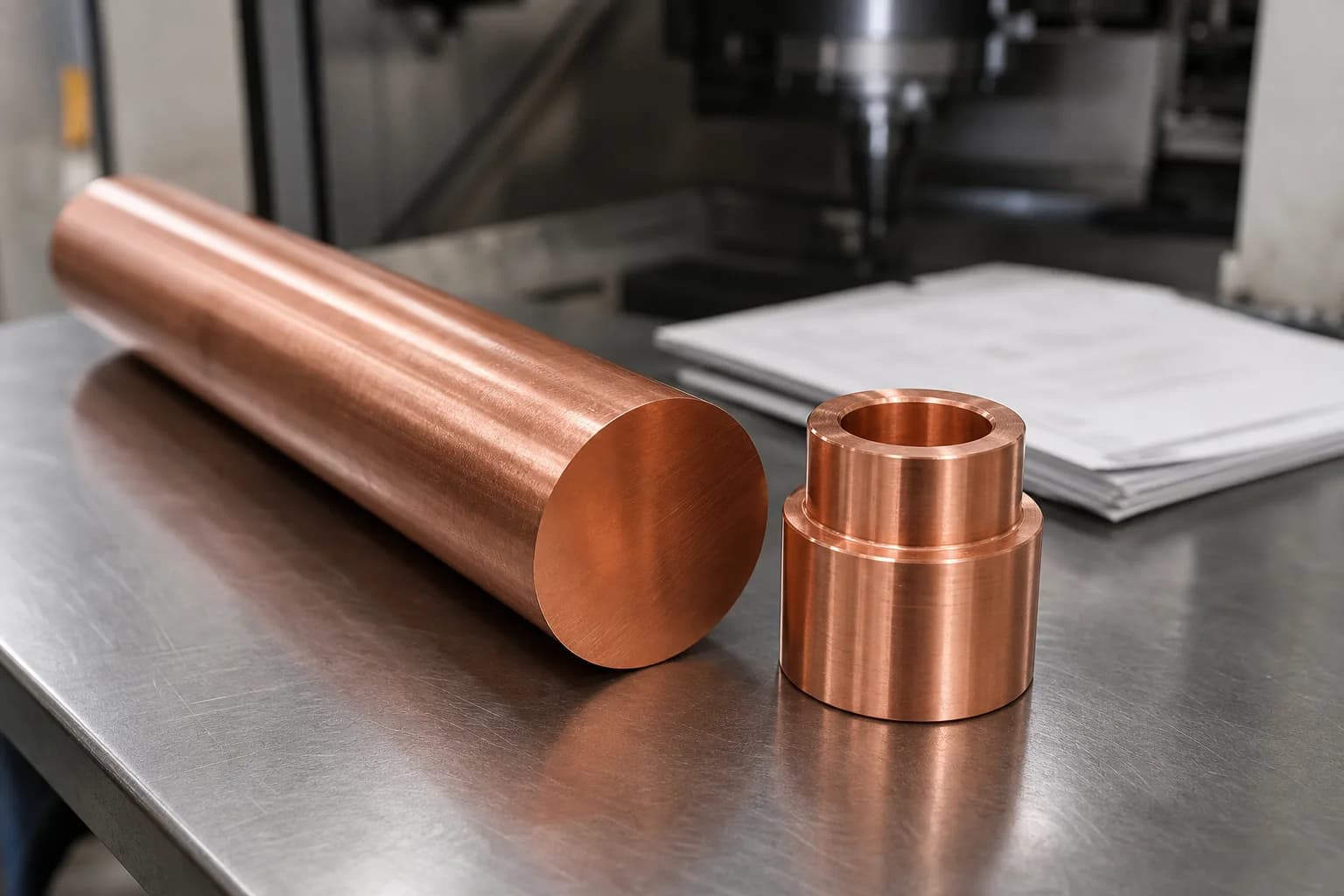
Electrical, Thermal, and Mechanical Properties
| Property | Value | Condition / Notes |
|---|---|---|
| Electrical conductivity | 101% IACS minimum | At 68°F (20°C); 5.84×10⁷ S/m |
| Electrical resistivity | 1.71 µΩ·cm | At 68°F (20°C) |
| Thermal conductivity | 391 W/m·K | At 68°F (20°C) — very high among common engineering metals; silver is higher |
| Density | 8.94 g/cm³ | — |
| Specific heat | 385 J/kg·K | At 68°F (20°C) |
| Coefficient of thermal expansion | 9.2 µin./in./°F (16.5 µm/m·°C) | 68–572°F (20–300°C) range |
| Melting point | 1,083°C (1,981°F) | — |
| UTS (Annealed O61) | 220 MPa (32 ksi) | Annealed condition |
| UTS (Half-Hard H02) | 290 MPa (42 ksi) | Standard bar stock condition |
| Yield strength (H02) | 250 MPa (36 ksi) | 0.5% extension under load |
| Elongation (H02) | 14% | In 2 in gauge length |
| Hardness (H02) | HRF 60 / HB 78 | — |
| Machinability | 20% | Vs. C36000 free-cutting brass = 100% |
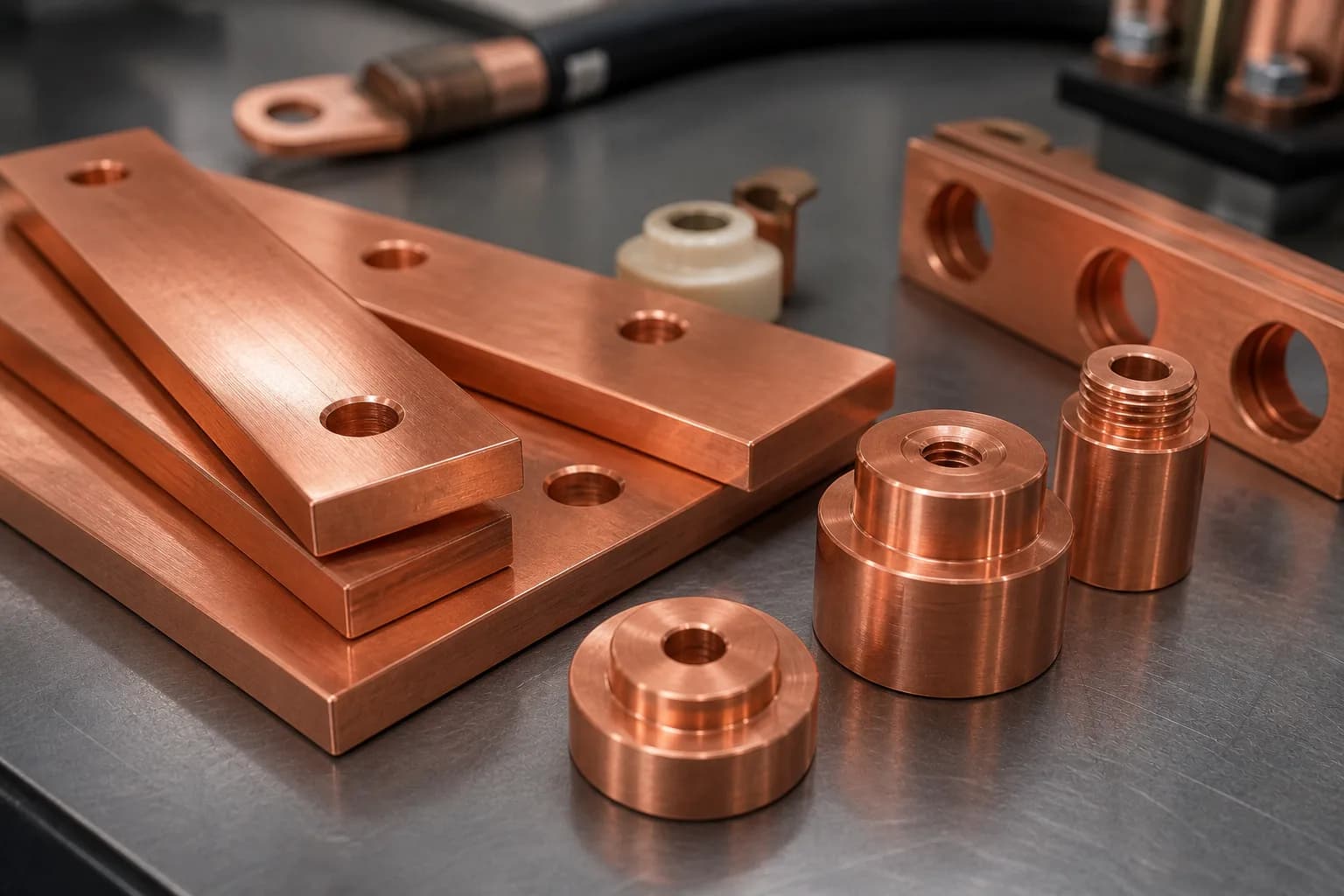
CNC Machine Copper 101 at MakerStage
MakerStage machines C101 (OFHC) copper for electrical contacts, feedthroughs, and vacuum-critical parts. Upload your CAD file for RFQ-stage manufacturability feedback and quote options. Material certification is available on request.
Get a Copper 101 CNC QuoteMachinability and CNC Parameters
Copper 101 is rated at 20% machinability relative to C36000 free-cutting brass. Key challenge: built-up edge and long chips require specific tooling and parameters.
Turning Parameters
Design Tips for C101 Parts
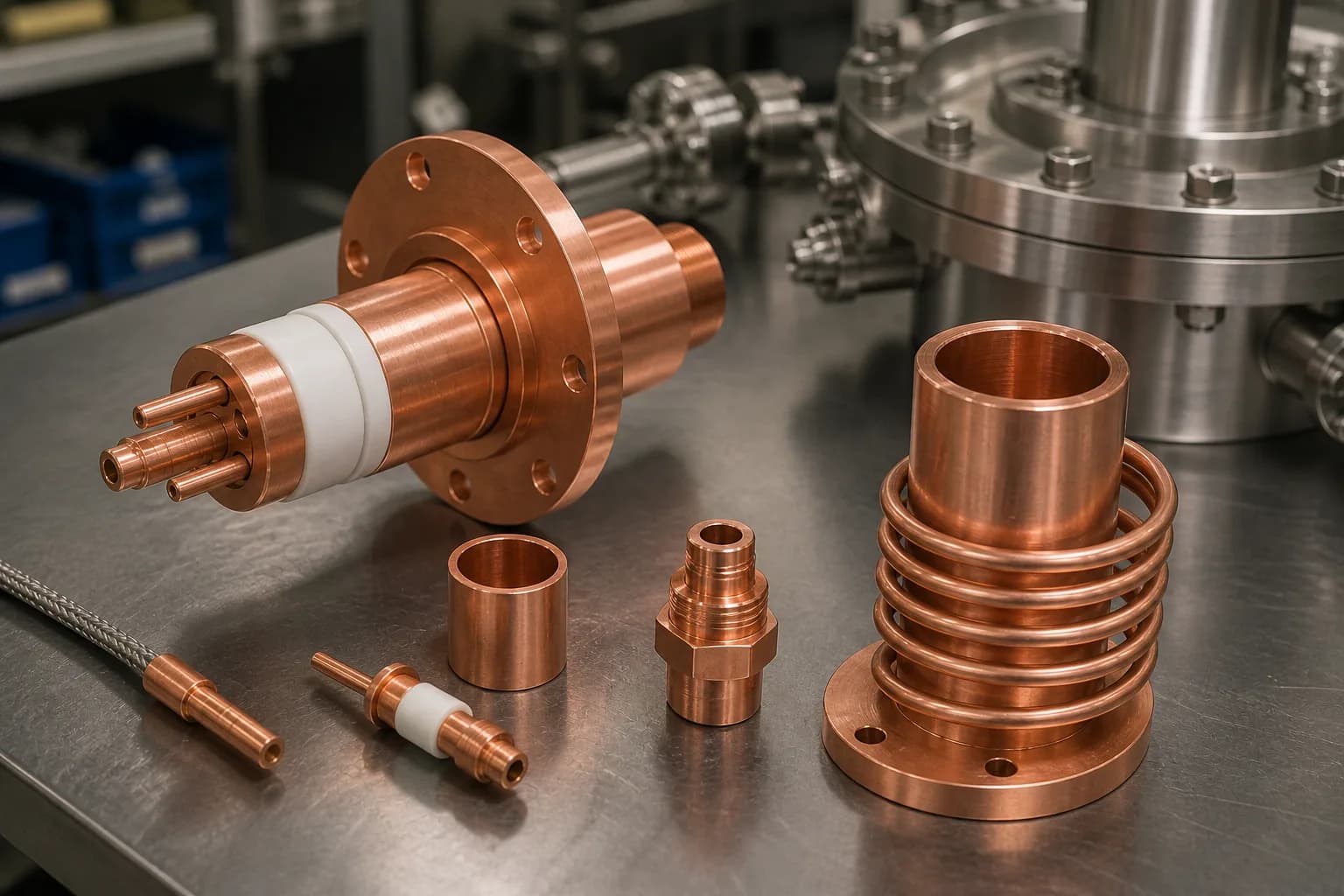
Common Applications
Brazed assemblies
Coils, manifolds, and heat exchanger tubes that will be silver-brazed or torch-brazed in air or reducing atmosphere. C110 would embrittle at the braze joint interface.
Vacuum feedthroughs
Electrical and fluid feedthroughs for vacuum chambers and electron beam equipment. The oxygen-free grade prevents outgassing of Cu₂O under vacuum bakeout conditions.
RF and coaxial conductors
Center conductors and shells for high-precision RF connectors and coaxial cable where minimal dielectric loss and no outgassing are required.
Induction heating components
Induction heating work coils and susceptors that are directly heated in hydrogen or mixed atmosphere furnaces for brazing or annealing operations.
High-vacuum electrical contacts
Contacts in vacuum interrupter switches, particle accelerator components, and synchrotron beamline hardware where Cu₂O microstructure is incompatible.
Medical and semiconductor equipment
Parts used in oxygen-sensitive process environments where Cu₂O inclusions could cause oxygen contamination or interfere with ultra-high-purity processes.
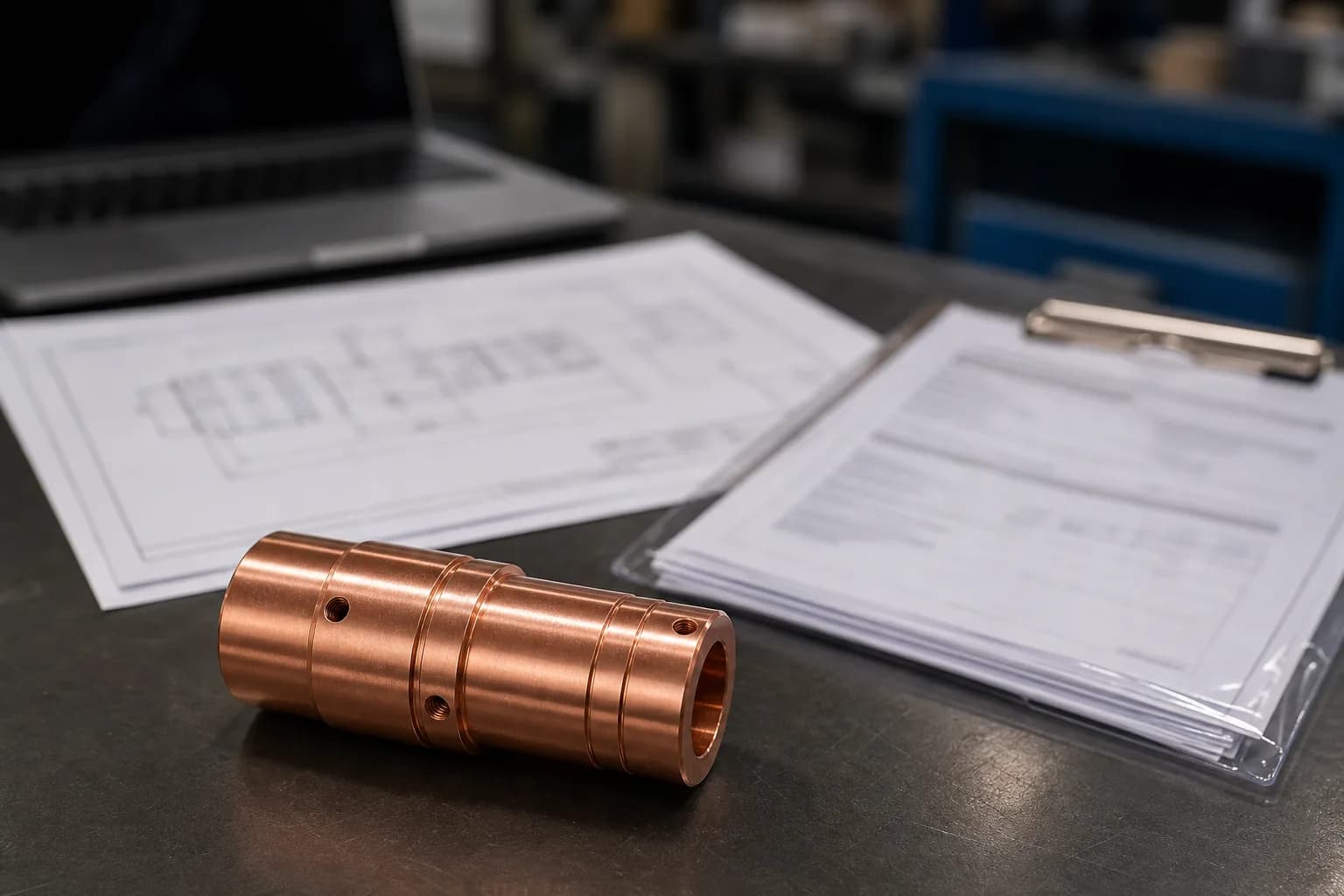
Drawing Callout Format
Precision material callout prevents shop substitution of C110 for C101, which is the most common error in copper procurement.
Standard Rod/Bar (CNC Machining)
Copper, UNS C10100, ASTM B187
Temper: Half-Hard (H02)
Note: OFHC copper required.
ETP copper (UNS C11000) NOT acceptable.
The explicit rejection note for C110 is the most important part. Without it, the shop will substitute based on availability. Mill certificate (MTR) confirming C10100 and oxygen content ≤0.0005% should be required for critical applications.
Sheet/Strip (Formed or Cut Parts)
Copper, UNS C10100, ASTM B152
Temper: Annealed (O61)
Annealed temper for sheet/strip where forming, stamping, or deep drawing will be performed after machining. For applications requiring H02 temper in strip form, confirm with your material supplier — annealed strip is more commonly stocked.
Frequently Asked Questions
Ready to Machine Your Copper 101 Part?
Upload your drawing for a Copper 101 CNC quote. MakerStage can include RFQ-stage manufacturability feedback and material certification options when requested.
Get a Copper 101 CNC Quote