PEEK vs Delrin vs Nylon: Which Plastic for CNC Parts?
PEEK, Delrin (acetal / POM), and nylon 6/6 are the three most common engineering plastics for CNC machined parts. They cover different performance tiers — and PEEK costs 7–20× more than the other two. This guide compares mechanical properties, temperature limits, chemical resistance, machinability, and cost so you can pick the right material without over-specifying.
UpdatedQuick Answer
Use Delrin (acetal) for precision wear parts, bushings, and gears where dimensional stability and low friction matter. Use nylon 6/6 for impact-loaded structural parts and weight-sensitive applications where cost is a priority. Use PEEK only when the application demands continuous service above 200 °F (93 °C), autoclave sterilization, or broad chemical resistance — its 7–20× cost premium is only justified when the other two materials physically cannot survive the environment.
Why These Three Plastics?
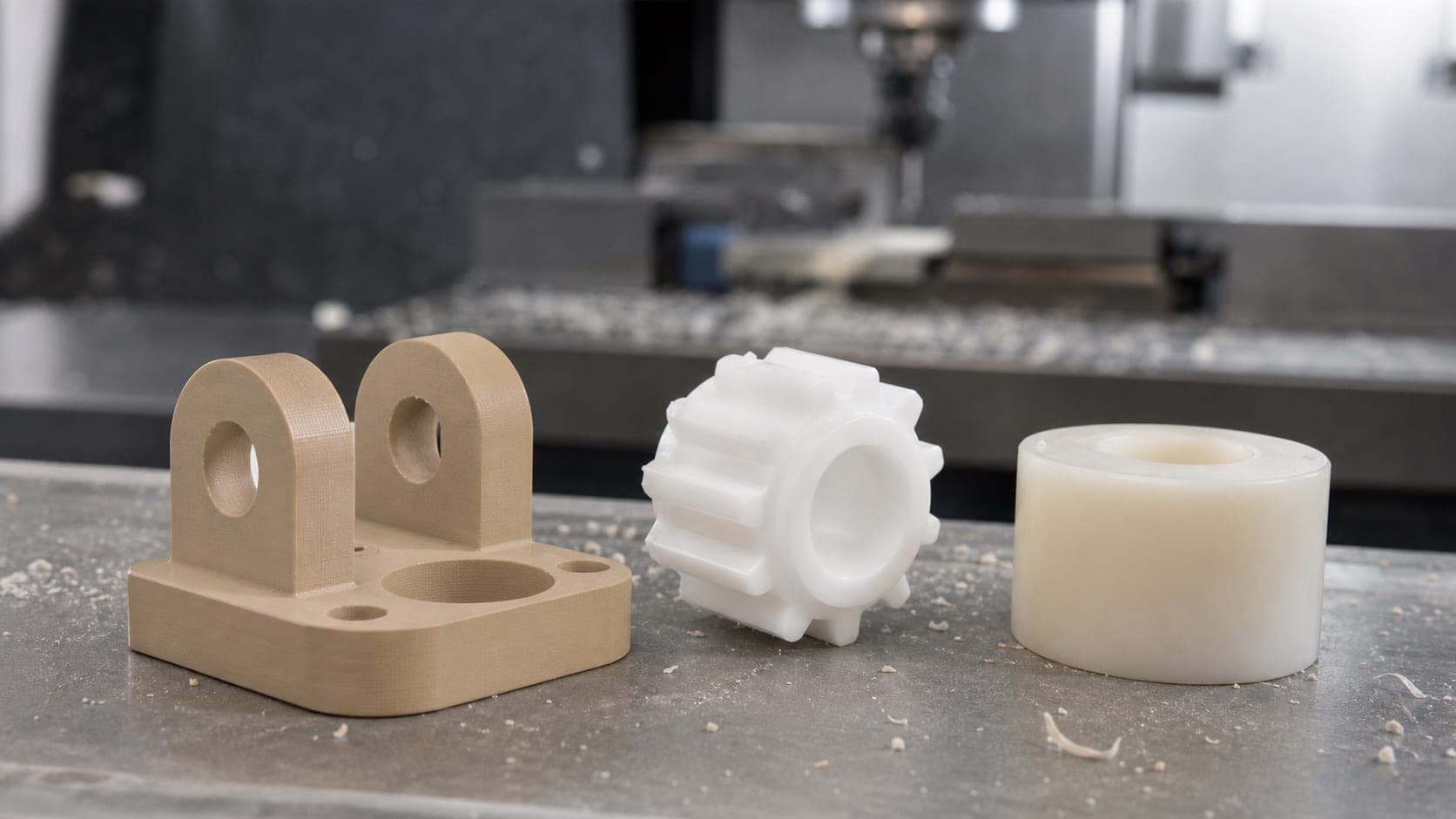
PEEK, Delrin, and nylon 6/6 cover the performance spectrum for CNC-machined engineering plastics. They share one trait — all three machine well on standard CNC equipment — but differ dramatically in temperature resistance, chemical compatibility, dimensional stability, and cost. Understanding the trade-offs prevents two common mistakes: over-specifying PEEK when Delrin would suffice (wasting money) and under-specifying nylon when the application demands Delrin or PEEK (causing field failures).
Highest strength and stiffness. Continuous service to 480 °F (250 °C). Broad chemical resistance. Autoclave-safe. Biocompatible grades available (PEEK-OPTIMA).
7–20× material cost premium. Moderate machinability — requires carbide tooling and careful heat management.
Lowest friction (0.20–0.35). Tightest CNC tolerances (±0.001 in. / 0.025 mm). Excellent chip formation. Dimensionally stable (0.20% water absorption). FDA-compliant grades.
Max service temp 180 °F (82 °C). Flammable (HB rated). Attacked by strong acids and oxidizers.
Highest impact toughness. Lightest of the three (1.14 g/cm³). Lowest material cost. Good fatigue resistance. Self-extinguishing (V-2).
High moisture absorption (1.2–1.5%) causes 1–2% dimensional swelling. Properties degrade in wet environments. Stringy chips during machining.
Mechanical & Thermal Properties Compared
All values are for unfilled, natural-color grades at room temperature and dry-as-molded condition. Filled grades (glass fiber, carbon fiber, PTFE) modify these properties significantly. For acetal-specific deep dives, see the acetal (POM/Delrin) guide.
| Property | PEEK | Delrin 150 NC010 (Natural Delrin / POM-H) | Nylon 6/6 |
|---|---|---|---|
| Tensile Strength | 14,500 psi (100 MPa / 1,000 bar) | 10,000 psi (69 MPa / 690 bar) | 11,800 psi (82 MPa / 820 bar) |
| Flexural Modulus | 595,000 psi (4.1 GPa / 41,000 bar) | 420,000 psi (2.9 GPa / 29,000 bar) | 410,000 psi (2.8 GPa / 28,000 bar) |
| Elongation at Break | 30–50% | 25–75% | 15–80% |
| Continuous Service Temp | 480 °F (250 °C) | 180 °F (82 °C) | 220 °F (105 °C) |
| Deflection Temp (264 psi / 18 bar) | 320 °F (160 °C) | 210 °F (99 °C) | 194 °F (90 °C) |
| Coefficient of Friction (dry) | 0.35–0.45 | 0.20–0.35 | 0.30–0.45 |
| Water Absorption (24 hr) | 0.10% | 0.20% | 1.2–1.5% |
| Chemical Resistance | Broad (acids, bases, solvents, hydrocarbons) | Good (weak acids, bases, fuels; not strong acids) | Moderate (attacked by strong acids, absorbs moisture) |
| Inherent Flame Rating | V-0 (UL 94) | HB (flammable) | V-2 (self-extinguishing) |
| Density | 0.047 lb/in³ (1.30 g/cm³) | 0.051 lb/in³ (1.41 g/cm³) | 0.041 lb/in³ (1.14 g/cm³) |
Sources: MatWeb, Ensinger data sheets, Victrex PEEK 450G TDS, Delrin Product Reference Guide (150 NC010, ISO 75), BASF Ultramid A3K TDS. Values are typical; confirm with your resin supplier for the specific grade, conditioning, and test method.
Temperature Limits & Chemical Resistance
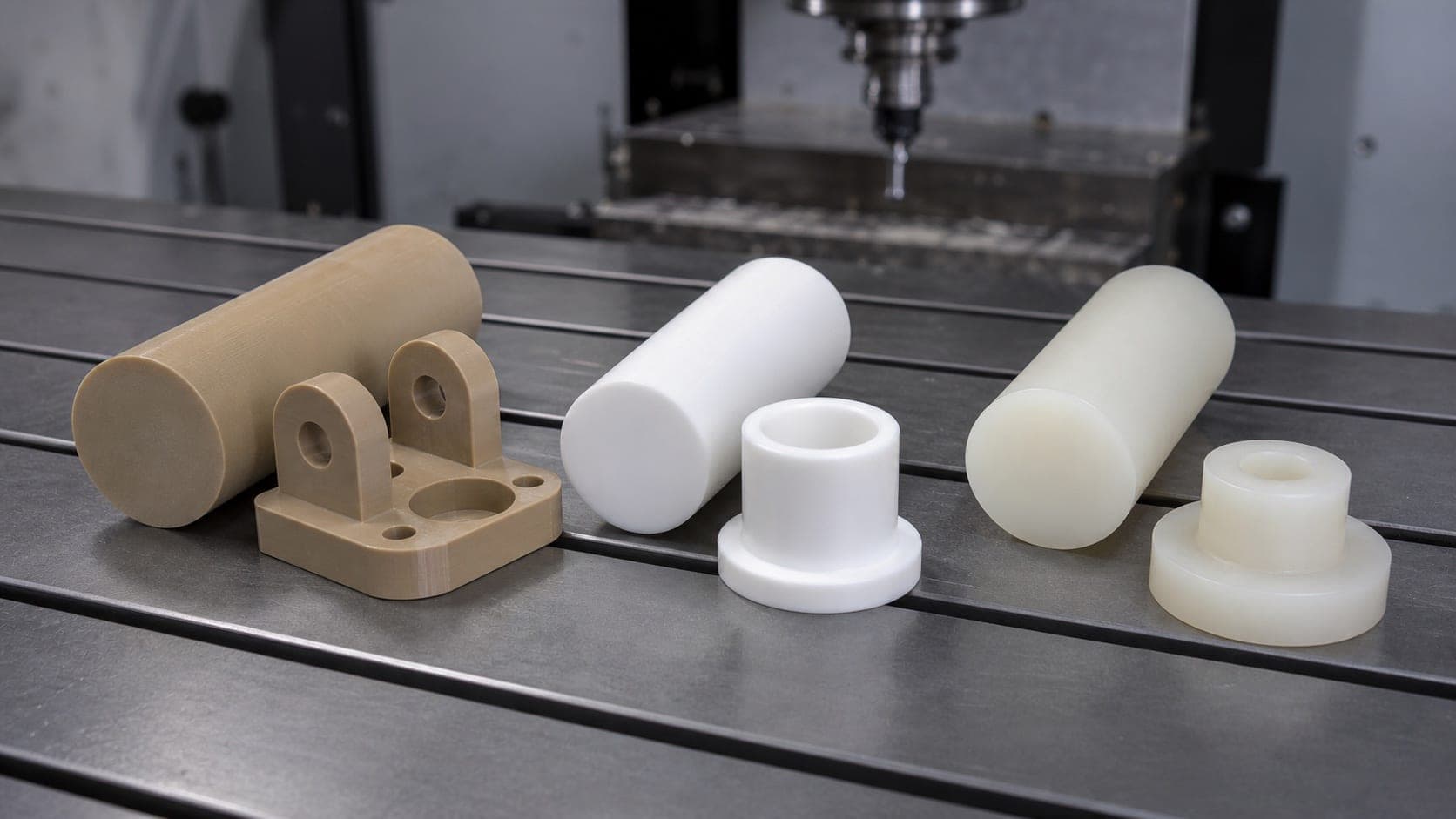
Temperature and chemical exposure are the two factors that most often force the material decision. If the part operates below 180 °F (82 °C) in a chemically benign environment, the choice is between Delrin and nylon based on mechanical requirements and cost. The moment you cross 200 °F or encounter aggressive chemicals, PEEK becomes the only viable option.
PEEK: the high-temperature champion
Continuous service to 480 °F (250 °C). Withstands autoclave sterilization at 270 °F (132 °C) with no dimensional change. Resists virtually all common solvents, acids (except concentrated H₂SO₄), bases, and hydrocarbons. The go-to material when thermal or chemical requirements disqualify the other two.
Delrin: stable up to 180 °F (82 °C)
Begins to soften and creep above 180 °F (82 °C). Good resistance to fuels, weak acids, bases, and common solvents. Attacked by strong mineral acids (HCl, H₂SO₄) and strong oxidizers. No formaldehyde off-gassing at normal service temperatures but may produce formaldehyde if burned — avoid flood coolant during machining as a precaution.
Nylon 6/6: moderate heat, moisture-sensitive
Service to 220 °F (105 °C) in dry conditions, but strength drops 10–20% when moisture-saturated. Attacked by strong acids (formic acid, phenol, ZnCl₂ solutions). Absorbs 1.2–1.5% moisture in 24 hr immersion — dimensional growth of 1–2% and plasticization of the polymer backbone.
Decision rule: temperature threshold
Below 180 °F (82 °C) → Delrin or nylon (cost-driven choice). 180–220 °F (82–105 °C) → Nylon 6/6 (if dry environment and moderate tolerance OK). Above 220 °F (105 °C) → PEEK is the only option. Autoclave sterilization → PEEK only. Chemical exposure → check PEEK compatibility chart first, then Delrin, then nylon.

CNC Machinability & Achievable Tolerances
All three materials machine on standard 3-axis CNC mills and lathes, but they behave differently at the tool tip. Delrin is the gold standard for CNC plastic machinability; nylon and PEEK require more attention to chip management and heat control.
| Factor | PEEK | Delrin 150 NC010 (Natural Delrin / POM-H) | Nylon 6/6 |
|---|---|---|---|
| Machinability Rating | Moderate | Excellent | Good |
| Typical Surface Finish (Ra) | 32–63 µin. (0.8–1.6 um) | 16–32 µin. (0.4–0.8 um) | 32–63 µin. (0.8–1.6 um) |
| Achievable Tolerance | ±0.002 in. (±0.05 mm) | ±0.001 in. (±0.025 mm) | ±0.002–0.003 in. (±0.05–0.08 mm) |
| Tool Wear | Moderate–High (use carbide) | Low (HSS or carbide) | Low–Moderate (carbide preferred) |
| Chip Formation | Short, well-broken chips | Excellent chip-breaking | Long stringy chips (use chip-breaker geometry) |
| Coolant | Air blast or light mist | Air blast (avoid flood — formaldehyde risk) | Air blast or flood coolant |
| Dimensional Stability | High (low moisture uptake) | High (low moisture, low creep) | Low — swells 1–2% with humidity |
| Typical Material Cost (rod, 2 in. (51 mm) dia) | $180–300/ft | $15–25/ft | $10–20/ft |
Material Cost: The 7–20× PEEK Premium
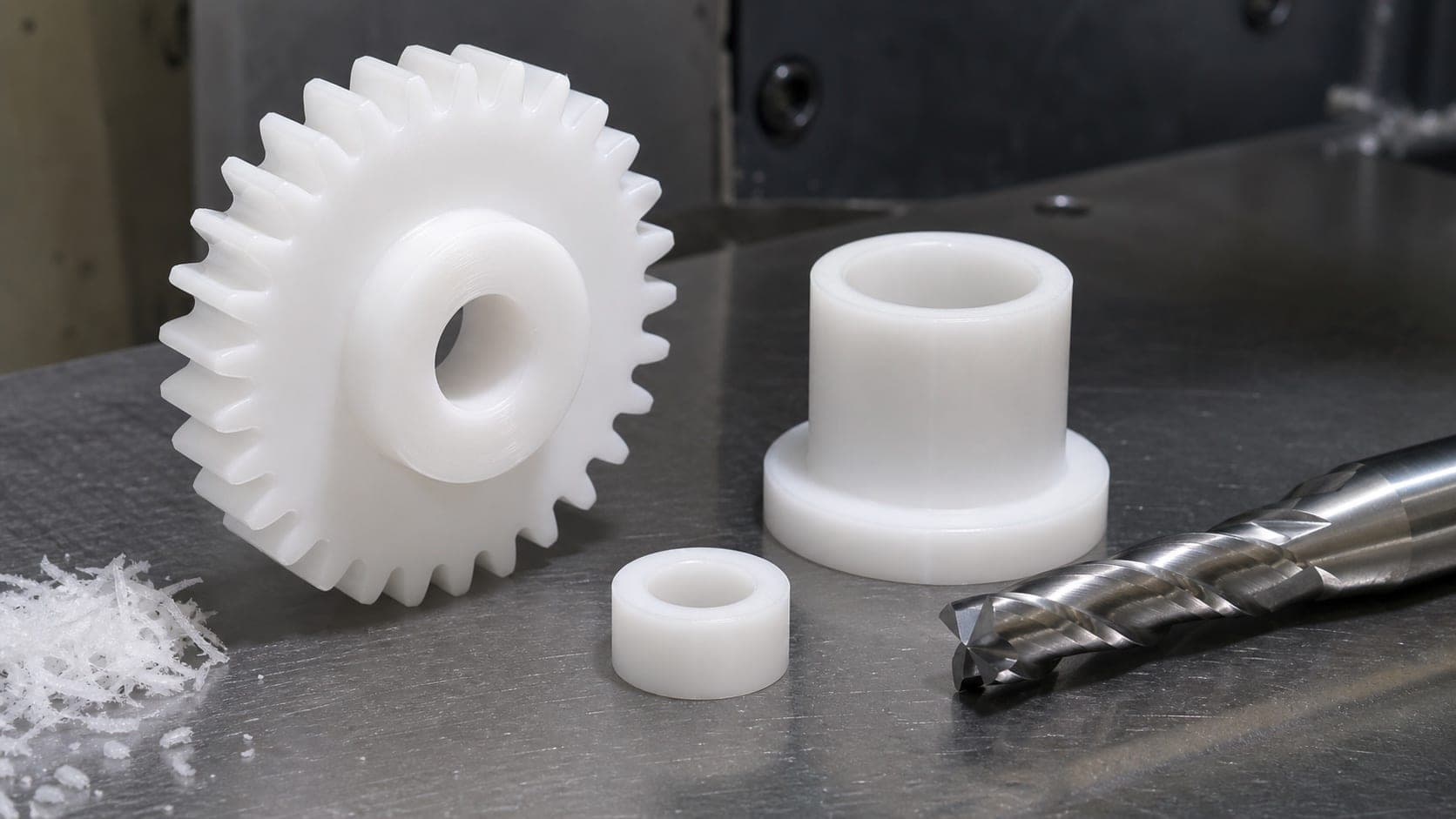
Material cost is the dominant cost driver for plastic CNC parts — unlike metals where machining time often exceeds material cost. On a typical 3×3×1 in. (76×76×25 mm) bracket, the material alone for PEEK is $40–80 vs $3–8 for Delrin or nylon.
Machining cost for all three is comparable on standard CNC equipment ($75–125/hr). PEEK may require 10–20% longer cycle times due to slower speeds and carbide tooling wear, but the material cost gap dwarfs the machining cost difference. For strategies to reduce per-part cost regardless of material, see our guide to reducing CNC machining cost.
Don’t spec PEEK “just in case”
The most common over-spec mistake: calling out PEEK for a part that operates at room temperature in a benign chemical environment. If the application does not require sustained heat above 200 °F, autoclave sterilization, or broad chemical resistance, Delrin or nylon provides equivalent mechanical performance at 7–20× lower material cost. Prototype in the cheaper material first; switch to PEEK only when testing proves the lower-cost option fails.
Not Sure Which Plastic to Spec?
Upload your drawing and tell us the operating environment. MakerStage engineers can flag when a tolerance callout does not match the plastic's capability and point out when PEEK, Delrin, or nylon appears to be the safer production fit.
Get a Plastic QuoteApplication Decision Table
Match your design scenario to the recommended material. Each row explains the reasoning and gives typical applications in robotics, medical devices, and industrial automation.
| Design Scenario | Recommended Material | Why | Typical Applications |
|---|---|---|---|
| Bushings, bearings, and wear pads (dry sliding) | Delrin (acetal) | Lowest coefficient of friction (0.20–0.35), self-lubricating, dimensionally stable, and 7–12× cheaper than PEEK. Acetal is the standard choice for dry bearing applications up to 180 °F (82 °C). | Robotics: joint bushings, conveyor guides, cable management slides |
| Precision gears and cams | Delrin (acetal) | Excellent dimensional stability under cyclic loading, low moisture absorption, and the tightest CNC tolerances of the three (±0.001 in. / 0.025 mm). Nylon gears swell with humidity and lose mesh precision. | Robotics: spur gears, worm drives. Medical: sterilizable drive mechanisms |
| High-temperature environments (>200 °F / 93 °C) | PEEK | Only PEEK maintains strength above 200 °F (93 °C). Delrin softens at 180 °F (82 °C); nylon 6/6 at 220 °F (105 °C). For sustained operation above 250 °F (121 °C), PEEK is the only unfilled option in this comparison. | Semiconductor: wafer handling fixtures. EV: battery module insulators |
| Autoclave or steam sterilization (270 °F / 132 °C) | PEEK | PEEK withstands repeated autoclave cycles at 270 °F (132 °C) without dimensional change. Delrin degrades above 250 °F. Nylon absorbs moisture during steam sterilization and swells. | Medical devices: surgical instrument handles, sterilization trays, implant-grade guides |
| Aggressive chemical exposure (concentrated acids, ketones) | PEEK | PEEK resists virtually all common chemicals except concentrated sulfuric acid and some halogenated solvents. Delrin is attacked by strong acids (pH <4). Nylon is dissolved by phenol and formic acid. | Semiconductor: chemical delivery components. Industrial: pump impellers, valve seats |
| Structural parts requiring high impact toughness | Nylon 6/6 | Nylon 6/6 has the highest impact strength of the three and absorbs energy through plastic deformation. Use for snap-fit housings, impact-loaded brackets, or parts that must survive drop tests. | Robotics: end-effector housings, cable chain links. Consumer: enclosure clips |
| Lightweight parts (density-critical) | Nylon 6/6 | At 1.14 g/cm³, nylon 6/6 is 12% lighter than PEEK and 19% lighter than Delrin. For weight-sensitive robotic end-of-arm tooling, nylon provides a higher strength-to-weight option when moisture-driven swelling is acceptable. | Robotics: lightweight gripper jaws, EOAT mounting plates |
| FDA food contact or USP Class VI compliance | Delrin (acetal) or PEEK | Delrin 150 and certain PEEK grades meet FDA 21 CFR 177.2480 and USP Class VI. Nylon 6/6 is not inherently FDA-compliant due to caprolactam extraction. Always verify the specific grade with the resin supplier. | Medical: fluid pathway connectors. Food: conveyor components |
| Budget-constrained prototypes (material cost matters) | Nylon 6/6 or Delrin | Nylon rod is $10–20/ft; Delrin $15–25/ft; PEEK $180–300/ft. For functional prototypes where material performance is adequate, nylon or Delrin cuts material cost by 7–20× versus PEEK. Switch to PEEK only when thermal or chemical requirements demand it. | All industries: first-run prototypes, fit-check samples, pre-production validation |
Medical Device & Robotics Applications
MakerStage’s two primary customer segments — medical device and robotics teams — both rely heavily on engineering plastics. The material choice maps directly to regulatory requirements for medical and to performance/cost trade-offs for robotics.
Medical devices
- Autoclave-sterilized surgical instruments → PEEK (PEEK-OPTIMA for implant contact)
- EtO-sterilized disposable guides / fixtures → Delrin 150 (FDA 21 CFR 177.2480)
- Fluid pathway connectors (non-implant) → Delrin or PEEK depending on chemical exposure
- Sterilization tray inserts → PEEK for autoclave; Delrin for EtO/gamma
Robotics
- Joint bushings and sleeve bearings → Delrin (low friction, wear resistance)
- Lightweight gripper jaws and EOAT plates → Nylon 6/6 (lowest density, good impact)
- High-temp motor insulators and sensor mounts → PEEK (thermal stability)
- Cable management slides and guides → Delrin (low friction, snap-fit retention)
Frequently Asked Questions
Related Resources
CNC Parts in PEEK, Delrin, or Nylon
Upload your drawing and call out the operating environment so the quote review can flag whether PEEK, Delrin, or nylon better matches the tolerance, temperature, and chemical requirements.
Get a Plastic Quote