Urethane Casting vs Injection Molding
Under 200 parts with geometry still moving, urethane casting is usually the safer default. When you need the real thermoplastic, injection molding is not one bucket. Prototype, pilot aluminum, and production steel tooling each change the cost and schedule in a different way.
Urethane casting solves revision risk. Injection molding solves repeatable production.
Both processes make multiple plastic parts from a mold, but the mold material changes the entire business case. In the broader DFM best practices and the prototype to production scaling roadmap, this is the core pattern: silicone tooling buys speed and flexibility, while metal tooling buys long-run consistency and lower unit cost.
Urethane casting
Master pattern + silicone tool + cast polyurethane resin
Urethane casting starts with a master, not a production mold. You machine or print a master pattern, pour a silicone mold around it, then cast two-part resin into that flexible tool. The process exists because you often need molded-looking parts before you are ready to freeze CAD and buy metal tooling.
- Fast to launch when geometry is still moving
- Flexible silicone tolerates mild undercuts and cosmetic changes better than steel
- Best for bridge quantities, pilot builds, and customer validation sets
Injection molding
Metal mold + molten thermoplastic + repeatable cycle
Injection molding starts with a production-intent tool. You cut cavities, gates, runners, cooling, and ejection into aluminum or steel, then run the real thermoplastic through a repeatable machine cycle. The process exists because once demand is real, tool cost gets diluted and the same mold can make parts far more consistently than a silicone tool.
- Lower unit cost once tooling is amortized
- Uses the exact production resin, color, and process behavior
- Better for repeatability, validation, and long-run supply
| Attribute | Urethane casting | Injection molding | Why it matters |
|---|---|---|---|
| Tool type | Silicone mold poured around a master pattern | Prototype aluminum through hardened steel mold with cavities, gates, cooling, and ejection | Silicone is fast and cheap to change. Metal is expensive up front but stable for long runs. |
| Typical tool life | About 15–30 parts per silicone mold, depending on geometry and tear risk; higher bridge volumes usually mean remaking molds from the same master | Hundreds to millions of cycles, depending on whether the tool is prototype aluminum or hardened production steel | Tool life is the main reason casting is a bridge process and molding is a production process. |
| Lead time to first parts | Often 7-15 business days including master pattern and mold build | Quick-turn prototype tools can be 5–15 business days; pilot and production tools are more often 3–12+ weeks | If your schedule is measured in days, silicone tooling usually wins. |
| Undercuts and late design changes | More forgiving because the silicone can flex during demold | Tool actions, lifters, or manual picks add cost and schedule | Complex geometry is cheaper to explore in casting before steel is frozen. |
| Material fidelity | Uses cast polyurethane resins that mimic ABS-like, PC-like, or elastomer feel | Uses the actual production thermoplastic resin grade | If exact resin behavior matters, molding has the advantage. |
The crossover is a tooling math problem, not a piece-price sound bite.
Total program cost = tooling cost + (unit cost x quantity). That is the ground truth. If you compare only the quoted part price, you miss the whole reason urethane casting exists. This cost logic sits next to our guides on what is injection molding and injection molding costs, because the real decision is always program-level, not one-line-quote level.
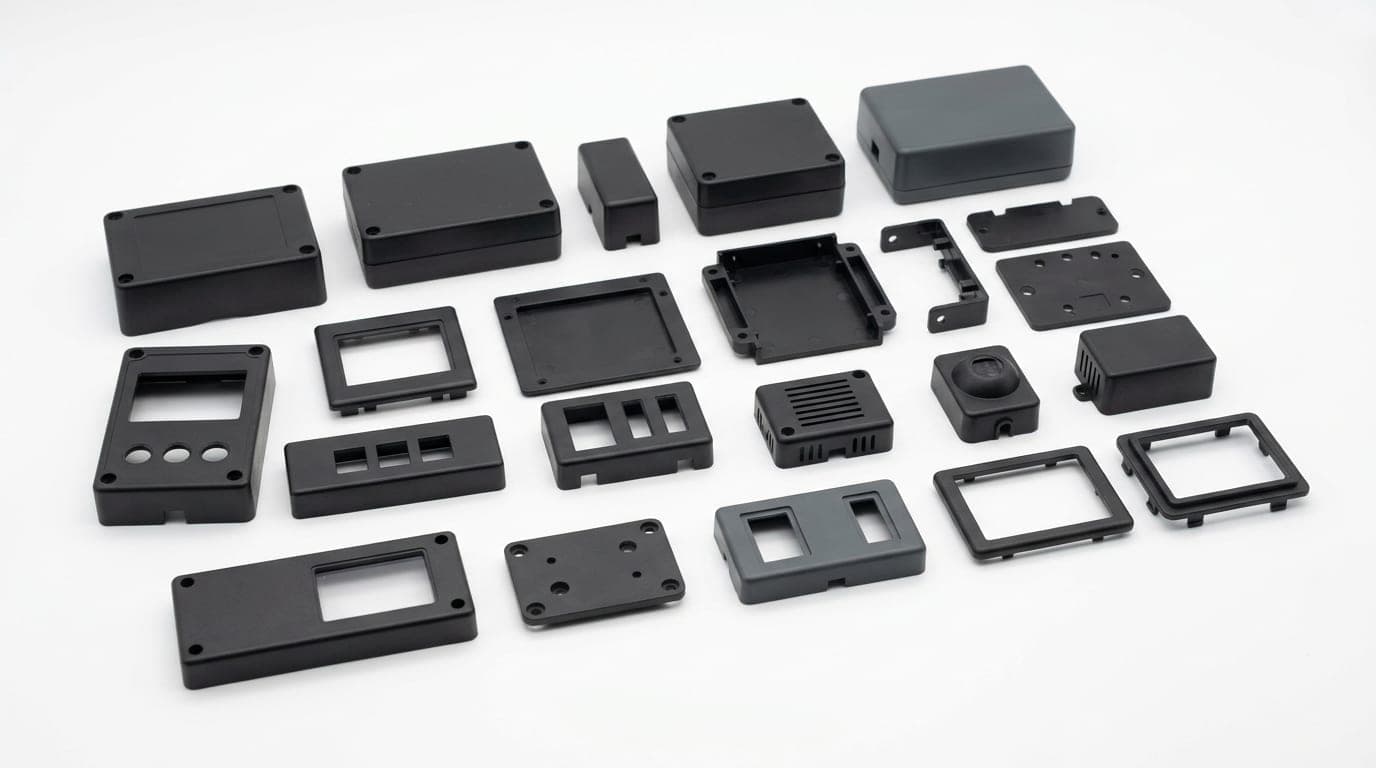
Worked example: handheld enclosure with moderate texture
Assumptions: one palm-sized enclosure, no slides, moderate cosmetic finish, one color, no automation. Urethane casting model uses $1,200 for master + silicone tooling and $55 per part. Injection molding model uses $12,000 for an aluminum production-intent mold and $6 per part.
($12,000 - $1,200) / ($55 - $6) = about 220 parts
This means the decision can flip quickly when quantity, secondary labor, cosmetic requirements, or design-change risk shifts.
| Quantity | Urethane total | Urethane effective | Injection total | Injection effective | Better fit |
|---|---|---|---|---|---|
| 20 parts | $2,300 total | $115/part effective | $12,120 total | $606/part effective | Urethane casting |
| 100 parts | $6,700 total | $67/part effective | $12,600 total | $126/part effective | Urethane casting |
| 250 parts | $14,950 total | $60/part effective | $13,500 total | $54/part effective | Near crossover |
| 1,000 parts | $56,200 total | $56/part effective | $18,000 total | $18/part effective | Injection molding |
Typical program ladder
A simple visual for how teams usually move
CNC machining or 3D printing wins when geometry is moving weekly.
Urethane casting wins when you need molded form factor before buying metal tooling.
Quick-turn molding wins when you need real thermoplastic data or molded validation parts before launch.
Aluminum and then steel tooling take over as volume, repeatability, and tool life start to dominate the economics.
They compare a urethane quote to a molded piece price and ignore the mold. Or they compare hard-tool molding to a program that is still changing every two weeks. Both are modeling errors, not sourcing strategy.
Need help finding the crossover before you commit to tooling?
Upload your CAD, target quantity, and finish notes. MakerStage can quote CNC machining, 3D printing, sheet metal, and bridge-volume options so you do not buy the wrong process too early.
Get a reviewed quoteIf the program needs the real production resin, molding wins for reasons that casting cannot fake.
Material fidelity is not the same as visual similarity. Urethane casting can look close to a molded part, and that is why it is powerful for pilot builds. But if your team is validating chemical resistance, snap-fit life, or final resin shrink behavior, the right answer is often the actual resin or a fallback prototype plan documented in your RFQ checklist.
| Criterion | Urethane casting | Injection molding | Practical numbers |
|---|---|---|---|
| Dimensional repeatability | Useful for prototypes and pilot parts, but silicone wear pushes variation upward over repeated pulls. | More repeatable once the mold, gate, and process window are tuned. | Urethane casting often lands around +/-0.010 to +/-0.015 in. (+/-0.25 to +/-0.38 mm) on small-to-medium features. Injection molding commonly targets about +/-0.003 to +/-0.008 in. (+/-0.08 to +/-0.20 mm) on stable features, geometry dependent. |
| Surface finish and cosmetics | Copies the master pattern very well, which is why it is good for cosmetic pilot housings. | Keeps texture and gloss more consistent across hundreds or thousands of parts. | A polished SLA or CNC master gives very good first-article cosmetics, but silicone tools lose edge sharpness and texture consistency after repeated use. |
| Material behavior | Good for fit checks, appearance models, and moderate functional testing. | Best for final mechanical, thermal, chemical, and regulatory validation because the resin is real production stock. | Use molding when exact resin grade, flame rating, sterilization behavior, or long-term creep performance matters more than launch speed. |
| Feature robustness | Thin clips, sharp snap fits, and very fine shutoffs are riskier because cast resins and silicone tools are less forgiving. | Better for repeatable snap features, molded bosses, and production inserts. | If your design depends on repeated flexing, molded threads, or tight shutoffs, injection molding usually de-risks the program faster. |
Where urethane casting shines
Cosmetic housings, pilot builds, customer demos, operator trials, and bridge programs where look and fit matter more than exact production resin behavior.
- Strong option when the design still changes after every test cycle
- Useful for color, texture, and assembled fit checks before a steel tool exists
- Lower penalty for late gate, boss, or snap-feature edits
Where injection molding pulls ahead
Production housings, clips, knobs, handles, and covers where exact resin grade, repeatability, and long-run economics are more important than design flexibility.
- Best when validation must happen on the actual production thermoplastic
- Better repeatability across hundreds or thousands of parts
- Lower unit cost once demand is predictable enough to carry the mold
Ask four questions before you release any tooling PO.
The wrong process usually comes from answering the wrong question. Teams often ask, "Which quote is cheaper today?" The better question is, "How many parts do we need before the next revision, and what must those parts prove?" If you need more context, compare this with your broader manufacturing capabilities plan and release package.
| Question | Lean urethane casting | Lean injection molding |
|---|---|---|
| How many identical parts do you need before the next design revision? | 10-200 parts is the classic sweet spot. | Real-resin validation can justify prototype molding below 250 parts; pilot and production tooling pull ahead as demand hardens. |
| Do you need the exact production resin and real gate behavior? | No. ABS-like or PC-like behavior is good enough for this phase. | Yes. Final resin properties, shrink, and process signatures matter. |
| How frozen is the CAD model? | Geometry is still moving and you want cheap tool changes. | The part is close to release and late tool edits are unlikely. |
| What is the schedule risk? | You need housings, covers, or grips in days, not months. | Quick-turn molding can land in days, but pilot and production tools need more schedule margin. |
Choose urethane casting when
- You need molded-looking parts before design freeze.
- The next design revision is likely within weeks.
- You need 10-200 parts for pilot or customer testing.
Choose injection molding when
- You need the exact production resin and final process behavior.
- Demand is high enough to amortize the tool.
- Repeatability and long-run piece price matter more than flexibility.
Common mistakes
- Buying steel before the clip, boss, and gate strategy are stable.
- Treating cast urethane as proof of final resin performance.
- Ignoring the cost of revision loops when comparing quotes.
Frequently Asked Questions
Related Resources
Ready to choose the right process before you pay for tooling?
If you are balancing prototype speed, bridge-volume demand, and production cost, send your CAD and target quantity. MakerStage can quote CNC machining, 3D printing, sheet metal, and urethane-casting paths so the next step is based on numbers instead of guesswork.
Start a manufacturing quote