CNC Machining PEEK: The Complete Engineer's Guide
PEEK (polyether ether ketone) is a high-performance semi-crystalline thermoplastic that can be CNC machined — continuous service to 480°F (250°C), inherent chemical resistance, and a strength-to-weight ratio that rivals aluminum. But it costs 7–20× more than acetal, demands annealing before tight-tolerance work, and punishes poor tooling with cracked surfaces and scrapped stock. This guide covers grade selection, speeds and feeds, annealing schedules, achievable tolerances, DFM rules, and cost breakdown so you can specify and machine PEEK parts with fewer avoidable quote loops.
Published480°F (250°C)
Service Temp
±0.005 in. (±0.13 mm)
Standard Tolerance
300–600 SFM (91–183 m/min)
Surface Speed
$50–120/lb ($110–265/kg)
Material Cost
PEEK Machines Like a High-Performance Metal — Not Like a Typical Plastic
If you've machined acetal or nylon, your instincts about plastic cutting parameters will get you started — but they won't get you to spec. PEEK's glass transition temperature (Tg) of 289°F (143°C) means it stays rigid far above temperatures where other engineering plastics soften. Its semi-crystalline structure creates residual stresses during extrusion that must be relieved before precision machining. And at $50–200/lb ($110–440/kg), every scrapped part is an expensive lesson. This guide walks you through each challenge and how to solve it.
Why PEEK Is Difficult to Machine
PEEK (polyether ether ketone) is a semi-crystalline thermoplastic — meaning its polymer chains fold into ordered crystalline regions interspersed with amorphous zones. This dual-phase structure is what gives PEEK its remarkable combination of strength, stiffness, and chemical resistance. But it also creates three machining challenges that don't exist with simpler plastics like acetal or nylon.
High Glass Transition
PEEK's Tg of 289°F (143°C) and melting point of 649°F (343°C) mean the material stays rigid at temperatures where acetal (Tg approximately −4°F / −20°C for copolymer) turns gummy. That helps the finished part but hurts machinability: PEEK doesn't form the easy-to-break chips acetal does. Chips can be stringy and reweld to the surface if cutting speed is too low.
Residual Stress
Extruded PEEK rod and plate stock cools from the outside in, locking compressive stress into the surface and tensile stress into the core. When you machine away one side, the stress balance changes — and the part warps. On a 4 in. (100 mm) diameter rod, unannealed stock can move 0.005–0.015 in. (0.13–0.38 mm) after rough machining. That's larger than a standard CNC tolerance.
Cost of Mistakes
A 2 in. (50 mm) diameter × 12 in. (300 mm) long rod of unfilled PEEK costs $150–300 depending on grade. Glass-filled or carbon-filled stock costs more. Scrapping a part doesn't just cost cycle time — it costs $100+ in raw material. This is why PEEK machining requires more planning, annealing, and process control than any other engineering plastic.
Worked Example — Thermal Expansion in PEEK
The coefficient of thermal expansion (CTE) — how much a material grows per degree of temperature change — determines whether your part stays in tolerance as temperature varies. Unfilled PEEK's CTE is 26 µin./in./°F (47 µm/m/°C).
Formula: ΔL = L × CTE × ΔT
Example: A 6 in. (150 mm) PEEK shaft, 68°F (20°C) → 200°F (93°C) (ΔT = 132°F / 73°C):
ΔL = 6 × 26 × 10⁻⁶ × 132 = 0.0206 in. (0.52 mm)
That's 4× the ±0.005 in. (±0.13 mm) standard tolerance — PEEK parts operating at elevated temperatures need thermal compensation in the design.
For comparison: GF30 PEEK CTE is 15 µin./in./°F (27 µm/m/°C) — 42% lower thermal growth. Choose filled grades when dimensional stability at temperature matters.
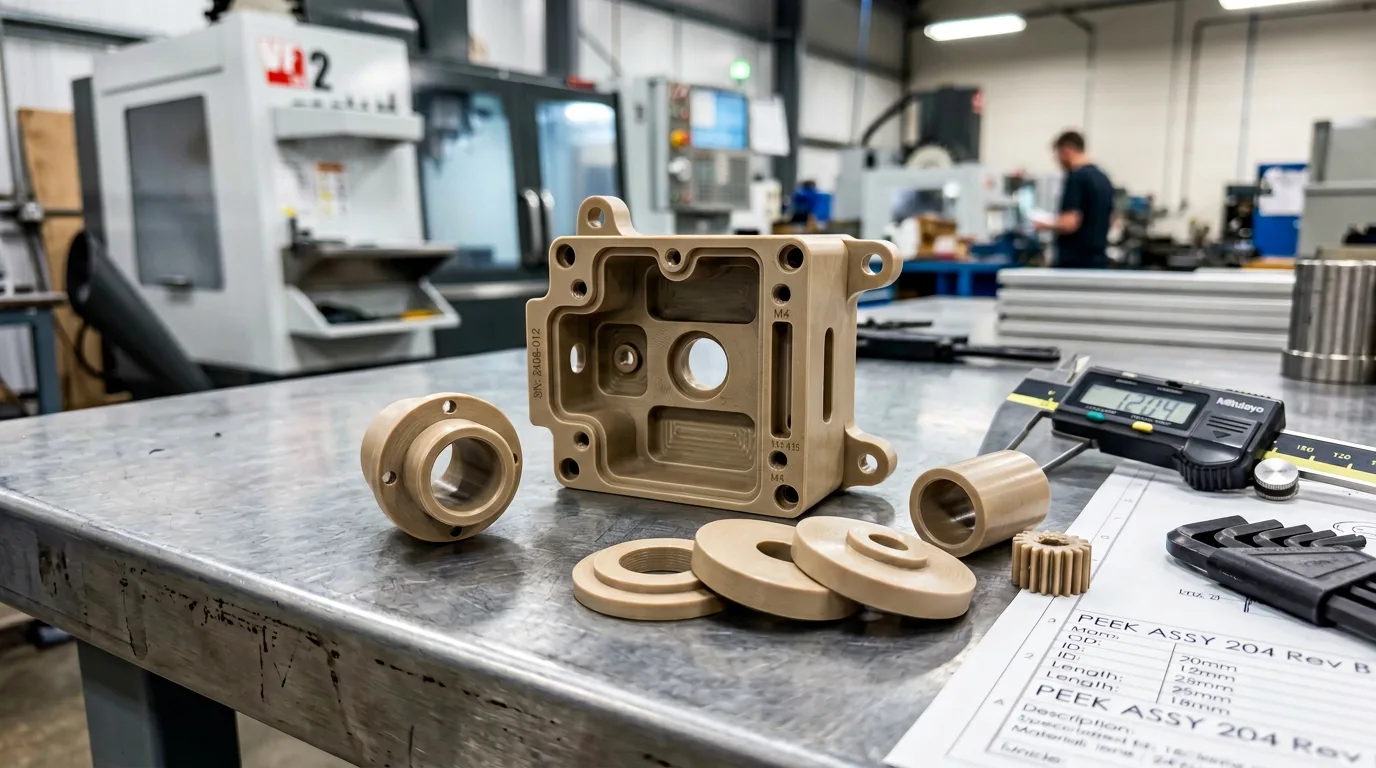
PEEK Grades and When to Use Each
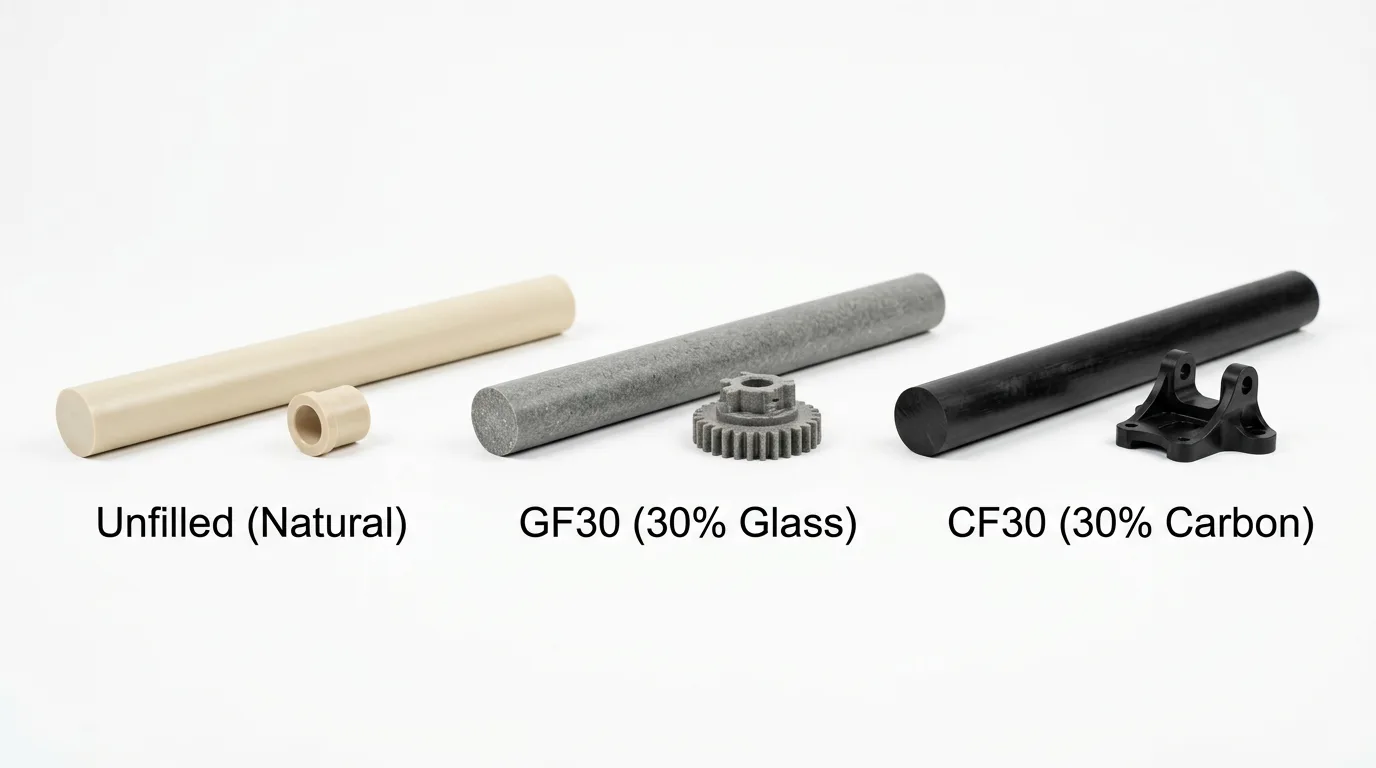
"PEEK" is not a single material — it's a family of grades with significantly different mechanical properties, machinability, and cost. Specifying the wrong grade is the most common source of over-spending on PEEK parts. Unfilled PEEK handles most general-purpose applications. Filled grades add stiffness, dimensional stability, or wear resistance — but at higher cost and with reduced elongation (toughness). Medical-grade PEEK carries biocompatibility certifications required for implantable devices.
| Grade | UTS | Flexural Modulus | Max Service Temp | Elongation | Cost Tier | Typical Use |
|---|---|---|---|---|---|---|
| Unfilled (450G) | 14.5 ksi (100 MPa) | 595 ksi (4,100 MPa) | 480°F (250°C) | 30–50% | $50–120/lb ($110–265/kg) | Seals, bushings, electrical insulators |
| GF30 (30% glass) | 23 ksi (160 MPa) | 1,600 ksi (11,000 MPa) | 480°F (250°C) | 2–3% | $80–160/lb ($175–350/kg) | Structural brackets, housings, stiffness-critical parts |
| CF30 (30% carbon) | 31 ksi (212 MPa) | 2,600 ksi (18,000 MPa) | 480°F (250°C) | 2–3% | $100–200/lb ($220–440/kg) | High strength-to-weight, semiconductor, robotics |
| Bearing (PTFE/graphite) | 10 ksi (69 MPa) | 580 ksi (4,000 MPa) | 480°F (250°C) | 10–20% | $70–140/lb ($155–310/kg) | Wear surfaces, bushings, thrust washers |
| Medical (PEEK-OPTIMA) | 14.5 ksi (100 MPa) | 595 ksi (4,100 MPa) | 480°F (250°C) | 30–50% | $120–250/lb ($265–550/kg) | Spinal cages, surgical tools, dental implants |
UTS and modulus values are typical per manufacturer datasheets (Victrex, Solvay KetaSpire, Ensinger TECAPEEK). Medical-grade pricing includes traceability documentation premium. All values at room temperature, 73°F (23°C).
Quick Grade Selection Rule
Start with unfilled PEEK unless your application needs one of these: stiffness or dimensional stability → GF30, highest strength-to-weight → CF30, wear/friction → bearing grade, implantable device → medical grade. Unfilled PEEK handles 60–70% of applications at the lowest material cost.
Speeds, Feeds, and Cutting Parameters
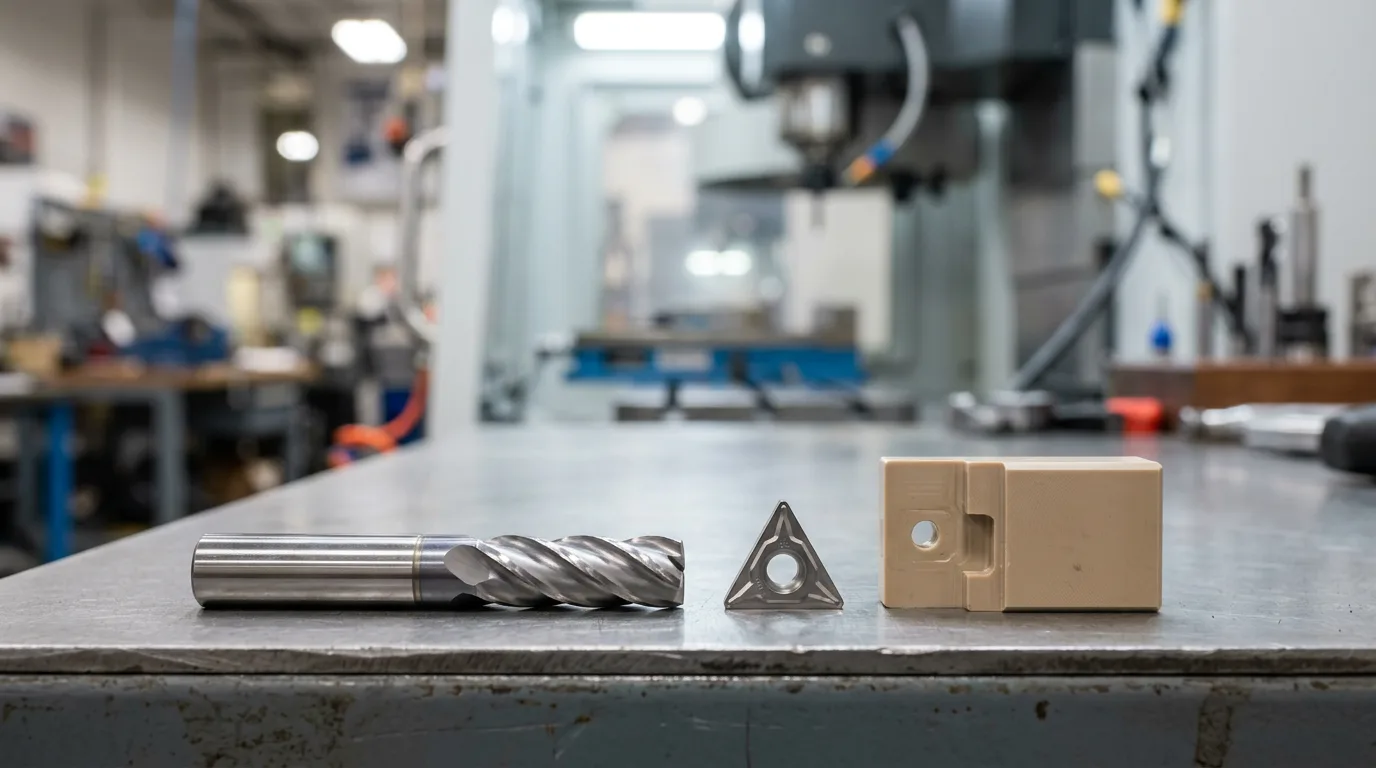
Surface speed — the linear velocity of the cutting edge relative to the workpiece — is the primary variable controlling chip formation and surface quality in PEEK machining. Run too slow, and PEEK chips reweld to the cut surface (smearing). Run too fast, and frictional heat exceeds the glass transition temperature, creating a melted, discolored surface. The sweet spot for unfilled PEEK is 300–600 SFM (91–183 m/min) — roughly twice the speed used for acetal.
Tool material matters. Use uncoated carbide with polished flutes — coatings like TiN and TiAlN increase friction and generate more heat without improving tool life on thermoplastics. For filled grades (GF30, CF30), the glass or carbon fibers are abrasive and wear carbide edges quickly. Switch to polycrystalline diamond (PCD) tools for production runs of 50+ parts in filled PEEK — PCD lasts 5–10× longer.
| Operation | Cutting Speed | Feed Rate | Depth of Cut | Notes |
|---|---|---|---|---|
| Face milling (unfilled) | 400–600 SFM (122–183 m/min) | 0.004–0.008 in./tooth (0.10–0.20 mm/tooth) | 0.040–0.120 in. (1.0–3.0 mm) | Positive rake 10–15°. Compressed air preferred. |
| Face milling (GF30/CF30) | 300–500 SFM (91–152 m/min) | 0.003–0.006 in./tooth (0.08–0.15 mm/tooth) | 0.030–0.080 in. (0.8–2.0 mm) | PCD tooling for 50+ parts. Glass fibers abrade carbide. |
| OD turning (unfilled) | 400–600 SFM (122–183 m/min) | 0.005–0.012 in./rev (0.13–0.30 mm/rev) | 0.040–0.150 in. (1.0–3.8 mm) | Sharp positive insert. Nose radius ≤0.015 in. (0.4 mm). |
| Boring | 300–500 SFM (91–152 m/min) | 0.003–0.008 in./rev (0.08–0.20 mm/rev) | 0.010–0.040 in. (0.25–1.0 mm) | Light finishing pass. Support thin walls with backup fixture. |
| Drilling | 200–400 SFM (61–122 m/min) | 0.003–0.008 in./rev (0.08–0.20 mm/rev) | — | 118° point angle. Peck drill at 2× diameter depth. Compressed air for chip evacuation. |
| Tapping | 40–80 SFM (12–24 m/min) | Per thread pitch | — | Spiral-point tap. Flood coolant. 2× diameter engagement depth minimum. |
| Slotting / pocketing | 300–500 SFM (91–152 m/min) | 0.003–0.006 in./tooth (0.08–0.15 mm/tooth) | 0.030–0.080 in. (0.8–2.0 mm) | Ramp entry, not plunge. 2-flute end mill for chip clearance. |
Values are starting points for uncoated carbide tooling. Adjust ±20% based on machine rigidity, part geometry, and cooling setup. SFM = Surface Feet per Minute; m/min = meters per minute.
Coolant Strategy: Air vs. Flood
Compressed air is preferred for most PEEK operations — it evacuates chips without introducing thermal shock that can increase residual stress. Use flood coolant only when heat generation is unavoidable: deep drilling, tapping, and heavy roughing. When using flood, choose a water-soluble coolant without chlorine — chlorinated coolants can stress-crack PEEK under sustained load. Never use solvents (acetone, MEK) as coolant — PEEK is resistant to most chemicals, but ketones can cause environmental stress cracking.
Annealing and Stress Relief
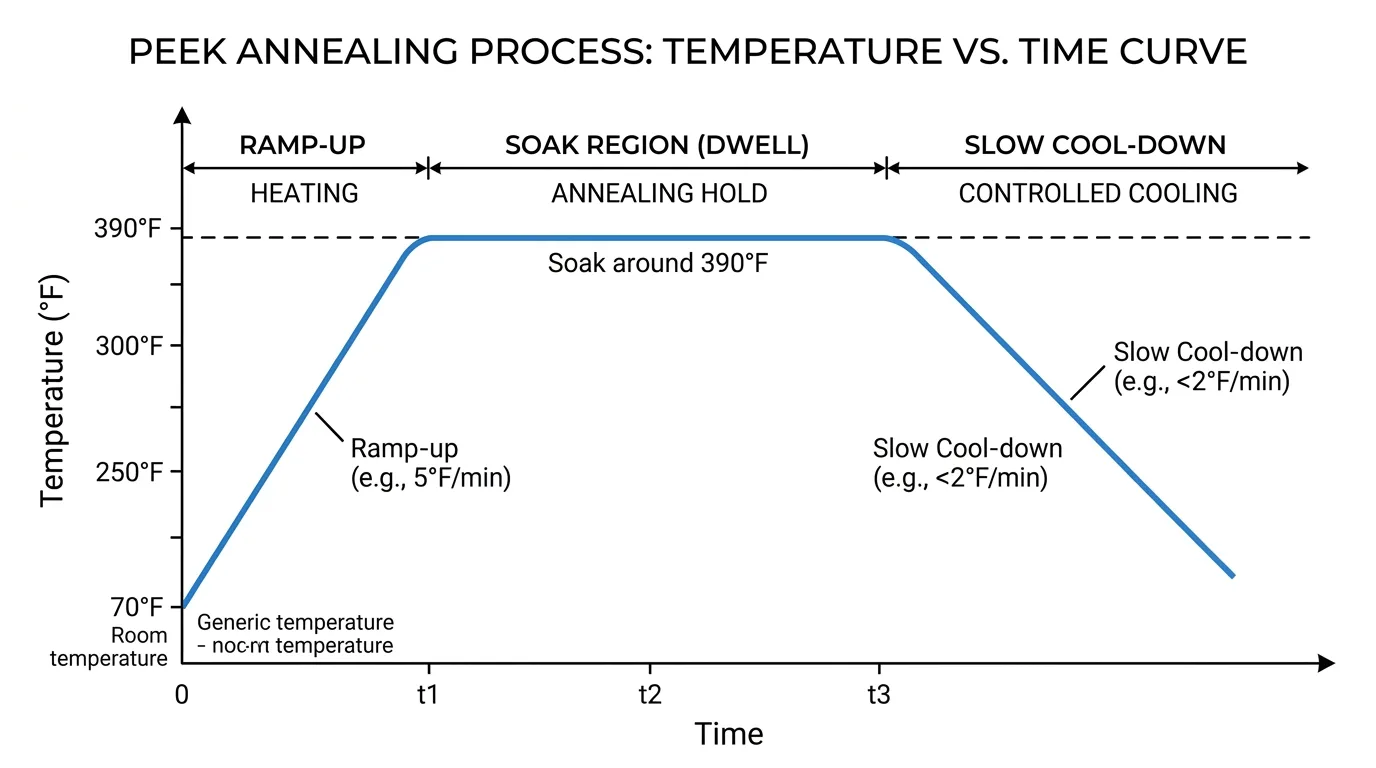
Annealing is a controlled heat-treatment cycle that relaxes residual stresses locked into PEEK stock during extrusion. When you extrude a PEEK rod, the outer surface cools and solidifies first while the core is still molten. This creates a stress gradient — compression at the surface, tension in the core. Machining removes material asymmetrically and upsets this balance, causing the remaining material to warp, bow, or go out-of-round.
Annealing also increases the crystallinity of PEEK from the as-extruded level (typically 25–30%) toward the maximum achievable level (35–40%). Higher crystallinity improves wear resistance, chemical resistance, and compressive strength — but slightly reduces elongation and impact toughness. For most machined parts, this tradeoff is favorable.
Recommended Annealing Schedules for PEEK
| Stage | Pre-Machining Anneal | Post-Machining Stress Relief |
|---|---|---|
| Ramp rate | 40–60°F/hr (22–33°C/hr) | 40–60°F/hr (22–33°C/hr) |
| Soak temperature | 390°F (200°C) | 300°F (150°C) |
| Soak time | 2 hr + 1 hr per 0.5 in. (13 mm) of cross-section thickness | 1 hr + 0.5 hr per 0.5 in. (13 mm) of cross-section thickness |
| Cooling rate | ≤20°F/hr (≤11°C/hr) to 200°F (93°C), then air-cool | ≤20°F/hr (≤11°C/hr) to 150°F (66°C), then air-cool |
| Environment | Air oven (nitrogen optional for filled grades) | Air oven |
Based on Victrex and Solvay processing guidelines. For cross-sections >2 in. (50 mm), extend soak time proportionally. The slow cooling rate is critical — faster cooling reintroduces thermal stress.
When to skip annealing: If your part tolerance is ±0.010 in. (±0.25 mm) or wider, the part has no thin walls (wall thickness >0.25 in. / 6 mm), and the geometry is roughly symmetric, you can often machine from as-extruded stock without annealing. But verify by measuring the first article before committing to a production run.
Achievable Tolerances for CNC Machined PEEK
A tolerance defines the acceptable range of variation around a nominal dimension. No CNC machine produces an exact number — tolerances define how close the machine needs to get. PEEK's dimensional stability is better than nylon (0.1–0.5% moisture absorption vs. 2.5%) but worse than metals because thermal expansion and residual stress both work against you. Proper annealing is the single biggest factor in achieving tight tolerances on PEEK parts.
| Feature Type | Standard (No Anneal) | With Annealing | Notes |
|---|---|---|---|
| Linear dimensions | ±0.005 in. (±0.13 mm) | ±0.002 in. (±0.05 mm) | Annealing critical for features >3 in. (75 mm) |
| Bore diameter | ±0.003 in. (±0.08 mm) | ±0.001 in. (±0.025 mm) | Post-machining stress relief for H7 class fits |
| OD (turned) | ±0.003 in. (±0.08 mm) | ±0.001 in. (±0.025 mm) | Spring pass at 0.005 in. (0.13 mm) DOC |
| Flatness | 0.003 in. per 1 in. (0.076 mm per 25.4 mm) | 0.001 in. per 1 in. (0.025 mm per 25.4 mm) | Machine both sides. Flip and face in same setup. |
| Surface finish (Ra) | 32–63 µin. (0.8–1.6 µm) | 16–32 µin. (0.4–0.8 µm) | Light spring pass. PCD tooling for filled grades. |
| Concentricity | 0.003 in. TIR (0.08 mm) | 0.001 in. TIR (0.025 mm) | Single-setup turning. Collet preferred over 3-jaw chuck. |
"Standard" values assume as-extruded stock, no pre-machining anneal. "With Annealing" values assume both pre-machining anneal and post-machining stress relief per Section 4. Actual results depend on part geometry, wall thickness, and asymmetry.
PEEK Quote Review Before Release
Upload your PEEK part for quote-stage manufacturability feedback. We can flag annealing requirements, tolerance risks, and grade-selection questions before production release.
Common Defects and Troubleshooting
PEEK machining defects fall into two categories: thermal damage (too much heat in the cut zone) and stress-related distortion (residual stress from the stock or from machining itself). Identifying the root cause is essential because the fixes are different — thermal issues require speed/feed changes, while stress issues require annealing or fixturing changes.
Surface cracking (crazing)
Cause: Excessive heat softens the surface, and thermal stress during cooling creates micro-cracks visible as a hazy or crazed surface.
Fix: Reduce cutting speed by 20%. Switch from flood coolant to compressed air (thermal shock from flood coolant can cause crazing). Verify tool sharpness — dull tools generate more heat.
Warping after machining
Cause: Asymmetric material removal releases residual stress unevenly, causing the part to bow or twist hours to days after machining.
Fix: Pre-anneal the stock per Section 4. Machine in multiple passes with stress-relief holds between roughing and finishing. Machine both sides of plate stock.
Chip smearing / rewelding
Cause: Cutting speed too low — PEEK chips don't break cleanly and instead smear back onto the machined surface, creating a rough, built-up finish.
Fix: Increase cutting speed by 30–50%. PEEK needs higher SFM than acetal to form clean chips. Verify positive rake geometry (6–15°).
Delamination (filled grades)
Cause: Glass or carbon fibers pull out of the matrix at the cut surface, creating a fuzzy or layered appearance along cut edges.
Fix: Use PCD tooling — sharper edges shear fibers cleanly. Reduce DOC to 0.020–0.040 in. (0.5–1.0 mm) for finishing. Climb milling preferred over conventional.
Discoloration (yellowing / browning)
Cause: Localized overheating at the tool tip oxidizes the surface. The part is not structurally damaged but may be cosmetically unacceptable.
Fix: Increase chip load (feed rate) to move heat into the chip rather than the part. Add compressed air for cooling. Replace dull tools — discoloration often signals worn cutting edges.
Dimensional drift between parts
Cause: Tool wear changes dimensions progressively across a batch. Glass-filled PEEK is especially abrasive — carbide tools can lose 0.001 in. (0.025 mm) per 20–30 parts.
Fix: Measure every 10th part. Use PCD tooling for filled grades. Set tool-wear offsets in the CNC program. Establish a tool-change interval before starting production.
DFM Rules for PEEK Parts
Design for manufacturability (DFM) is the practice of designing parts so they can be machined efficiently, with fewer setups, less scrap, and predictable quality. PEEK's high material cost makes DFM even more important than with metals — every unnecessary feature increases the amount of expensive stock that ends up as chips. These rules apply specifically to CNC machined PEEK; general CNC design guidelines also apply.
Wall Thickness
- Minimum: 0.060 in. (1.5 mm) for unfilled; 0.080 in. (2.0 mm) for filled grades
- Uniform walls preferred — varying thickness causes uneven stress and warping
- Thin walls flex during cutting — use backup fixtures or reduce DOC to 0.010 in. (0.25 mm)
Pockets and Cavities
- Depth-to-width ratio: ≤4:1 (tools deflect in deep narrow pockets)
- Internal corner radius: ≥0.060 in. (1.5 mm) — matches standard 1/8 in. end mill
- Full-radius floors reduce stress concentrations that cause cracking in PEEK
Threads
- Thread engagement: 2× nominal diameter minimum (vs. 1.5× for metals)
- For M4 (#8-32) and smaller: use brass heat-set inserts or Helicoil wire inserts
- Thread relief groove at bottom of blind tapped holes — tap won't form clean threads at the bottom otherwise
Tolerances
- Call out ±0.001 in. (±0.025 mm) only on critical functional features
- Every tight-tolerance feature requires annealing — budget 1–2 days for the cycle
- Going from ±0.005 in. (±0.13 mm) to ±0.001 in. (±0.025 mm) typically adds 40–80% to machining cost
Stock Shape Selection
- Rod: available 0.25–6 in. (6–150 mm) diameter. Least expensive per unit volume.
- Plate: available 0.25–4 in. (6–100 mm) thick. Use for flat parts to minimize material waste.
- Tube: limited availability. Reduces machining time for annular parts (bushings, spacers).
Material Specification
- Always specify grade on the drawing: "PEEK per ASTM D6262, unfilled" not just "PEEK"
- For medical: call out ASTM F2026 and required biocompatibility testing
- Specify supplier if lot traceability is required (Victrex 450G, Solvay KetaSpire XT)
PEEK Part Cost Breakdown
Material cost dominates PEEK part pricing — typically 40–60% of total part cost, compared to 10–20% for aluminum or acetal parts. This flips the usual CNC cost optimization strategy: with metals, you optimize cycle time; with PEEK, you optimize material utilization. Every cubic inch of PEEK you remove as chips is money in the scrap bin.
| Cost Component | Acetal (POM) | Unfilled PEEK | GF30 PEEK |
|---|---|---|---|
| Raw stock (2 in. / 50 mm rod, per lb) | $3–6/lb ($7–13/kg) | $50–120/lb ($110–265/kg) | $80–160/lb ($175–350/kg) |
| Cycle time (typical bushing) | 5–8 min | 6–10 min | 8–12 min |
| Annealing (pre + post) | Not required | $5–15/part (batch oven) | $5–15/part (batch oven) |
| Tooling premium | Baseline | +10–20% | +30–50% (PCD required) |
| Typical part cost (qty 50) | $8–15 | $40–80 | $60–120 |
Example part: 1.5 in. (38 mm) OD × 0.75 in. (19 mm) ID × 1.0 in. (25 mm) long bushing. Typical production quantity 50 pieces. Pricing is 2026 US market estimate. Actual pricing varies by supplier, volume, and tolerances.
When PEEK Justifies Its Cost Premium
- •Temperature: Operating above 300°F (150°C) continuously — acetal maxes out at 180°F (82°C), nylon at 250°F (120°C)
- •Chemical exposure: Aggressive chemicals (strong acids, hydrocarbons, steam) that attack acetal and nylon
- •Biocompatibility: Implantable medical devices requiring USP Class VI / ISO 10993 compliance
- •Weight reduction: Replacing metal components — PEEK density is 0.047 lb/in³ (1.30 g/cm³), ~60% lighter than titanium
- •Semiconductor purity: Ultra-low outgassing and particle generation in wafer handling equipment
If none of these apply, consider acetal as a lower-cost alternative. Acetal handles most room-temperature, non-chemical applications at 7–20× lower material cost.
PEEK Applications by Industry
PEEK is used wherever the combination of temperature resistance, chemical resistance, and mechanical strength eliminates cheaper alternatives. Below are the primary application areas, with the recommended PEEK grade and the material property driving the selection.
Medical Devices
Grade: PEEK-OPTIMA (Invibio) or equivalent USP Class VI / ISO 10993 grade. Applications: Spinal fusion cages (radiolucent — visible on X-ray without metal artifact), dental implant abutments, surgical instrument handles, sterilizable clamps. Why PEEK: Biocompatible, withstands 1,000+ autoclave cycles at 270°F (132°C), elastic modulus close to cortical bone (reduces stress shielding). Per ASTM F2026.
See also: CNC machining for medical devices
Semiconductor Equipment
Grade: Unfilled or CF30 PEEK. Applications: Wafer handling end-effectors, process chamber components, test socket insulators, chemical delivery system fittings. Why PEEK: Ultra-low outgassing (<0.01% TML), chemical resistance to aggressive etch/clean chemistries (HF, sulfuric acid), and ESD-safe formulations available for wafer handling.
Robotics
Grade: Bearing grade (PTFE/graphite-filled) for wear parts; CF30 for structural components. Applications: High-temperature joint bushings, lightweight structural links, gripper jaw inserts (non-marring contact surface), sensor housing insulators. Why PEEK: Self-lubricating bearing grades eliminate grease in clean environments. CF30 offers strength-to-weight competitive with titanium at 40% lower density.
See also: CNC machining for robotics
Electrical & Industrial
Grade: Unfilled PEEK. Applications: High-voltage connectors, transformer bobbins, pump impellers, valve seats, compressor rings. Why PEEK: Dielectric strength of 480 V/mil (19 kV/mm), UL 94 V-0 flame rating without additives, hydrolysis resistance for continuous steam exposure. PEEK seals and valve seats operate in environments that destroy PTFE, acetal, and nylon.
How to Specify PEEK on an Engineering Drawing
A material callout — the text on your engineering drawing that specifies exactly what material to use — must be unambiguous enough that any machine shop can procure the correct stock without calling you. "PEEK" alone is insufficient because there are dozens of grades. Specify the ASTM standard, the fill type, and the supplier/trade name if biocompatibility traceability is required.
General-Purpose (Unfilled):
MATERIAL: PEEK PER ASTM D6262, UNFILLED, NATURAL COLOR
Glass-Filled:
MATERIAL: PEEK PER ASTM D6262, 30% GLASS-FILLED (GF30)
Carbon-Filled:
MATERIAL: PEEK PER ASTM D6262, 30% CARBON FIBER-FILLED (CF30)
Medical / Implant-Grade:
MATERIAL: PEEK-OPTIMA (INVIBIO) PER ASTM F2026, USP CLASS VI, WITH LOT TRACEABILITY AND COC
Bearing Grade:
MATERIAL: PEEK PER ASTM D6262, PTFE/GRAPHITE-FILLED BEARING GRADE
If annealing is required for your tolerances, add a note: NOTE: PRE-MACHINE ANNEAL AND POST-MACHINE STRESS RELIEVE PER [YOUR SPEC OR SUPPLIER GUIDELINES]. This ensures the shop doesn't skip the thermal cycle.
Further Reading
- Acetal vs. PEEK: When Is PEEK Worth the Cost? — side-by-side comparison for engineers choosing between the two
- PEEK vs Delrin vs Nylon: Which Plastic for CNC Parts? — three-way comparison with a 9-scenario decision table
- CNC Tolerances Guide — general tolerance reference across materials
- Surface Finishes Guide — Ra measurement, mechanical, and chemical finishes
- CNC Machining for Medical Devices — biocompatible materials, tolerances, and ISO 13485
Frequently Asked Questions
Ready to Machine Your PEEK Parts?
Upload your CAD file for a PEEK CNC quote. MakerStage can route the RFQ to shops with PEEK machining experience, annealing access, and inspection capability for the requirements you provide.