MJF vs SLS: Which Powder Bed Process Fits Your Part?
MJF and SLS both build support-free nylon parts from powder beds, but they optimize different parts of the decision. MJF usually wins when you need smoother standard-finished parts, crisp small detail, and production-oriented PA12 or PA11 output. SLS usually wins when you need a broader material and supplier ecosystem, a wider machine range, or a powder family outside the mainstream HP stack.
If you need the broader cluster context first, start with the 3D printing guide. If you are already sourcing functional nylon parts, this page shows when to route the job to 3D printing services, the dedicated MJF 3D printing guide, or the SLS 3D printing guide.
What actually changes when you pick MJF instead of SLS?
The first-principles difference is how the powder bed is fused. SLS scans the layer with a laser, while MJF lays down agents over the layer and then uses infrared energy to fuse the selected zones. That single difference changes edge quality, build economics, feature behavior, finishing workload, and the supplier ecosystem available to you.
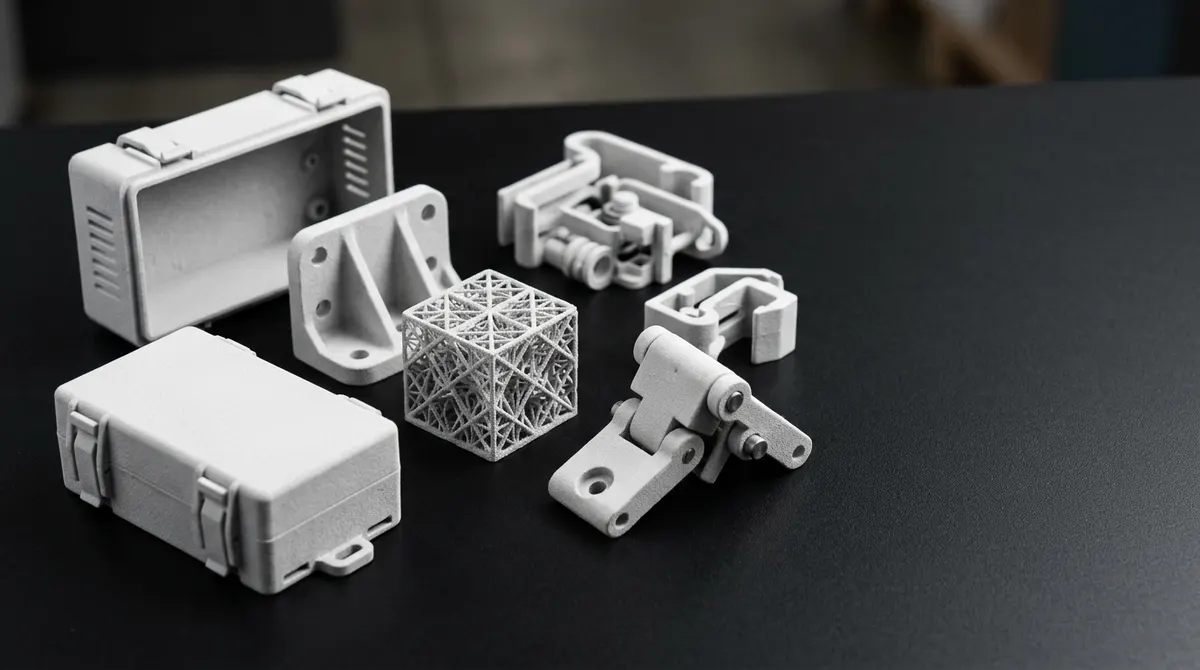
MJF usually fits:
Smooth, production-oriented nylon work
- Dense builds of housings, clips, brackets, and production fixtures
- Programs where PA12 or PA11 is already acceptable and surface cleanup time matters
- Small text, fine lattices, and edge definition that benefits from HP's detailing-agent approach
SLS usually fits:
Broader material and supplier choice
- Programs that need a wider powder menu or more supplier optionality across regions
- Parts that will be tumbled, dyed, or polished anyway, so raw finish is not the main selection variable
- Jobs where platform range matters more than staying inside one OEM ecosystem
One practical consequence: nominal PA12 strength is very close on paper, but not in exactly the same way. HP cites about 7.0 ksi (48 MPa) tensile strength for MJF PA12 in XYZ testing, while EOS lists about 7.0 ksi (48 MPa) in X/Y and about 6.1 ksi (42 MPa) in Z for PA 2200 SLS nylon. In practice, that means material grade, wall design, load direction, fit requirements, post-processing, and supplier control usually matter more than arguing over one headline tensile value alone. If you want the full AM landscape first, the types of 3D printing comparison is the broader hub-and-spoke entry point.
How MJF and SLS build the same class of part in different ways
A process comparison starts with the machine physics. Both technologies spread thin powder layers and rely on the surrounding unfused powder as natural support. The difference is the heat-delivery pattern: SLS writes the layer with a laser path, while MJF defines the layer chemically first and then fuses it thermally.
Laser scans the powder
- 1
Spread a fresh nylon powder layer across the bed.
- 2
A laser scans the selected regions and sinters the geometry point by point.
- 3
Drop the bed, recoat, and repeat until the part is complete.
- 4
Cool the powder cake, depowder, then blast, tumble, or polish if needed.
Agents define the layer first
- 1
Spread a fresh powder layer across the bed.
- 2
Jet fusing and detailing agents onto the exact regions that should become the part.
- 3
Apply infrared energy so the treated regions fuse as the whole layer is processed.
- 4
Cool, depowder, and blast or tumble depending on the required finish.
MJF vs SLS comparison table for functional nylon parts
Use this table to separate true process differences from marketing noise. The categories below matter because each one changes cost, printability, finish, or supplier risk. If a row does not affect your part, do not over-weight it.
| Decision area | SLS | MJF | Why it matters |
|---|---|---|---|
| How the layer is fused | A laser scans and sinters each selected region point by point. | The machine jets fusing and detailing agents across the full layer, then IR energy fuses the slice. | MJF usually benefits dense nests because more of the layer is processed at once; SLS build time depends more on scan path and packed area. |
| Typical surface finish | Standard-finished nylon parts are usually rougher; additional polishing or tumbling can tighten the finish. | Standard-finished PA12 parts are usually smoother out of the machine. | Formlabs measured HP MJF PA12 as low as 106 µin. Ra (2.7 µm Ra) in its comparison, while SLS improved materially after extra finishing steps. |
| Fine detail and small features | Good functional detail, but small holes and text depend heavily on powder, laser tuning, orientation, and cleanup. | HP specifically positions the detailing agent around edges to sharpen feature boundaries. | Thin lattices, embossed text, and small cosmetic details usually lean MJF when the material is otherwise comparable. |
| Material ecosystem | Broader vendor ecosystem across PA12, PA11, glass-filled, carbon-filled, flame-retardant, aluminide, and TPU classes. | Production-focused HP stack centered on PA12, PA11, PP, and flexible materials. | If a very specific powder family matters more than throughput, SLS gives you more supplier optionality. |
| Nominal PA12 strength | EOS PA 2200 lists about 7.0 ksi (48 MPa) tensile strength in X/Y and about 6.1 ksi (42 MPa) in Z, with 0.239 Msi (1.65 GPa) modulus. | HP PA12 literature cites about 7.0 ksi (48 MPa) tensile strength in XYZ testing and about 0.247-0.261 Msi (1.70-1.80 GPa) modulus. | The headline PA12 numbers are close, but SLS orientation matters more. If your load path runs through Z, anisotropy can matter more than the nominal material label. |
| Machine and supplier range | Available from compact systems up through large-format industrial platforms across multiple OEMs. | Mostly production-oriented industrial platforms centered on the HP ecosystem. | If your part size, supplier location, or material qualification requires a wider machine base, SLS is easier to source. |
| Powder economics | Reuse economics vary by machine, material, refresh rate, and supplier workflow. | HP promotes up to 100% surplus powder reuse on supported materials and pack densities. | That is one reason MJF often wins medium-volume PA12 production parts, especially when the build can be nested tightly. |
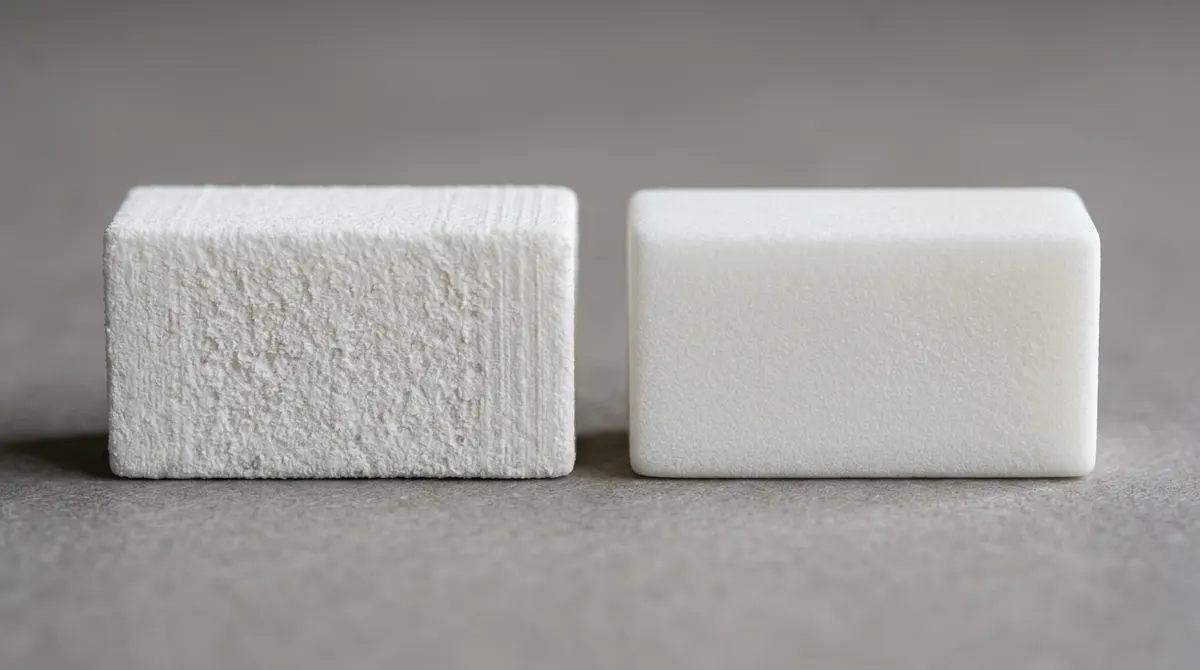
In Formlabs' published surface-finish comparison, the biggest surface-quality shift came from post-processing, not just the machine label. That is why you should compare quote packages as "printed + finished" systems, not as raw process names.
SLS and MJF overlap heavily on PA12 and PA11. The real difference is ecosystem depth: SLS gives you more powder families and more OEMs, while MJF gives you a tighter, more standardized production lane.
If both quotes are PA12, do not expect the process label alone to create a huge X/Y static-strength swing. Geometry, build orientation, packing, finish, and inspection discipline typically move the needle more than one nominal datasheet value.
The CAD details that change when you switch from SLS to MJF
A design rule is the geometry threshold where repeatability starts to fall off. These rules exist because heat flow, powder removal, and edge definition are all process-dependent. The numbers below are the right place to start a prototype, not a substitute for a fit coupon.
| Feature | SLS | MJF | Design consequence |
|---|---|---|---|
| Short-wall baseline | Vertical walls: 0.6 mm (0.024 in.); horizontal walls: 0.3 mm (0.012 in.) on Formlabs Fuse SLS guidance. | HP recommends 0.3 mm (0.012 in.) for short XY walls and 0.5 mm (0.020 in.) for short Z walls. | The process is not isotropic in geometry even if the polymer is similar. Dimension the orientation that matters, not just the nominal wall thickness. |
| Starting clearance for mating parts | Formlabs uses 0.2 mm (0.008 in.) below 20 mm^2 features and 0.4 mm (0.016 in.) above 20 mm^2. | HP suggests 0.4 mm (0.016 in.) total gap as a good starting point for connecting parts. | These are first-pass CAD rules, not guaranteed final fits. Print coupons before you lock snap fits, bushings, or sliding interfaces. |
| Printed-in-place assemblies | Integrated assemblies start around 0.3-0.6 mm (0.012-0.024 in.) depending on feature area. | HP uses 0.7 mm (0.028 in.) as the general minimum between moving faces. | Moving mechanisms need more room than static fits because trapped powder and fuse growth both work against free motion. |
| Small holes and hollow parts | Minimum recommended hole diameter is 1.0 mm (0.039 in.); enclosed cavities should use at least two 3.5 mm (0.138 in.) drain holes. | HP recommends drain holes for hollow parts and a 2.0 mm (0.079 in.) wall as a practical hollow-part baseline. | If your part traps powder, finishing and inspection get slower fast. Design for powder escape before you optimize for aesthetics. |
One lesson engineers learn the hard way: a quoted powder-bed tolerance does not guarantee a functional fit. Holes, snap arms, printed threads, and bearing seats all respond differently to powder removal and surface texture. If the part has a critical fit, print a coupon and pair it with the RFQ checklist so the supplier sees the actual inspection intent.
Why MJF often wins production lots and SLS often wins flexibility
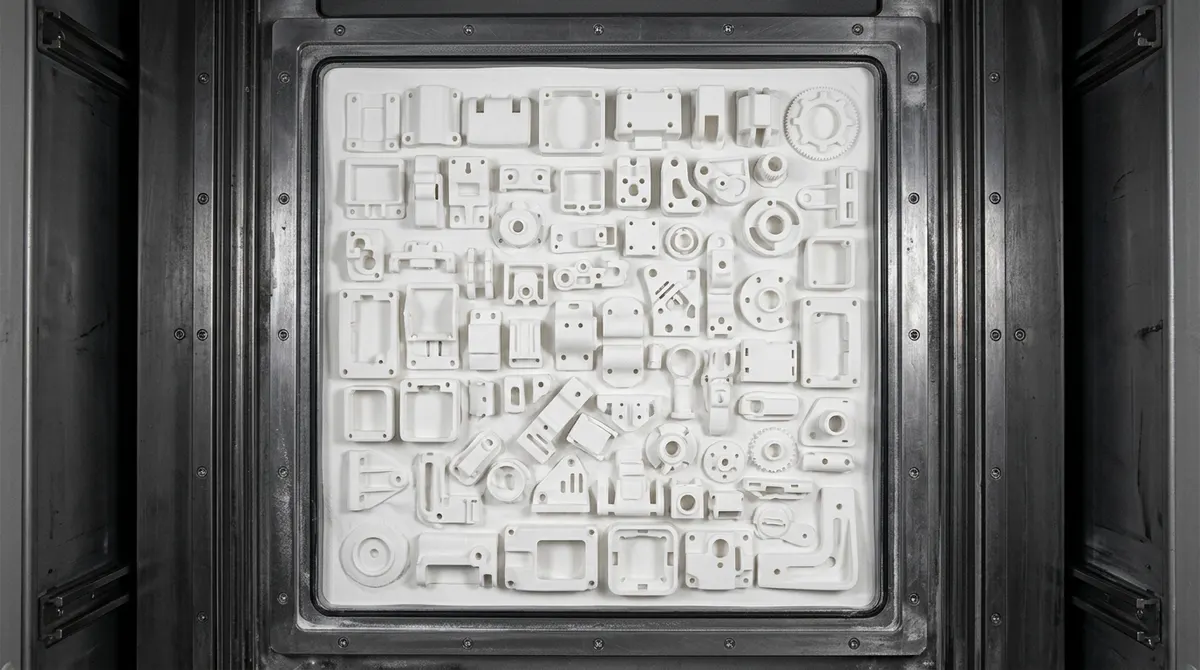
Process cost is machine-time plus powder strategy plus finishing labor. MJF tends to look strong when the build is packed densely and the material is a mainstream HP polymer. SLS tends to look strong when you need alternate machine formats, broader powder choice, or a service bureau that is already optimized around a specific SLS workflow.
HP promotes layer-wide fusion and up to 100% surplus powder reuse on supported materials. In practice, that usually helps dense PA12 or PA11 production builds more than sparse one-off geometry.
SLS has more OEMs, more service bureaus, and more machine formats. That flexibility can shorten sourcing time or make specialty materials feasible even when the per-part finish is not as strong as MJF out of the box.
Ask for the same quantity, finish, color, and inspection assumptions from both processes. Otherwise you are comparing two different quoting packages, not two manufacturing methods.
Worked example: compare cost per shipped part, not just the machine label
Your quoting baseline should be total cost per accepted part. Use this formula: total quote / accepted parts = quoted cost per shipped part. Example: if an MJF quote for 120 bead-blasted PA12 housings is $1,440 total, the cost is $12.00 per part. If a comparable SLS quote is $1,680 total because depowdering and post-finishing add $240 more labor, the cost is $14.00 per part. That is the kind of dense, mainstream-nylon job that usually leans MJF.
| In-house machine economics | Typical price band | What it usually implies |
|---|---|---|
| Benchtop industrial SLS | $30,000-$60,000 complete solution | Lower barrier to entry, smaller footprint, and good fit for teams bringing nylon powder-bed printing in-house for prototyping or lighter production. |
| Traditional industrial SLS | $200,000 and up | Broader materials and larger machine formats, but with more infrastructure, operator, and maintenance burden. |
| Production MJF | $350,000-$600,000 complete solution | High-capital, production-oriented equipment that makes the most sense when the build queue is stable and the part family stays inside MJF's strongest materials. |
Need help deciding MJF vs SLS before you release the RFQ?
Upload your CAD, quantity, finish, and fit requirements. MakerStage can quote both powder-bed processes, flag quote-stage manufacturability risks, and call out the geometry changes that affect wall thickness, trapped powder, or mating clearances before you waste a build.
Upload CAD for MJF vs SLS reviewThe practical MJF vs SLS recommendation
Choose the process that matches the real failure mode of the job. If the project fails when the surface is rough, the text is soft, or the cost per nested part is too high, MJF is usually the better answer. If the project fails because you need a specialty material, broader supplier coverage, or an unconventional machine format, SLS is usually the better answer.
Choose MJF
Use MJF when you want smoother standard-finished nylon parts, crisp small detail, and production-oriented PA12 or PA11 economics.
- Dense nests of housings, enclosures, clips, brackets, and jigs
- Cosmetic nylon parts that should need less secondary smoothing
- Programs where HP-style PA12 or PA11 is already acceptable
Choose SLS
Use SLS when material choice, supplier flexibility, or platform range matters more than squeezing the last bit of finish out of a standard PA12 build.
- Programs requiring specialty nylon blends, broader sourcing, or larger-format machine options
- Applications where tumbled or polished post-processing is already planned
- Teams that want more OEM and service-bureau options across regions
If you are turning this comparison into a real sourcing event, send the same CAD revision, finish callout, quantity break, and inspection notes to both processes. Then use the RFQ checklist or go straight to the quote form so you are comparing process capability, not paperwork differences.
Frequently Asked Questions
Related Resources
Ready to quote MJF or SLS nylon parts?
Send the CAD, quantity breaks, finish target, and any fit concerns. MakerStage can quote both powder-bed processes, flag quote-stage manufacturability risks, and show where geometry should change before you pay for the wrong build.
Get a Free MJF or SLS Quote