Copper Sheet Metal Fabrication
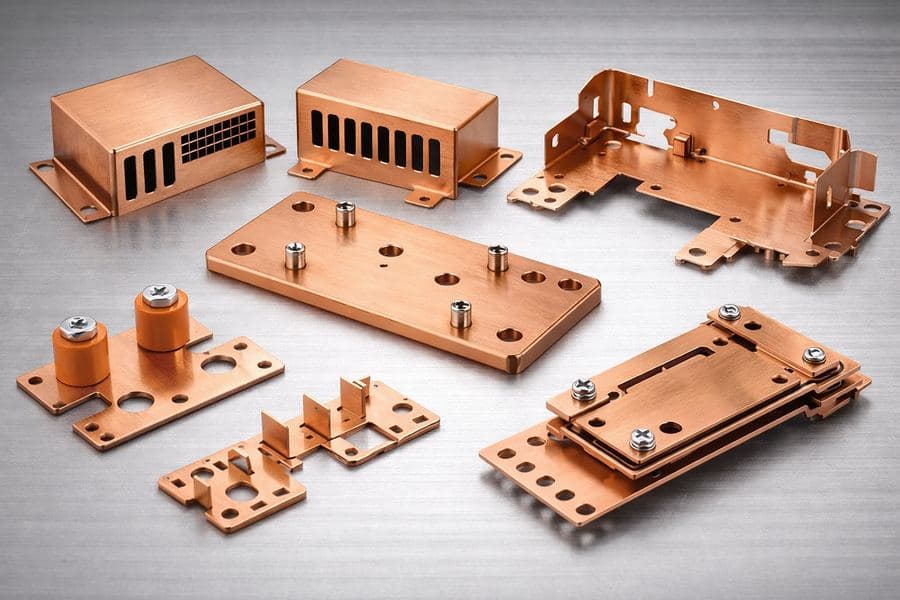
Copper sheet metal fabrication usually makes sense when your part still looks like a flat blank for most of its life in the shop: bus bars, RF shields, battery tabs, heat spreaders, terminals, and bent electrical covers. This guide walks through how to choose the alloy, temper, cut process, bend strategy, and finish without treating copper like generic sheet metal.
When Copper Sheet Metal Fabrication Makes Sense
A simple way to choose the process is to ask what really defines the part. If the part can be made by cutting a profile out of sheet, adding a few bends or joins, and then finishing the surface, copper sheet metal fabrication is usually the simpler route. If you are still deciding between grades, start with our copper alloys guide first. If you need thick cross-sections, milled pockets, or tightly located machined datums, the design is drifting toward CNC machining copper instead.
Best-fit geometries
Choose copper sheet metal fabrication when the part is still fundamentally a 2D blank after manufacturing: tabs, shields, covers, bus bars, terminals, and bent heat spreaders.
Main engineering risks
Copper is softer than stainless or carbon steel, scratches easily, work-hardens under repeated forming, and oxidizes fast enough that edge condition and finish selection matter.
What a good RFQ includes
Send alloy, temper, thickness, finish, and whether conductivity, flatness, solderability, or cosmetic appearance is the real priority. Those choices drive the process plan.
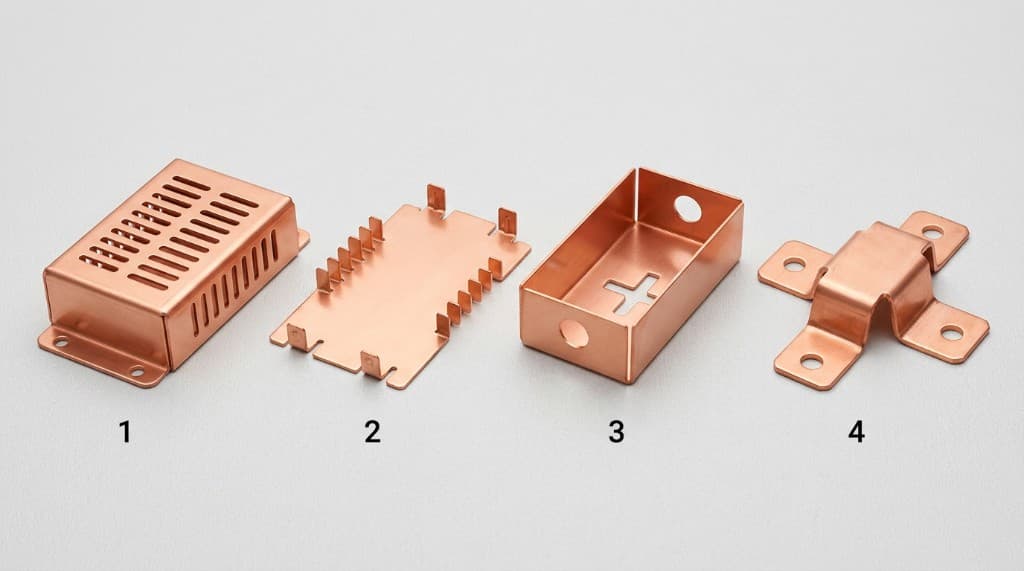
Vented Enclosure
Laser-cut ventilation slots, four-wall bends, and mounting tabs at the base. Typical for RF shields and electronics housings where airflow and EMI shielding both matter.
Heat Spreader Base
Flat stamped plate with bent locking tabs around the perimeter. Used as a thermal interface between a heat source and an enclosure or heat sink in semiconductor and power electronics.
Open Box with Cutouts
Simple four-wall box with a round hole and cross-shaped cutout for cable pass-through or connector access. Common in medical device housings and industrial control enclosures.
Mounting Bracket
Bridge-shaped bracket with four mounting holes stamped from a single blank. Carries current between two bus bars or secures a component to a chassis in robotics and automation assemblies.
A simple rule of thumb: if the geometry is mostly defined by the flat pattern and bend lines, start with sheet metal. If the geometry is mostly defined by pockets, milled surfaces, and tapped features, start with machining. For a broader primer on the process itself, see what sheet metal fabrication actually includes.
How Copper Sheet Parts Are Actually Made
Copper sheet metal fabrication looks similar to aluminum or stainless at the routing level, but the process window is tighter. Reflectivity changes cut behavior, softer surfaces mark more easily, and finish decisions are more functional because electrical performance can depend on them.
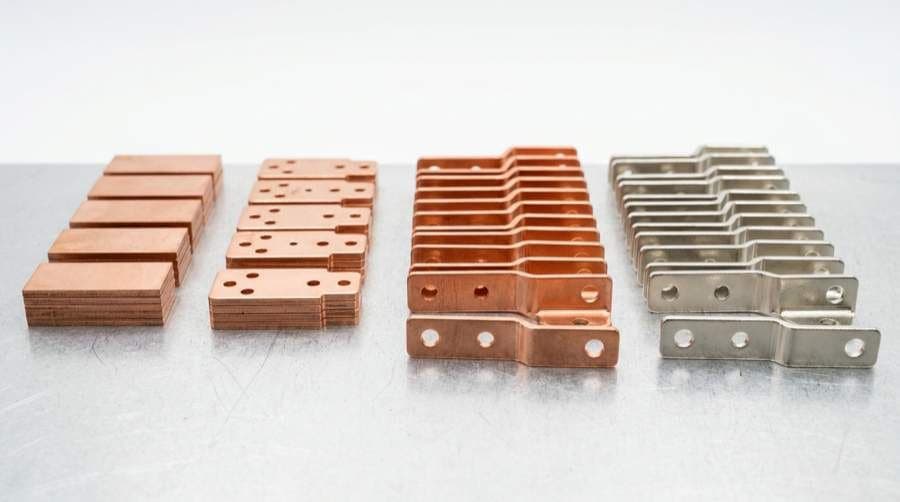
The photographed contact stack highlights the same process logic: sheet-derived copper features are defined by blanking, piercing, forming, and finish sequencing.
Cutting
Modern fiber lasers can cut copper sheet, but copper is more sensitive than steel because high reflectivity and thermal conductivity make pierce quality, edge oxidation, and heat balance harder to control.
Engineering note: Use nitrogen assist when a cleaner conductive edge matters. Use waterjet when you want zero heat tint or the edge will be brazed, plated, or inspected cosmetically.
Bending
Copper bends well in soft tempers, but springback, grain direction, and cracking become more important as you move into half-hard or harder tempers.
Engineering note: For tight bends, keep bend lines perpendicular to rolling direction and avoid redesigns that require rebending after the first form operation.
Joining
TIG welding, laser welding, brazing, and mechanical fastening are all possible, but copper pulls heat away from the joint so process stability is more sensitive than on mild steel.
Engineering note: Electrical parts often favor brazed or mechanically fastened joints because they preserve geometry and simplify downstream plating or assembly.
Finishing
Bare copper oxidizes quickly. That oxide can hurt appearance, solderability, and contact resistance depending on the application.
Engineering note: Tin is the default low-cost solderable finish, silver is used when contact resistance matters most, and nickel is a good barrier or wear layer. See our copper surface finish guide for callout details.
Finishes are not an afterthought on copper
On many aluminum sheet metal parts, finish is mostly about corrosion and appearance. On copper, finish often changes solderability, contact resistance, and oxidation rate. If that is new territory, go straight to our copper surface finishes guide before locking the drawing.
Copper Grades and Tempers That Matter
Most copper sheet metal programs do not fail because the wrong CAD model was sent. They fail because the drawing says “copper” but never says which copper, how hard it is, or what surface condition the part needs when it reaches final assembly.
For copper parts, surface condition is part of the engineering definition. The same formed geometry can behave very differently depending on temper, oxide state, and what finish happens after forming. Conductivity in the table below is shown as % IACS (International Annealed Copper Standard), the common baseline used to compare copper electrical conductivity.
| Material / Temper | Conductivity | Bend Radius | Best Fit | Notes |
|---|---|---|---|---|
| C110 (ETP), annealed or soft temper | 100% IACS | 0-0.5 x thickness typical starting point | Bent shields, tabs, covers, and formed electrical parts | The general-purpose choice for copper sheet metal fabrication. Best balance of conductivity, availability, and cost. |
| C110 (ETP), half-hard / harder tempers | 100% IACS | 1.0-2.0 x thickness or larger | Parts that need more stiffness and only limited forming | Use when springiness or flatness matters more than aggressive bend geometry. Tight radii become much less forgiving. |
| C101 (OFHC), soft temper | 101% IACS minimum | Similar to soft C110 | Vacuum, brazed, or very high-purity electrical assemblies | Choose C101 when oxygen-free copper is part of the design requirement, not as a default substitute for every C110 part. |
Default choice: C110
If the design is a standard bus bar, shield, terminal, or thermal spreader, C110 is usually the right first choice. For more detail on the material itself, see the Copper C110 material guide.
Upgrade to C101 only when the design justifies it
C101 is valuable for oxygen-free or specialty electrical environments, but it is not automatically the best commercial choice. Use it when purity, brazing behavior, or vacuum service actually matter. The background is in our Copper 101 guide.
Six DFM Rules for Copper Sheet Metal Fabrication
These are the decisions that prevent rework. None of them are glamorous, but every one of them changes whether the first build comes back usable or full of RFIs and cosmetic escapes.
Call out alloy, temper, and thickness explicitly
Write C110, C101, or the exact copper grade on the drawing, then add temper and thickness. "Copper sheet" is not specific enough to quote accurately.
Treat bend radius as a temper decision
Soft copper can take tighter bends; harder tempers need larger radii. If you skip temper, the shop cannot confidently choose tooling or predict cracking risk.
Orient bends with rolling direction in mind
For tighter bends, aim to place the bend line perpendicular to rolling direction, which is the direction the sheet was reduced at the mill. This reduces the chance of grain-direction cracking at the outer surface.
Protect cosmetic or plated surfaces early
Copper scratches and fingerprints show easily. If appearance or plating yield matters, specify masking or protective film at quoting time instead of after scrap appears.
Separate conductivity-critical edges from decorative ones
If a cut edge becomes a contact surface, say so. That may change the cut process, deburr spec, plating flow, or whether machining is added after fabrication.
Do not force sheet metal to solve thick 3D geometry
Once the design needs heavy sections, deep pockets, or precision tapped datums, copper billet machining or a hybrid fabricated-plus-machined route is usually cleaner.
Ready to quote a fabricated copper part?
If your drawing already defines alloy, temper, thickness, finish, and the conductivity-critical surfaces, the part is usually ready for a sheet metal fabrication quote. If not, use the RFQ checklist before sending it out.
Sheet Metal vs. CNC Machining for Copper Parts
The cleanest process decision is usually obvious once you define what the part is trying to optimize: geometry, conductivity, stiffness, flatness, or assembly cost.
Choose sheet metal when
- The part is mostly a flat profile with bends, tabs, holes, and simple joins.
- Material yield matters because the part is large and relatively thin.
- You need faster production of shields, tabs, plates, or formed current-carrying parts.
Choose CNC machining when
- The part needs thick sections, pockets, milled datums, or precision tapped features.
- Contact faces or sealing surfaces must be machined after forming would already be complete.
- Geometry is truly 3D, not a bent 2D blank.
Use a hybrid route when
- A fabricated blank gives you material efficiency, but one or two machined features control the assembly.
- You want formed stiffness with post-machined contact pads or datums.
- The part is electrically functional but still needs one critical precision interface.
If your team is debating that boundary, read our CNC machining copper guide next. It explains where fabricated copper hands off to billet machining and where a hybrid process usually saves the program.
Copper Sheet Metal Fabrication FAQ
Common engineering and sourcing questions about copper sheet parts.
Need a real manufacturability read on a copper part?
Send the CAD, target alloy, temper, thickness, finish, and which feature is electrically critical. That is enough to tell whether you want cutting + bending, cutting + plating, or a fabricated-plus-machined hybrid.
Include the surface finish up front if the part will be soldered, plated, or used as a contact surface. On copper, that is not optional context.