Copper 101 vs. C110 Which Do You Actually Need?
OFHC and ETP copper both deliver ~100% IACS conductivity. The difference that matters is oxygen content — and when it causes catastrophic hydrogen embrittlement.
The Conductivity Is Nearly Identical — The Failure Mode Is Not
C101 and C110 both deliver essentially 100% IACS conductivity. The 1% difference is not why you choose one over the other. The real decision is oxygen content and what happens to that oxygen when your part gets heated. This guide explains the failure mechanism, gives you the full property comparison, and provides a definitive decision tree so you never over-specify C101 where C110 is sufficient — or under-specify it where embrittlement is a genuine risk.
The Metallurgical Difference
Both alloys are refined from electrolytic copper cathode. The casting process — specifically how oxygen is handled — is what makes them fundamentally different materials.
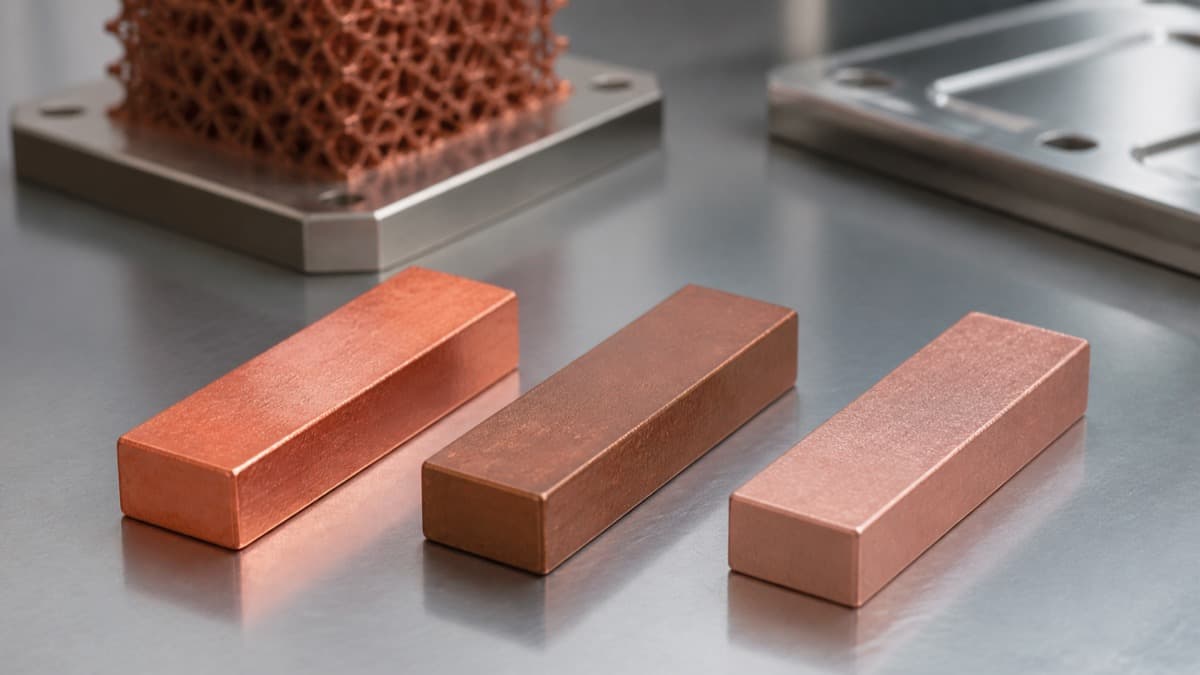
C10100 — OFHC (Oxygen-Free, High-Conductivity)
After electrolytic refining, the copper melt is cast in a vacuum or inert (nitrogen/argon) atmosphere to prevent oxygen pickup. The result is a microstructure with no Cu₂O inclusions — purity ≥99.99% Cu. The IACS conductivity reference was defined at 100% for copper at a specific purity; C101 exceeds this by ~1% because the absence of dissolved oxygen removes a small conductivity-depressing impurity. ASTM B170 defines OFHC cathode quality.
C11000 — ETP (Electrolytic Tough Pitch)
After electrolytic refining, the copper is cast in air or with controlled oxygen addition. A small oxygen content (0.02–0.04%) is deliberately retained as finely distributed Cu₂O inclusions throughout the grain structure. This “tough pitch” oxygen improves castability and grain refinement. The Cu₂O inclusions are finely dispersed (typically 1–10 µm) — they do not affect conductivity, mechanical properties, or machinability at room temperature. The problem arises only when the part is heated in a reducing (hydrogen) atmosphere.
Key Insight
At room temperature and without heat exposure, C101 and C110 are functionally identical for electrical applications. The oxygen in C110 is trapped as inert Cu₂O particles that do not affect conductivity, strength, or machinability. The distinction only matters when the part is heated in a hydrogen-containing atmosphere — a condition that triggers a specific reaction that destroys ductility.
Full Properties Comparison
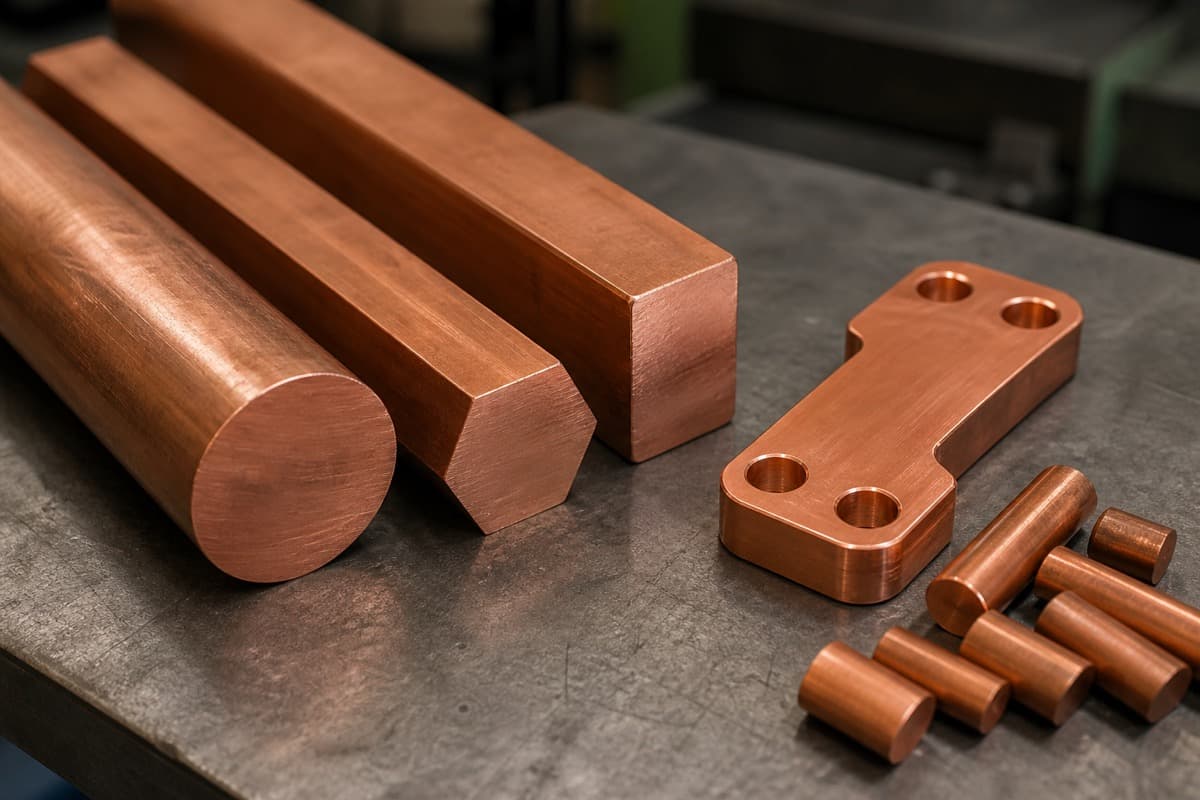
All values at 68°F (20°C) unless noted. Mechanical properties for half-hard (H02) rod/bar stock, which is the most common CNC machining condition.
| Property | C10100 (OFHC) | C11000 (ETP) | Practical Impact |
|---|---|---|---|
| Cu purity | ≥99.99% | ≥99.9% | Negligible for most applications |
| Oxygen content | <0.0005% | 0.02–0.04% (as Cu₂O) | Critical for heated parts in H₂ |
| Electrical conductivity | 101% IACS | 100% IACS | ~1% difference — not perceptible in practice |
| Thermal conductivity | 391 W/m·K | 388 W/m·K | Negligible difference |
| UTS (H02 half-hard) | 275 MPa (40 ksi) | 275 MPa (40 ksi) | Identical |
| Yield strength (H02) | 250 MPa (36 ksi) | 250 MPa (36 ksi) | Identical |
| Elongation (H02) | 14% | 14% | Identical before any heat exposure |
| Machinability | 20% (vs. C360 ref.) | 20% (vs. C360 ref.) | Identical — both challenging |
| Density | 8.89 g/cm³ | 8.89 g/cm³ | Identical |
| Hydrogen embrittlement | Immune | Risk at >700°F (>370°C) in H₂ | The decision-determining property |
| ASTM rod/bar spec | B187 | B187 | Same specification document |
| Relative raw material cost | ~15–25% premium | Baseline | C101 costs more — justify it |
Machine C101 or C110 at MakerStage
Both C101 (OFHC) and C110 (ETP) are available for CNC machining. Upload your drawing for an RFQ-stage review that can confirm material availability and flag geometry that may complicate machining pure copper.
Request a Copper CNC QuoteHydrogen Embrittlement in ETP Copper
The failure mechanism is specific and predictable. Understanding it tells you exactly when C110 is unsafe and C101 is required.
Hydrogen Diffusion
When ETP copper is heated above ~390°F (~200°C) in a hydrogen-containing atmosphere (hydrogen gas, hydrogen-bearing brazing flux, dissociated ammonia, cracked gas atmosphere), atomic hydrogen diffuses rapidly into the copper matrix. Copper has moderate hydrogen solubility at elevated temperature.
Reaction at Cu₂O Inclusions
Atomic hydrogen reacts with the Cu₂O inclusions distributed throughout the grain structure: Cu₂O + H₂ → 2Cu + H₂O. This reaction is thermodynamically favorable above ~700°F (~370°C) and produces water vapor in situ within the metal.
Internal Pressure Buildup
The water vapor cannot escape through the solid copper matrix. It accumulates at grain boundaries and around inclusion sites, building internal pressure. The vapor pressure at grain boundaries can exceed the local yield strength of the surrounding copper.
Microcracking and Ductility Loss
The internal pressure initiates intergranular microcracks. As the part cools and is mechanically loaded, these cracks propagate. Ductility (elongation) can drop from 14% to near zero — a part that appeared undamaged during brazing can fracture on the first flexural load. The failure is irreversible.
Processes That Create H₂ Risk
- Silver brazing with hydrogen-bearing flux
- Torch or induction brazing in reducing atmosphere
- Welding in hydrogen or mixed H₂/N₂ shielding gas
- Annealing in dissociated ammonia atmosphere
- Service at >700°F (>370°C) in hydrogen-rich environments
- Exothermic or endothermic atmosphere furnace processing
Processes That Are Safe with C110
- CNC machining at room temperature
- Electroplating (no thermal cycle)
- Room-temperature bending or forming
- Soldering (temperatures <480°F (<250°C), no hydrogen flux)
- Normal service environments at <390°F (<200°C)
- Crimping, pressing, or staking
Machinability — Both Are Challenging
C101 and C110 have the same machinability rating (20% relative to C360 free-cutting brass). Both require sharp tooling, positive rake, and flood coolant to achieve clean surfaces.
Built-Up Edge (BUE)
Pure copper is highly ductile and sticks to tool faces at the cutting temperature, forming a built-up edge that changes effective tool geometry and degrades surface finish. Solution: sharp, highly polished carbide or PCD inserts with positive rake (8–12°), high cutting speeds (200–350 sfm / 61–107 m/min), and flood coolant.
Long, Stringy Chips
Unlike free-cutting brass (C360), pure copper forms long, continuous chips that wrap around workholding and tooling. This is a chip-management problem, not a surface finish problem. Use chip-breaking insert geometry (if available for your nose radius), reduce depth of cut, or increase feed rate to promote chip curl and break-off.
Workholding Marking
Copper is soft (RF 40–50 in annealed condition; HRB ~40 in half-hard H02) and marks easily under chuck or collet pressure. Use brass-lined or soft-jaw workholding. Avoid steel serrated jaws directly on finish surfaces. For tight-tolerance OD features, consider final-pass spring cuts with reduced force.
| Parameter | C101 / C110 | C360 (Free-Cut Brass) | Ratio |
|---|---|---|---|
| Machinability rating | 20% | 100% (reference) | 5× advantage for C360 |
| Carbide turning speed | 200–350 sfm (61–107 m/min) | 500–800 sfm (152–244 m/min) | C360 runs ~2.5× faster |
| Chip form | Long, continuous | Short, discontinuous | C360 far easier to manage |
| Tool wear rate | High (BUE risk) | Low | C360 extends tool life |
| Typical tolerance (turned OD) | ±0.001 in | ±0.001 in | Same — with proper tooling |
| Surface finish achievable | Ra 32–63 µin (0.8–1.6 µm) | Ra 16–32 µin (0.4–0.8 µm) | C360 achieves finer finish more easily |
Application Decision Tree & Drawing Callouts
Answer three questions in order. If you reach a C101 recommendation and cannot justify the cost premium, revisit the process design — not the material.
Q1: Will this part ever be heated above 390°F (200°C) in a hydrogen-containing atmosphere during manufacturing or service?
Specify C101 (OFHC). The hydrogen embrittlement risk is real. C110 is not acceptable for this application.
Continue to Q2.
Q2: Is maximum electrical conductivity (>100% IACS) a verified requirement for your application?
C101 provides 101% IACS vs. C110's 100% IACS — a 1% advantage. In practice, this is rarely measurable in a system context. Verify the conductivity requirement is quantified before paying the C101 premium.
C110 at 100% IACS is sufficient for the vast majority of bus bars, terminals, and contacts. Continue to Q3.
Q3: Does your supply chain reliably stock C110, or is C101 more readily available in your required form?
Specify C110 (ETP). Widely stocked in flat bar, round rod, sheet. Lower cost, equivalent performance.
If C101 is equally available and priced comparably in your procurement region, C101 is an acceptable choice — but do not pay a premium solely for the alloy designation if the hydrogen risk is absent.
Drawing Callout Format
C10100 — OFHC Copper (when H₂ embrittlement risk exists)
Copper, UNS C10100, ASTM B187, Half-Hard (H02)
Note: OFHC copper required — ETP copper (UNS C11000) NOT acceptable.
The drawing note is critical. Without it, shops will substitute C110, which is stocked more widely and is less expensive. The note makes the engineering intent contractually binding.
C11000 — ETP Copper (standard bus bar and electrical contact)
Copper, UNS C11000, ASTM B187, Half-Hard (H02)Half-Hard (H02) is the standard stock temper for machined bus bar and terminal applications. Specify Annealed (O61) only if subsequent forming, crimping, or bending is required.
Related Guides in This Series
- Copper alloys for CNC machining — the complete hub guide
- CNC machining copper — design rules, tolerances, and DFM tips
- Surface finishes for copper parts — plating, coatings, and passivation
- Copper CNC machining capability
- RFQ checklist for copper parts
- DMLS copper 3D printing guide
- Copper C110 properties guide
- Copper 101 fundamentals guide
Frequently Asked Questions
Ready to Machine Your Copper Part?
Upload your CAD file for a copper CNC quote with RFQ-stage manufacturability feedback and material confirmation.
Request a Copper CNC Quote