Copper C110 Properties and Machining Guide
UNS C11000, 100% IACS, 99.9% Cu minimum. The workhorse commercial copper — correct for 95% of electrical applications and lowest cost among pure copper grades.
C110: The Default — Not the Compromise
Copper C110 (ETP) is the correct material for the vast majority of copper applications. It carries 100% IACS conductivity, the same thermal conductivity as C101, and costs less because it is produced in air rather than in vacuum. The single case where C110 should NOT be used is when the copper part will be heated above ~700°F (~370°C) in a hydrogen-containing atmosphere. This guide covers the full property set, the hydrogen embrittlement mechanism you need to understand before designing a brazed assembly, and the exact drawing callout to prevent shop-floor substitution.
Composition and Standards
| Element / Property | Specification | Notes |
|---|---|---|
| Copper (Cu) | ≥99.9% min | Lower purity floor than C101 — still very high purity |
| Oxygen (O) | 0.02–0.05% (200–500 ppm) | Present as Cu₂O inclusions at grain boundaries — the defining characteristic |
| Impurities (total) | ≤0.1% | Small trace amounts of As, Bi, Fe, Pb, Sb, Sn, S |
| UNS designation | C11000 | Unified Numbering System |
| European equivalent | EN CW004A (Cu-ETP) | DIN / EN designation |
| ASTM wire | ASTM B1 (soft-drawn), ASTM B2 (medium-drawn) | Most widely used copper wire standard |
| ASTM rod/bar | ASTM B187 | Rod, bar, and shapes |
| ASTM sheet/strip | ASTM B152 | Sheet, strip, plate, and rolled bar |
| ASTM tube | ASTM B75, ASTM B280 | Seamless copper tube (B75) and ACR tube (B280) |
| Common tempers | O61 (Annealed), H02 (Half-Hard), H04 (Hard) | H02 is standard for CNC bar stock |
Electrical, Thermal, and Mechanical Properties
| Property | Value | Condition / Notes |
|---|---|---|
| Electrical conductivity | 100% IACS minimum | At 68°F (20°C); slightly below C101 due to oxygen impurity |
| Electrical resistivity | 1.724 µΩ·cm | At 68°F (20°C) — the reference value for the IACS standard |
| Thermal conductivity | 385 W/m·K | At 68°F (20°C) — 6 W/m·K below C101 (not practically significant) |
| Density | 8.94 g/cm³ | — |
| Specific heat | 385 J/kg·K | At 68°F (20°C) |
| Coefficient of thermal expansion | 17.0 µm/m·°C | 68–212°F (20–100°C) |
| Melting point | 1,981°F (1,083°C) | — |
| UTS (Annealed O61) | 220 MPa (32 ksi) | Annealed condition |
| UTS (Half-Hard H02) | 290 MPa (42 ksi) | Standard bar stock |
| Yield strength (H02) | 250 MPa (36 ksi) | 0.5% extension under load |
| Elongation (H02) | 14% | In 2 in gauge length |
| Hardness (H02) | HRF 84 / HB 40 | — |
| Machinability | 20% | Vs. C36000 free-cutting brass = 100% |
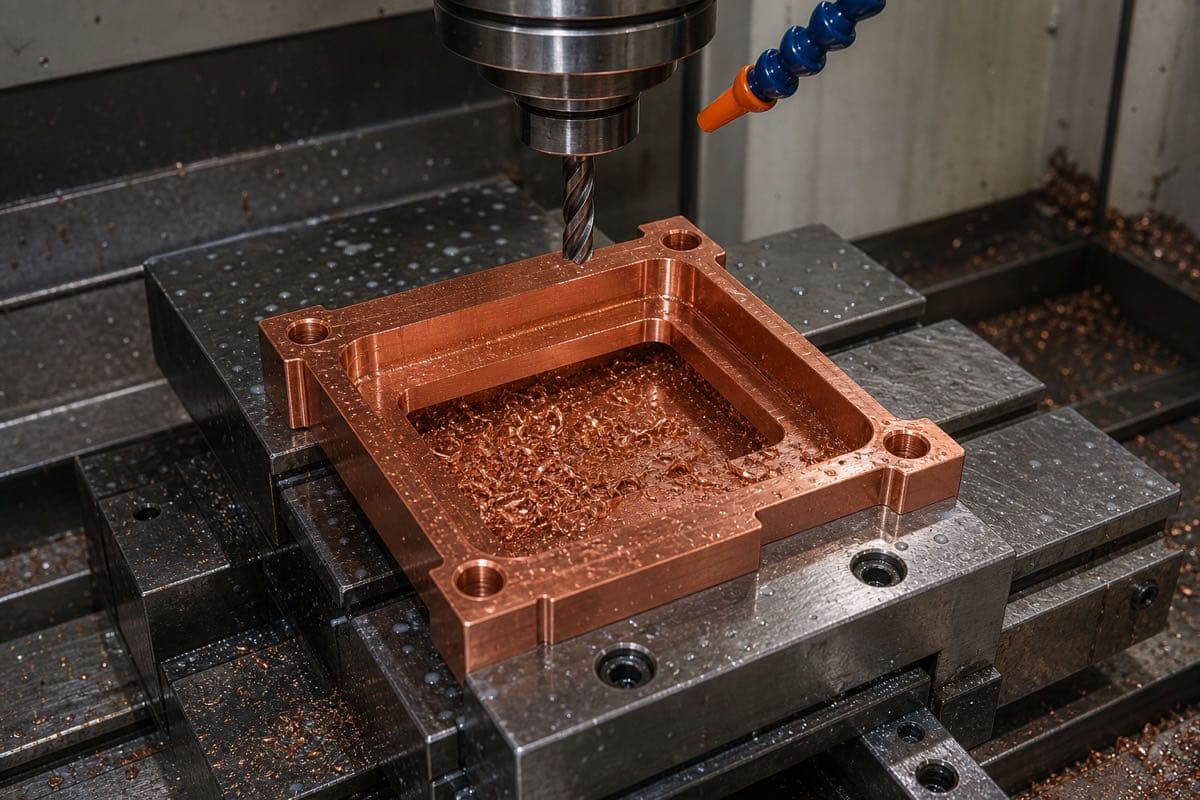
CNC Machine Copper C110 at MakerStage
MakerStage machines C110 (ETP copper) bus bars, terminals, contacts, and thermal parts. Upload your CAD for a quote-stage manufacturability review; material certification is available on request.
Request a C110 CNC QuoteHydrogen Embrittlement: The One Risk to Manage
Hydrogen embrittlement is the only significant limitation of C110 copper. Understanding the mechanism lets you design around it — or select C101 when you cannot.
Conditions That Cause Embrittlement
- ✗Silver brazing or torch brazing with a reducing flame (excess fuel) above 700°F (370°C)
- ✗Processing in hydrogen atmosphere furnaces (annealing, heat treat)
- ✗Welding with oxyacetylene in reducing mode
- ✗Repeated brazing cycles that extend exposure time above 700°F (370°C)
- ✗High-temperature service in mixed atmospheres containing H₂
Safe Conditions for C110
- ✓Brazing in air with a neutral flame — C110 is fine
- ✓All ambient-temperature electrical applications (bus bar, terminals, connectors)
- ✓Thermal management parts operating below 570°F (300°C) in air or inert gas
- ✓CNC machining, forming, stamping, rolling — no H₂ involvement
- ✓Plating processes (EN, silver, tin) — all operate in water-based chemistry
The Reaction Mechanism
Cu₂O (present in C110) + H₂ → 2Cu + H₂O (steam). The steam has no escape path, builds pressure at grain boundaries above the copper yield strength, and causes intergranular cracking. This produces a characteristic brittle fracture appearance — no necking, no ductility, catastrophic failure. If you see a copper brazed joint that cracked catastrophically after brazing, hydrogen embrittlement in ETP copper is the first diagnosis to rule out.
Machinability and CNC Parameters
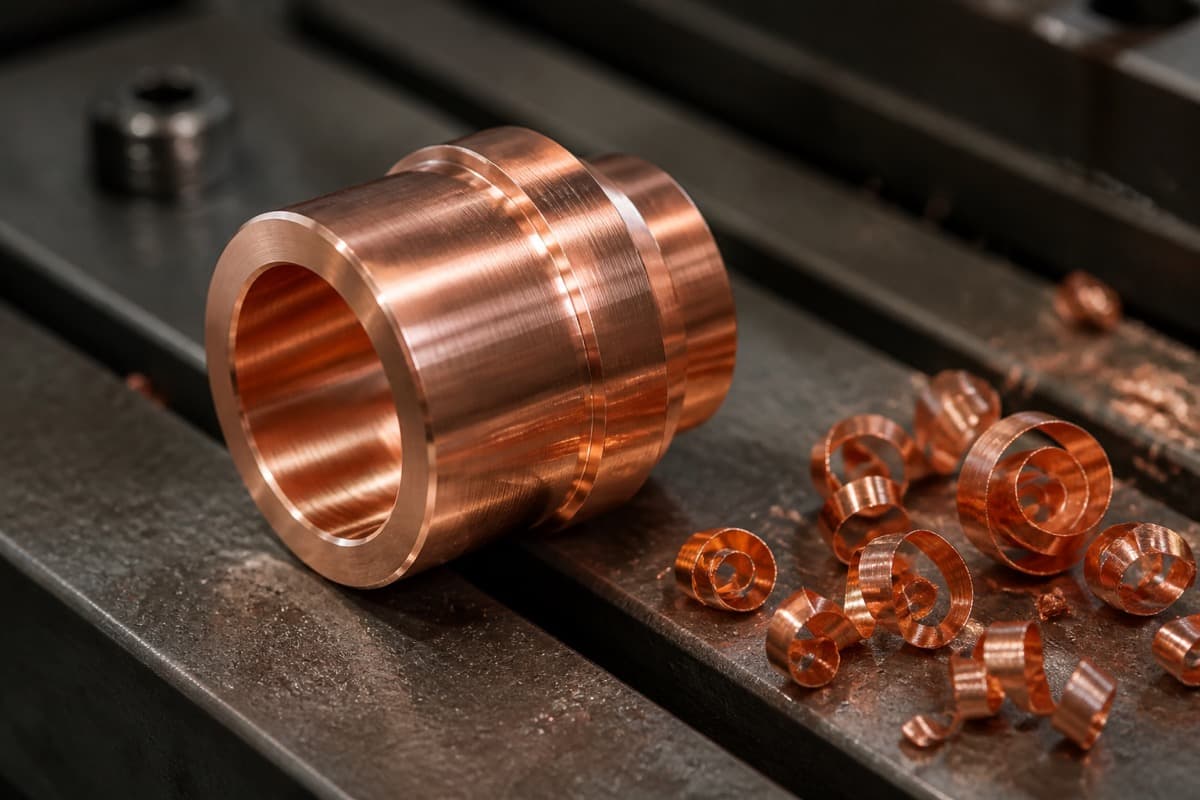
Turning Parameters
Milling Parameters
Drawing Callout Format
Rod/Bar (Standard CNC Parts)
Copper, UNS C11000, ASTM B187
Temper: Half-Hard (H02)
C11000 is the default for electrical terminals, bus bars, and connectors. No special notes required unless you need to explicitly allow substitution.
Electrical Wire
Copper, UNS C11000, ASTM B1
(Soft-Drawn)
or ASTM B2 (Medium-Drawn)
Most commercial copper wire is C11000 by default. Reference the relevant wire spec directly — ASTM B1 for soft-drawn, ASTM B2 for medium-drawn. Specify gauge (AWG) in the notes.
Sheet/Strip
Copper, UNS C11000, ASTM B152
Temper: O61 (Annealed)
or H02 (Half-Hard)
Annealed for forming operations; H02 for parts that require spring-back or greater stiffness. Specify as-machined or as-rolled requirements.
Tube (ACR / Refrigeration)
Copper, UNS C11000, ASTM B280
(ACR tube, seamless)
ASTM B280 is the air conditioning and refrigeration tube spec. ASTM B75 covers seamless copper tube in general industrial sizes. C110 is the standard alloy for both.
Related Guides
- Copper 101 vs. C110 — when OFHC is required vs. ETP
- Copper alloys overview — full alloy selection guide
- Surface finishes for copper: nickel, silver, tin, OSP
- C110 copper sheet metal fabrication — when ETP copper is the right formed-sheet grade
- Copper CNC machining capability
- RFQ checklist for copper parts
- Copper bus bar and electrical contact design
Frequently Asked Questions
Ready to Machine Your Copper C110 Part?
ETP copper bus bars, terminals, and contacts machined with RFQ-stage manufacturability feedback. Upload your drawing for a copper CNC quote.
Request a Copper CNC Quote