Aluminum vs Stainless Steel: When to Use Each in CNC Machined Parts
Choose aluminum when you need lightweight parts, fast machining, and lower cost. Choose stainless steel when corrosion resistance, high-temperature strength, or biocompatibility drives the design. This guide compares 6061, 7075, 303, 304, 316L, and 17-4 PH across every property that affects your CNC part decision.
Aluminum vs Stainless Steel: Quick Comparison
This is the one table you need to decide between aluminum and stainless steel for any CNC part — bookmark it. Aluminum alloys (6061-T6, 7075-T6) are compared against the four most common CNC stainless grades (303, 304, 316L, 17-4 PH).
| Property | Aluminum (6061-T6 / 7075-T6) | Stainless Steel (304 / 316L / 17-4 PH) |
|---|---|---|
| Density | 0.097–0.101 lb/in.³ (2.70–2.81 g/cm³) | 0.276–0.290 lb/in.³ (7.65–8.00 g/cm³) |
| Yield Strength | 40 ksi / 73 ksi (276 / 503 MPa) | 30–170 ksi (205–1,170 MPa) |
| UTS | 45 ksi / 83 ksi (310 / 572 MPa) | 75–190 ksi (515–1,310 MPa) |
| Elastic Modulus | 10.0–10.4 Msi (68.9–71.7 GPa) | 28.0–29.0 Msi (193–200 GPa) |
| Specific Strength (UTS/ρ) | ~200 kN·m/kg (7075-T6) | ~65 kN·m/kg (304) |
| Thermal Conductivity | 96–130 BTU/hr·ft·°F (130–167 W/m·K) | 9.4–10.6 BTU/hr·ft·°F (16.2–18.3 W/m·K) |
| Max Service Temp | 300 °F (150 °C) continuous | 800–1,100 °F (425–595 °C) |
| Corrosion Resistance | Good with anodize or chromate | Excellent — inherent Cr₂O₃ passive film |
| Machinability Rating | Excellent — 2–4× faster than stainless | Moderate (303) to challenging (316L) |
| Raw Material Cost | $3–5/lb ($7–11/kg) bar stock, 2026 | $4–8/lb ($9–18/kg) bar stock, 2026 |
| Typical CNC Tolerance | ±0.005 in. (±0.13 mm) standard | ±0.005 in. (±0.13 mm) standard |
Values for 6061-T6 and 304 stainless per ASM Handbook Vol. 2 and Vol. 1. 17-4 PH values are for Condition H900 per AMS 5643.
Mechanical Properties Compared
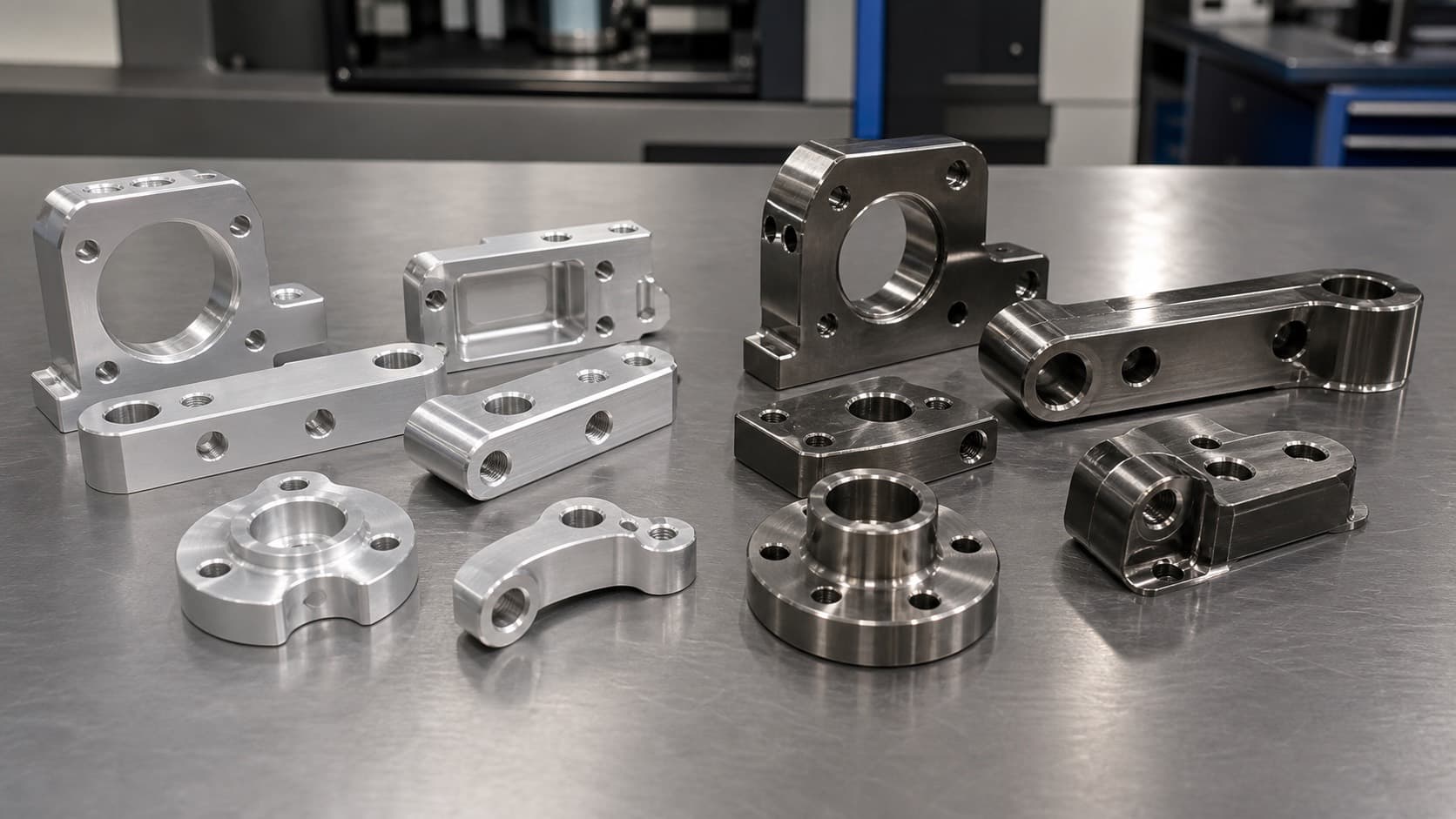
The right metric depends on your loading case — and picking the wrong metric is how engineers over-specify stainless where aluminum works, or under-specify where it does not. Absolute strength matters for static loads in constrained envelopes. Strength-to-weight (specific strength) matters for anything that moves — robot arms, pick-and-place tooling, portable instruments.
When Aluminum Wins
- Strength-to-weight ratio: 7075-T6 delivers 83 ksi (572 MPa) tensile strength at just 0.101 lb/in.³ (2.81 g/cm³) — roughly 3× the specific tensile strength of 304 stainless.
- Low inertia applications: Robot end-effectors, UAV brackets, and reciprocating mechanisms benefit from aluminum's 65% lower density, which reduces motor sizing and energy consumption.
- Vibration damping: Aluminum's lower elastic modulus (10.0 Msi (69 GPa) vs. 28.0 Msi (193 GPa)) means higher deflection per unit load, which can be advantageous in vibration-isolation fixtures when combined with appropriate damping treatments.
When Stainless Steel Wins
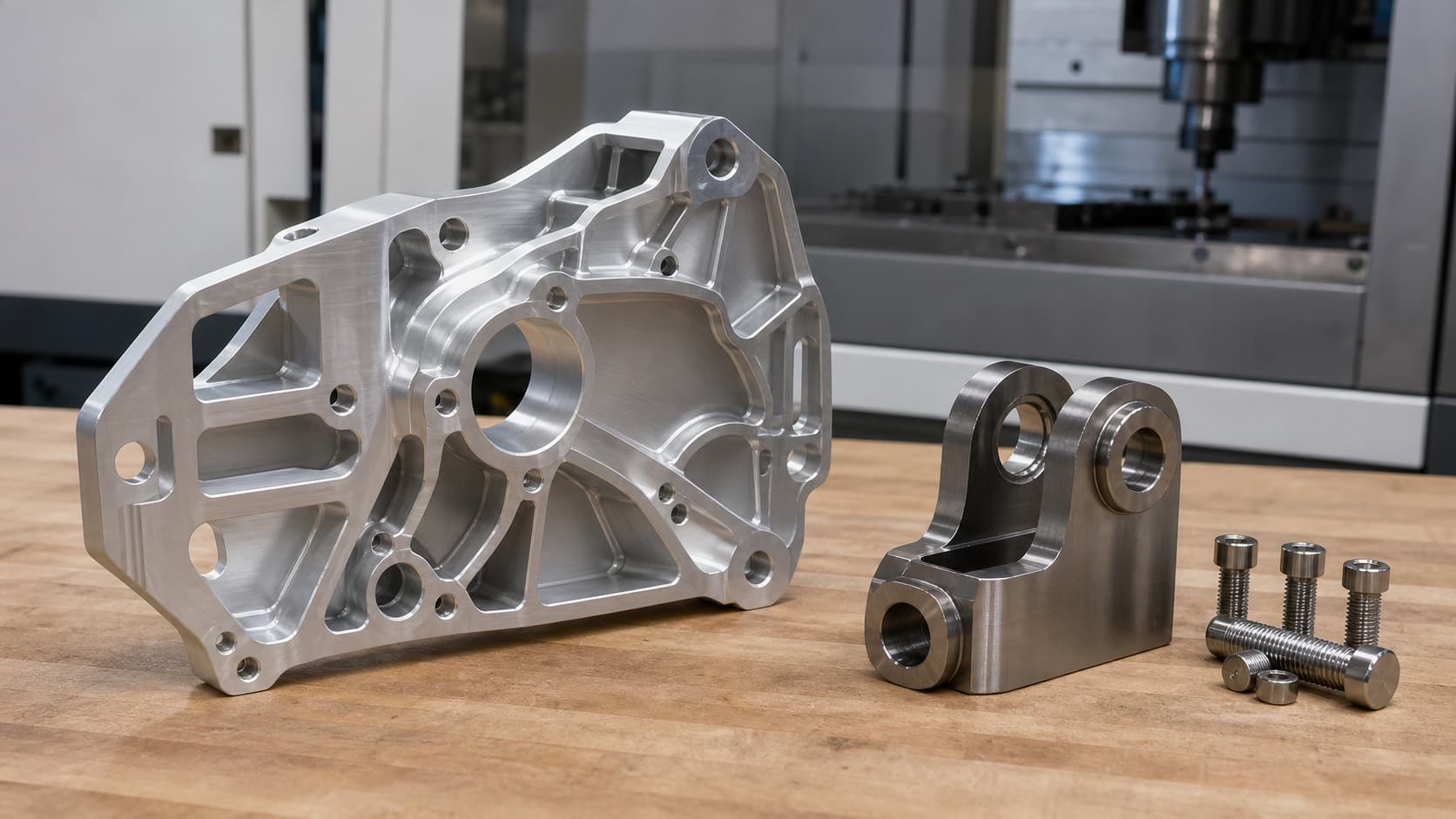
- Absolute strength: 17-4 PH Condition H900 reaches 170 ksi (1,170 MPa) yield — more than double 7075-T6 — making it suitable for high-load shafts, pins, and structural fasteners.
- Stiffness-critical designs: At 28.0 Msi (193 GPa), stainless deflects 2.8× less than aluminum under the same load, which matters for precision mounting plates and optical benches.
- Wear resistance: Stainless steels — particularly 17-4 PH at Rockwell C 40–44 — outlast aluminum in sliding contact, reducing replacement frequency on guide rails and bushing interfaces.
Engineer's Tip: Think Specific Properties
When comparing materials for weight-sensitive designs, divide the property by density. 7075-T6 aluminum has a specific stiffness (E/ρ) of roughly 25.7 GPa·cm³/g, while 304 stainless comes in at 24.1 GPa·cm³/g — nearly identical. The real aluminum advantage is in specific strength, not specific stiffness.
CNC Machining Cost: Aluminum vs Stainless Steel
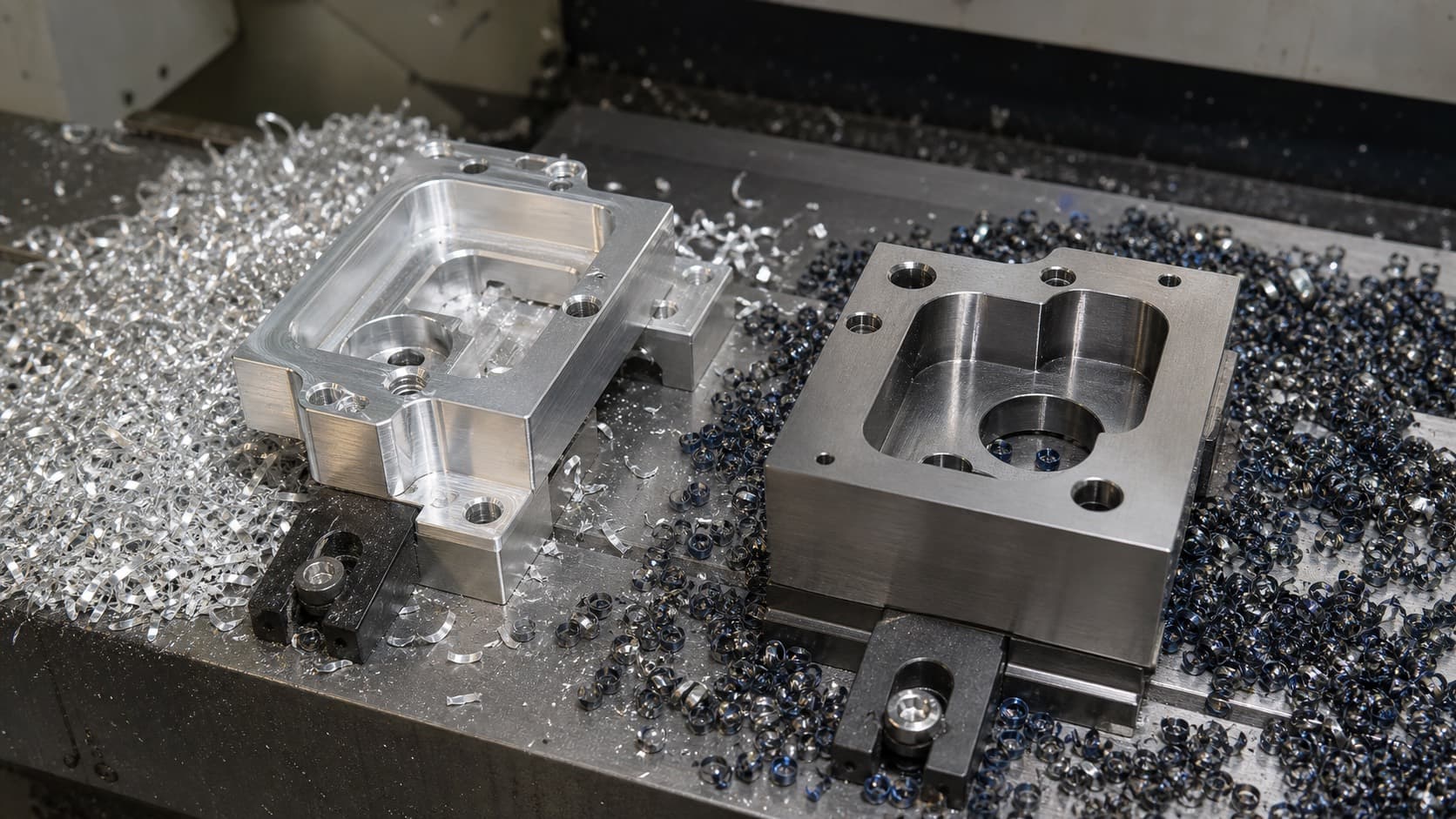
Your total CNC part cost is 70–80% machining time and only 20–30% raw material — and aluminum machines 3–5× faster than stainless steel, making it dramatically cheaper per part. This is where aluminum pulls ahead decisively.
| Cost Factor | Aluminum | Stainless Steel | Impact |
|---|---|---|---|
| Typical Cutting Speed | 800–2,000 SFM (244–610 m/min) | 200–400 SFM (61–122 m/min), austenitic | 2–4× cycle time advantage for aluminum |
| Tool Life | 500–2,000 parts/insert (carbide) | 50–200 parts/insert (coated carbide) | Stainless needs 3–10× more insert changes |
| Coolant / Lubrication | Flood or MQL | High-pressure flood required | Higher consumable cost for stainless |
| Deburring | Light — clean chip break | Moderate to heavy — stringy chips on 304/316L | Extra manual labor on stainless parts |
| Work Hardening | Minimal | Significant on 304 and 316L austenitic grades | Dwell or light passes ruin stainless surfaces |
| Total Part Cost (typical) | Baseline | 1.5–2.5× aluminum cost | Driven primarily by cycle time and tool wear |
303 Stainless: The Free-Machining Exception
303 stainless contains 0.15% min. sulfur, creating MnS inclusions that act as chip breakers. It machines at roughly 1.5× the speed of 304, with significantly less work hardening. Use 303 when machinability matters more than weldability or maximum corrosion resistance.
6061-T6 vs 7075-T6: Machining Difference
Both machine well, but 6061-T6 produces longer chips and builds up on the cutting edge more than 7075-T6. For high- volume production, 7075 often yields cleaner finishes as- machined. For anodizing compatibility, 6061 produces a more uniform Type II anodize layer.
Cost Rule of Thumb
For a moderately complex 3-axis milled bracket (4 in. (102 mm) × 3 in. (76 mm) × 1 in. (25 mm)), expect $25–50 per unit in 6061-T6 aluminum vs. $50–120 in 304 stainless at quantities of 50–100 parts. The gap narrows at high volume as fixturing costs amortize, but aluminum remains 40–60% cheaper on average.
Corrosion Performance: Passive Film vs Surface Treatment
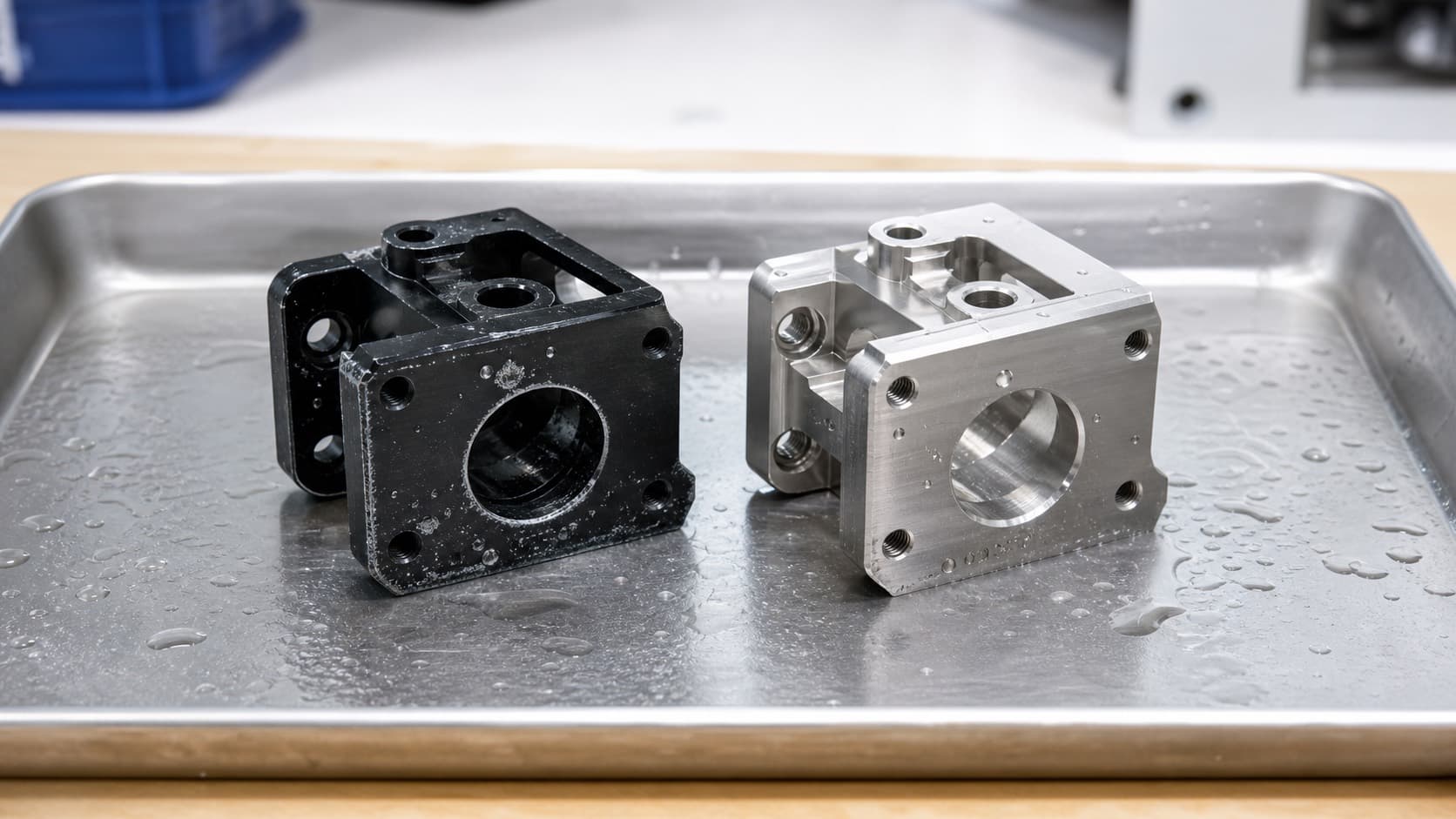
Both materials resist corrosion through passive oxide layers — but the mechanisms are different, and understanding why determines whether your part survives its environment. Stainless steel gets its corrosion resistance from a self-healing chromium oxide (Cr₂O₃) passive layer. Aluminum forms a thin natural Al₂O₃ oxide but depends on anodizing or coatings for aggressive environments.
Aluminum Corrosion Behavior
- Atmospheric: Bare 6061-T6 performs well in dry or indoor environments. Light pitting may occur outdoors within 2–5 years without surface treatment.
- Anodized (Type II): 0.0002–0.001 in. (0.005–0.025 mm / 5–25 µm) oxide layer provides reliable protection in most industrial and consumer environments — typical for robot chassis and instrument housings.
- Hard-coat (Type III): 0.001–0.003 in. (0.025–0.075 mm / 25–75 µm) — adds wear resistance (Rockwell C 60–70 equivalent hardness) on top of corrosion protection.
- Galvanic risk: Aluminum is anodic to most metals. Direct contact with stainless steel or copper in wet conditions causes accelerated galvanic corrosion of the aluminum. Isolate with nylon washers or chromate conversion.
Stainless Steel Corrosion Behavior
- Passive film: The Cr₂O₃ layer self-heals in oxidizing environments. Requires ≥10.5% Cr content — all 300-series and 17-4 PH exceed this.
- 304 stainless: Handles most atmospheric and mildly chemical environments. Susceptible to pitting in chloride-rich conditions above ~200 ppm Cl⁻ at elevated temperature.
- 316L stainless: 2–3% molybdenum raises pitting resistance (PREN ~25 vs. ~19 for 304). Required for marine, coastal, medical sterilization, and chemical processing environments.
- Passivation: Post-machining passivation per ASTM A967 / AMS 2700 removes free iron and restores the full passive layer — standard practice for any CNC-machined stainless part.
Thermal and Electrical Properties
If your part manages heat or conducts electricity, this section alone determines your material — aluminum outperforms stainless steel by an order of magnitude in both thermal and electrical conductivity. Aluminum conducts heat 10× faster and electricity roughly 17× faster than austenitic stainless steel.
Heat Dissipation
6061-T6 aluminum: 96 BTU/hr·ft·°F (167 W/m·K). 304 stainless: 9.4 BTU/hr·ft·°F (16.2 W/m·K). For heat sinks, cold plates, and motor housings, aluminum is typically the only practical choice without going to copper.
Electrical Conductivity
6061-T6: 43% IACS. 304 stainless: 2.5% IACS. Aluminum is used for bus bars, grounding straps, and EMI shielding enclosures. Stainless is functionally non-conductive for most electrical design purposes.
High-Temperature Service
Aluminum loses significant strength above 300 °F (150 °C) — 6061-T6 yield drops to roughly 75% at 400 °F (205 °C). 304 stainless retains useful strength to 800 °F (425 °C) and 17-4 PH to 600 °F (315 °C) before aging effects reduce hardness.
Common Alloy Grades for CNC Machined Parts
Writing "aluminum" or "stainless steel" on your drawing without a grade is a guaranteed substitution risk — specify the exact alloy and condition. Here are the six grades that cover 90%+ of CNC machined parts.
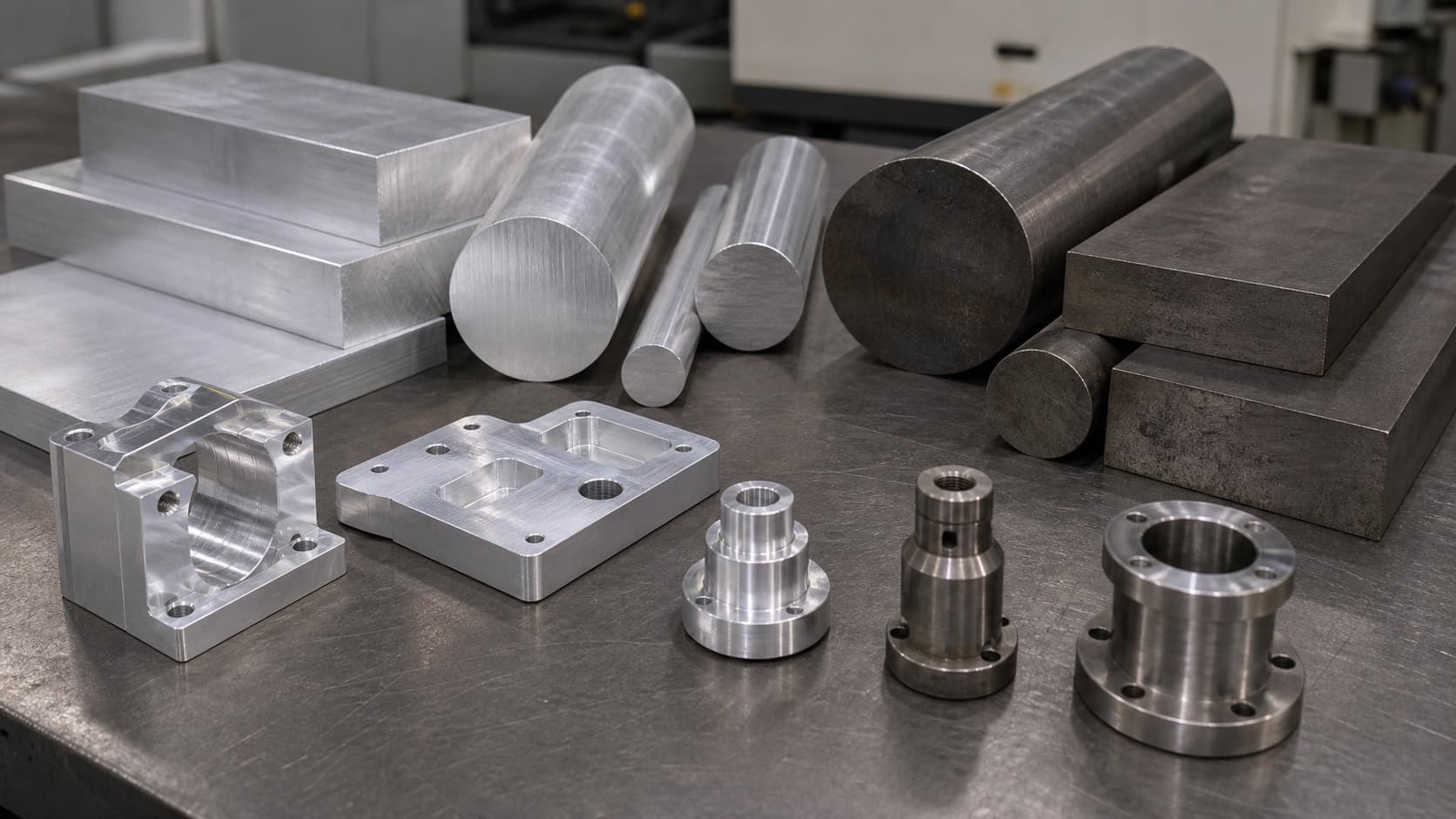
Aluminum Alloys
The default CNC aluminum. Good all-around mechanical properties (40 ksi (276 MPa) yield, 45 ksi (310 MPa) UTS), excellent anodizing response, and good weldability. Used in 60–70% of aluminum CNC orders.
Typical applications: Structural brackets, instrument housings, robot chassis plates, heatsink bodies, fixture plates.
High-strength aluminum (73 ksi (503 MPa) yield, 83 ksi (572 MPa) UTS). Approaches mild steel strength at one-third the weight. Limited weldability and less uniform anodize compared to 6061-T6.
Typical applications: Gearbox housings, high-load robot links, load-bearing structural components, precision tooling.
Stainless Steel Alloys
Sulfur-added (0.15% min.) for machinability — the "free-machining" stainless. 35 ksi (241 MPa) yield. Not weldable. Slightly lower corrosion resistance than 304 due to sulfide inclusions.
Typical applications: Fittings, shafts, valve components, fasteners, high-volume turned parts.
The workhorse stainless — 18% Cr, 8% Ni. 30 ksi (205 MPa) yield in annealed condition. Excellent general corrosion resistance, fully weldable. Work hardens significantly during machining.
Typical applications: Food-contact surfaces, general-purpose enclosures, brackets, medical device housings.
Adds 2–3% molybdenum for chloride resistance. "L" designates low carbon (≤0.03% C) for resistance to intergranular corrosion after welding. 25 ksi (170 MPa) yield. Harder to machine than 304.
Typical applications: Surgical instruments, marine hardware, chemical processing, implant-grade components.
Heat-treatable to very high strength: H900 condition reaches 170 ksi (1,170 MPa) yield at Rockwell C 40–44. Machines well in Condition A (annealed), then heat-treated to final hardness. Good corrosion resistance — comparable to 304 in most environments.
Typical applications: High-load shafts and pins, gears, surgical instruments, valve stems, springs.
Not Sure Which Material to Specify?
Upload your CAD files and MakerStage can review your design for material selection, tolerancing, and manufacturability during quote review. We machine both aluminum and stainless steel across 3-axis and 5-axis CNC platforms with standard tolerances of ±0.005 in. (±0.13 mm).
Compare Material Quote PathsWhen to Use Aluminum vs Stainless Steel
Walk through these five questions in order — your first "yes" determines the material family, and you can stop there. Then narrow to the specific alloy grade using the previous section.
Does the part operate above 300 °F (150 °C) continuously?
→ Stainless steel
Aluminum alloys lose significant yield strength above 300 °F (150 °C). Use 304 or 316L for temperatures up to 800 °F (425 °C), or 17-4 PH up to 600 °F (315 °C).
Is the part exposed to salt spray, chlorides, acids, or bodily fluids?
→ Stainless steel (316L or 17-4 PH)
Aluminum's passive layer breaks down in chloride and low-pH environments. Even anodized aluminum will fail in sustained salt spray. 316L provides the highest pitting resistance (PREN ~25).
Does the design require autoclave sterilization or FDA/ISO 10993 biocompatibility?
→ Stainless steel (316L)
Autoclave cycles at 270 °F (132 °C) and 30 psi (2.1 bar) exceed aluminum's safe operating range. 316L is the established material for ISO 10993 biocompatibility in medical device applications.
Is weight a primary constraint (strength-to-weight, inertia, portability)?
→ Aluminum (7075-T6 or 6061-T6)
Aluminum is 65% lighter. For robot arms, portable instruments, and anything with a motor-inertia budget, the weight savings typically dominate the design trade-off.
Is total part cost the primary driver, with no special environment or temperature needs?
→ Aluminum (6061-T6)
If none of the above conditions apply, 6061-T6 aluminum delivers the lowest total part cost — typically 40–60% cheaper than stainless for equivalent geometry — with typical lead times of 5–7 business days for prototype quantities.
| Application | Recommended Material | Why |
|---|---|---|
| Robot structural link | 7075-T6 aluminum | High specific strength, low inertia |
| Instrument enclosure (indoor) | 6061-T6 aluminum | Low cost, anodizes well, EMI shielding |
| Heat sink | 6061-T6 aluminum | 10× thermal conductivity vs. stainless |
| Surgical instrument | 316L stainless | Biocompatible, autoclavable, corrosion-resistant |
| Food-contact manifold | 304 stainless | FDA-compliant, easy to clean, corrosion-resistant |
| High-load shaft or pin | 17-4 PH stainless | 170 ksi (1,170 MPa) yield (H900), wear-resistant |
| High-volume turned fitting | 303 stainless | Free-machining, lowest stainless cycle time |
| Marine / coastal enclosure | 316L stainless | Chloride pitting resistance (PREN ~25) |
Frequently Asked Questions
Related Resources
Ready to Machine Your Aluminum or Stainless Steel Parts?
Upload your CAD files and get a quote for CNC machined parts in 6061-T6, 7075-T6, 303, 304, 316L, or 17-4 PH stainless steel. Quote review can help you compare material fit, machining risk, and finish choices before you place the order.
Get a CNC Machining Quote