Copper Alloys for CNC Machining
C101, C110, C260, and C360 — UNS numbering, conductivity data, machinability ratings, mechanical properties, and exactly which alloy to specify for your application.
“Copper” Is Never Just Copper
Writing “copper” on a drawing without a UNS designation is a procurement failure waiting to happen. The conductivity difference between C101 and C360 is 4×. The machinability difference between C110 and C360 is 5×. The cost difference can be 2–3×. This guide gives you the data to specify the right alloy the first time — with full property tables, machinability ratings, and exact drawing callout formats across the four alloys most commonly CNC machined.
The UNS Copper Alloy Numbering System
The Unified Numbering System (UNS) is the authoritative designation for copper alloys in the United States. The first digit of the five-digit C-number encodes the alloy family directly. Conductivity throughout this guide is stated as % IACS — International Annealed Copper Standard — where 100% equals the conductivity of commercially pure annealed copper at 68°F (20°C) (58.0 MS/m). Higher IACS means better electrical and thermal performance; lower IACS means conductivity has been traded for strength, machinability, or corrosion resistance.
Coppers (≥99.3% Cu)
Pure coppers and silver-bearing coppers. Maximum electrical and thermal conductivity. Includes C10100 (OFHC), C11000 (ETP), C12200 (DHP — deoxidized, high phosphorus). Primary use: electrical conductors, bus bars, heat exchangers.
Brasses (Cu-Zn)
Copper-zinc binary alloys. Zinc increases strength and reduces conductivity. C26000 (70/30 brass, cartridge brass) is the most common structural brass. Conductivity drops to ~27% IACS as zinc content rises.
Leaded Brasses (Free-Machining)
Lead additions (1–4%) make chips discontinuous and dramatically improve machinability. C36000 (3% Pb) is the free-cutting brass reference standard at 100% machinability. It is a cost-effective copper alloy for high-volume CNC turning.
Phosphor Bronzes (Cu-Sn-P)
Tin and phosphorus additions give high fatigue strength, excellent spring properties, and good corrosion resistance. C51000 (5% Sn) is used for springs and electrical contacts requiring flex life. Conductivity ~15% IACS.
Aluminum & Silicon Bronzes
Aluminum bronzes (C63000, C63200) deliver high strength for standard copper alloys — up to 110 ksi (760 MPa) UTS (beryllium copper can exceed this in specialized applications) — with excellent seawater corrosion resistance. Used for high-load bearings, marine hardware, and valve bodies.
Copper-Nickels
Cu-Ni alloys (C70600: 10% Ni, C71500: 30% Ni) have outstanding seawater corrosion resistance and are used in marine heat exchangers and desalination hardware. Lower machinability than brasses; higher than pure copper.
Why CNC Shops Focus on C1xx and C3xx
The vast majority of copper CNC machining falls into two families: C1xx (pure coppers) for electrical performance and C3xx (leaded brasses) for machinability. C2xx brasses handle structural applications. The other families (bronzes, copper-nickels) are specialty alloys ordered for specific corrosion or mechanical requirements — not general-purpose machined parts.
The Four Alloys You Will Actually Specify
Of the 400+ UNS copper alloys, four dominate CNC machining RFQs. Here is what distinguishes each one — technically, not vaguely.
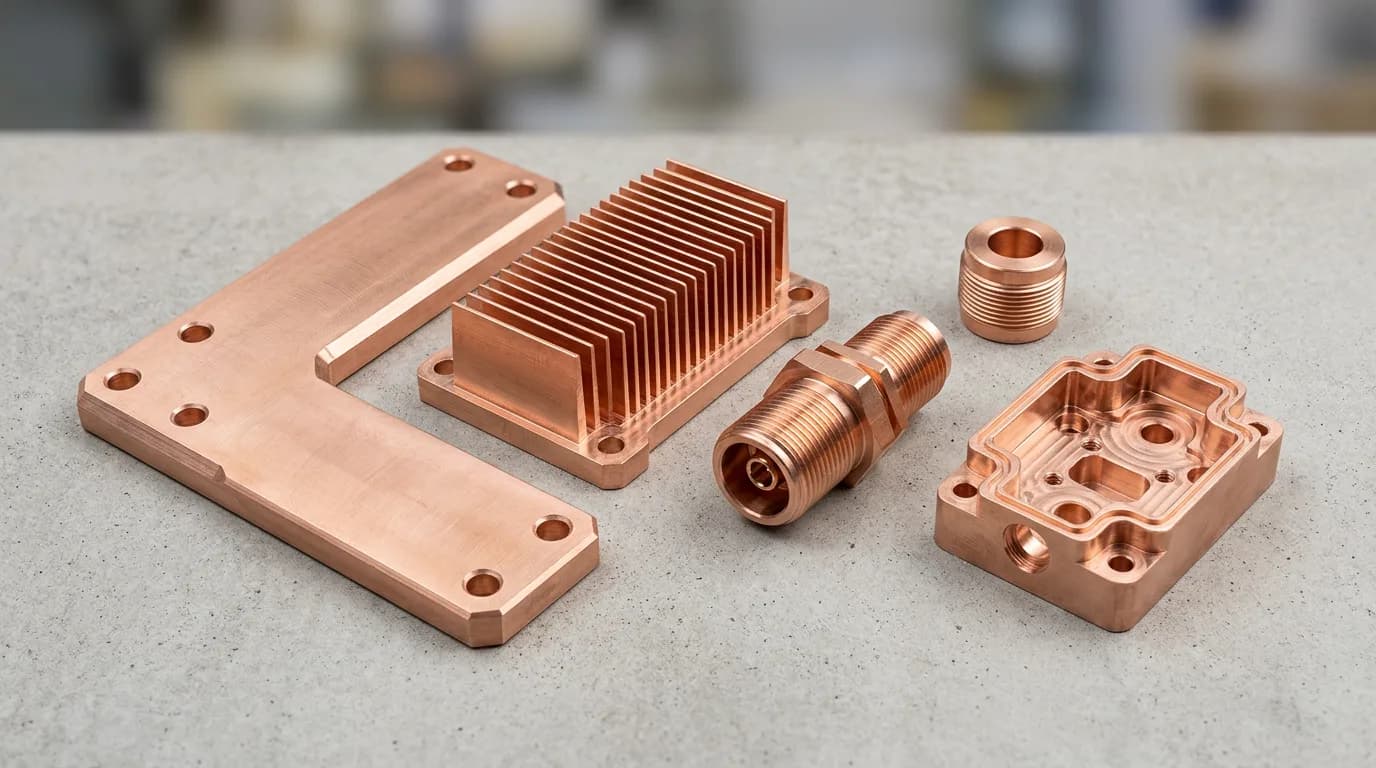
C10100 — OFHC Copper
99.99% Cu minimum, oxygen-free
A high-purity commercial copper. Oxygen is removed via vacuum or inert atmosphere casting, preventing Cu₂O grain-boundary films that cause hydrogen embrittlement when heated. Required for applications involving welding, brazing, or elevated-temperature service in hydrogen-containing atmospheres. Conductivity is slightly above the 100% IACS reference because the absence of oxygen removes a small conductivity-depressing impurity.
C11000 — ETP Copper
99.9% Cu minimum, electrolytic tough pitch
The workhorse electrical copper. Produced by electrolytic refining, then cast with a controlled oxygen content (0.02–0.04% as Cu₂O inclusions). The oxygen does not materially affect conductivity at room temperature but makes the material susceptible to hydrogen embrittlement if heated above ~700°F (~370°C) in a hydrogen atmosphere. Widely stocked in flat bar, round rod, and sheet for bus bars and terminal blocks.
C26000 — Cartridge Brass
70% Cu / 30% Zn
The standard structural brass. The 30% Zn content maximizes the alpha-phase ductility window, giving excellent cold-forming behavior (hence "cartridge" brass — it was the alloy for drawn ammunition cases). Machinability is only 30% — significantly worse than C360 — because the alpha-phase chips tend to be long and stringy. Use C26000 when forming or deep-drawing is required; use C36000 when high-volume machining is the primary operation.
C36000 — Free-Cutting Brass
61.5% Cu / 35.5% Zn / 3% Pb
The machinability reference standard. The 3% lead addition is insoluble in the brass matrix and precipitates as fine globules at grain boundaries. Under cutting, lead acts as an internal lubricant and chip-breaker, producing short, discontinuous chips at high cutting speeds. At 100% machinability — C36000 is the reference standard for copper alloys, equivalent to B1112 free-machining steel on the general machinability scale — C360 can be turned at surface speeds of 200–400 sfm (61–122 m/min) with carbide tooling. The most cost-effective copper alloy for fittings, valves, and connectors.
Copper Alloy Properties Comparison Table
All values for the most common CNC stock condition (annealed for C101/C110; half-hard H02 for C260/C360). Conductivity is at 68°F (20°C).
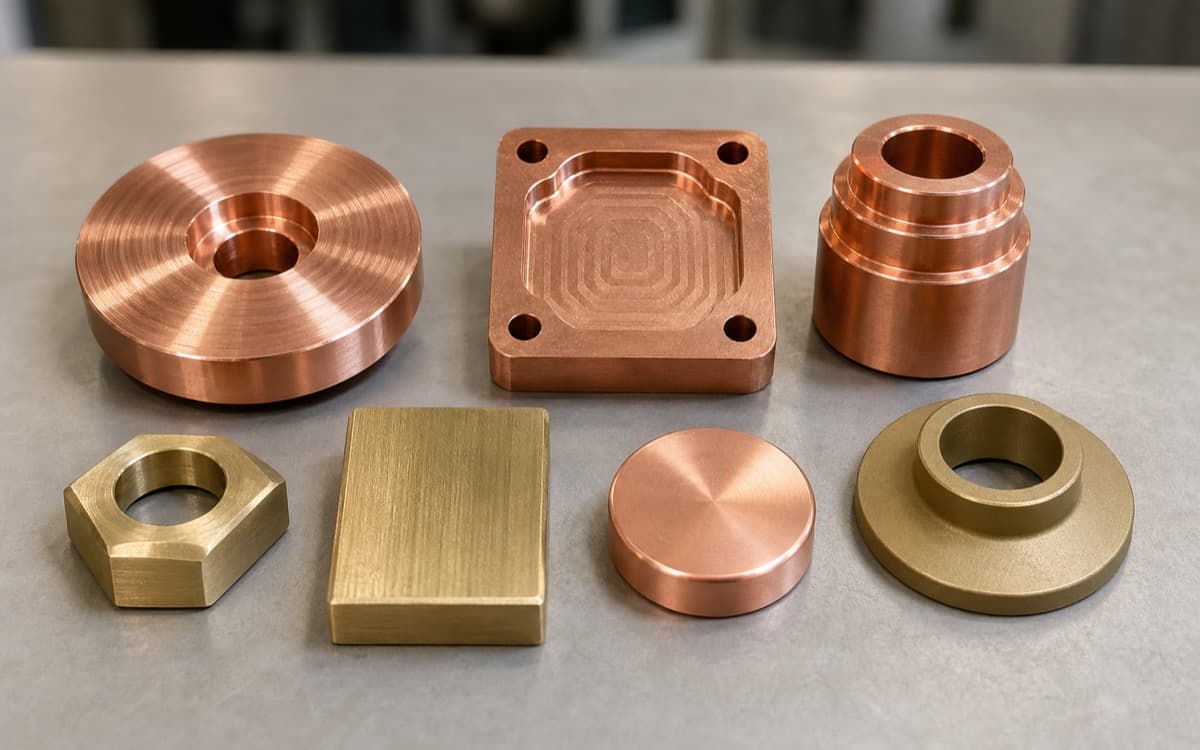
| Property | C10100 (OFHC) | C11000 (ETP) | C26000 (Brass) | C36000 (Free-Cut) |
|---|---|---|---|---|
| Cu Content | ≥99.99% | ≥99.9% | 68.5–71.5% | 60.0–63.0% |
| Electrical Cond. | 101% IACS | 100% IACS | 27–28% IACS | 26% IACS |
| Thermal Cond. | 391 W/m·K | 388 W/m·K | 121 W/m·K | 115 W/m·K |
| UTS (half-hard) | 275 MPa (40 ksi) | 275 MPa (40 ksi) | 395 MPa (57 ksi) | 385 MPa (56 ksi) |
| Yield Strength | 69 MPa (10 ksi) | 69 MPa (10 ksi) | 310 MPa (45 ksi) | 130 MPa (19 ksi) |
| Elongation | 35% | 35% | 23% | 25% |
| Density | 8.89 g/cm³ | 8.89 g/cm³ | 8.53 g/cm³ | 8.50 g/cm³ |
| Machinability | 20% | 20% | 30% | 100% (reference) |
| Oxygen Content | <0.0005% | 0.02–0.04% | N/A | N/A |
| Raw Cost (est.) | Highest (~2.5×) | High (~2×) | Moderate (~1.3×) | Baseline (1×) |
* Machinability rated relative to AISI B1112 free-machining steel = 100%. Copper values from CDA (Copper Development Association) datasheets and ASM Handbook Vol. 2. UTS/yield for annealed temper (O60) for C101/C110; half-hard (H02) for C260/C360.
If you need
Maximum conductivity (>95% IACS)
→ C101 or C110
101% / 100% IACS — 3–4× the conductivity of any brass alloy.
If you need
High-volume machined parts
→ C360 (Free-Cut)
100% machinability — typically shortest cycle time and lowest machined part cost.
If you need
Structural brass with forming
→ C260 (Cartridge)
23% elongation in H02 — deep-drawing and bending capability that C360 cannot match.
If you need
Lead-free / RoHS compliance
→ C110 or C260
Both are lead-free. C360 contains 3% Pb and fails most RoHS product exemptions.
Machine Any of These Copper Alloys at MakerStage
MakerStage machines C101, C110, C260, and C360 for CNC turned and milled copper parts. Upload your CAD file and get a DFM-reviewed quote — material availability confirmed, tolerances checked before you commit.
Get a Copper CNC QuoteAlloy Selection Decision Matrix
Start with C360 as your default for any machined copper part. Upgrade only when electrical performance, hydrogen embrittlement risk, or regulatory requirements demand it.
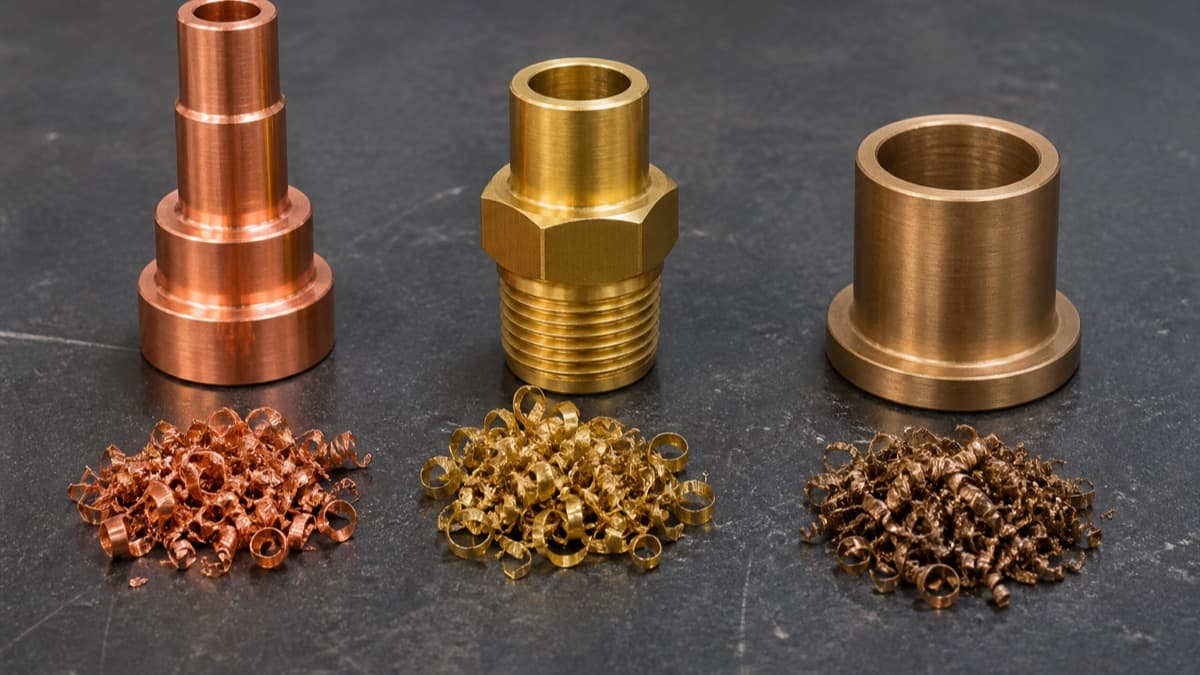
| Application | Recommended | Why | Avoid |
|---|---|---|---|
| Bus bars, power distribution rails | C110 (ETP) | 100% IACS conductivity, widely stocked in flat bar, lower cost than C101. | C360 (26% IACS — 4× conductivity penalty for high-current applications) |
| Parts exposed to welding or brazing | C101 (OFHC) | Oxygen-free — no hydrogen embrittlement risk when heated in reducing atmosphere. | C110 (ETP embrittles above ~700°F / ~370°C in H₂ atmosphere) |
| High-volume turned fittings, connectors | C360 (Free-Cut) | 100% machinability — typically the shortest cycle time and lowest part cost among copper alloys. Acceptable conductivity for non-critical paths. | C110 (20% machinability — 5× more tool wear and cycle time for equivalent geometry) |
| Structural brass parts, deep-drawn components | C260 (Cartridge) | Superior cold-forming ductility (23% elongation in H02 temper). Better corrosion resistance than C360. | C360 (lead content complicates forming, spring-back behavior) |
| RoHS / lead-free requirement | C110 or C260 | Both are lead-free. C360 contains 3% Pb and fails RoHS exemptions for many product categories. | C360 (3% Pb content) |
| Maximum thermal conductivity (heat sink, cold plate) | C101 or C110 | 391 / 388 W/m·K — more than 3× aluminum 6061. Justifies machining cost when thermal density is critical. | C260 / C360 (121 / 115 W/m·K — closer to aluminum than to pure copper) |
Decision Rule
If you need maximum conductivity: C110. If you need oxygen-free for brazing or welding: C101. If you need high-volume machined parts at typically lowest cost: C360. If you need structural brass with forming capability: C260. Do not default to C101 for bus bars — C110 delivers the same electrical performance at lower cost.
RoHS and Lead-Free Note
C360 contains 3% lead. RoHS Directive 2011/65/EU restricts lead to 0.1% max in electrical and electronic equipment. Some exemptions exist for copper alloys used in connectors, but verify applicability for your product category before specifying C360 in consumer electronics or medical devices.
Drawing Callout Format
A drawing that says “copper” will get whatever the shop has in stock. Use the UNS designation and ASTM standard — this is a binding contractual specification.
C10100 — OFHC Copper
Copper, UNS C10100, ASTM B152 (sheet/strip) or B187 (rod/bar), Annealed (O61)Add "Certify oxygen content ≤0.0005%" when embrittlement resistance must be verified. Required when parts will be brazed, welded, or used at elevated temperature in hydrogen-containing atmosphere.
C11000 — ETP Copper
Copper, UNS C11000, ASTM B187 (rod/bar) or B152 (sheet), Half-Hard (H02)Half-Hard (H02) temper is the standard stock condition for machined bus bar and terminal stock. Specify "Annealed (O61)" if subsequent forming or crimping is required.
C26000 — Cartridge Brass
Brass, UNS C26000, ASTM B19 (strip) or B36 (sheet), Half-Hard (H02)For drawn or formed parts, specify the final temper after forming. Do not call out C26000 for high-volume turning — cycle times will be significantly longer than equivalent C360 parts (30% vs. 100% machinability).
C36000 — Free-Cutting Brass
Brass, UNS C36000, ASTM B16 (rod/bar), Half-HardHalf-Hard is the standard rod stock temper and is almost always what shops inventory. If your application requires RoHS compliance, C360 cannot be used — substitute C110 or C260.
Pro Tip: Temper Affects Machinability
For C110 and C101, specify Half-Hard (H02) or Hard (H04) when ordering rod for CNC turning — the work-hardened temper improves chip formation compared to fully annealed stock. Annealed pure copper galls tool faces aggressively; a harder temper reduces built-up edge and extends tool life. Ask your material supplier to confirm temper on the mill certificate.
Deep Dives in This Copper Series
- Copper 101 vs. C110 — OFHC vs. ETP: which do you actually need?
- CNC machining copper — design rules, tolerances, and DFM tips
- Copper sheet metal fabrication — C110 vs. C101, bend radius, and plating guidance
- Copper 260 vs. 360 — choosing the right brass for your part
- Copper vs. aluminum for thermal management
- Copper CNC machining capability
- RFQ checklist for copper parts
- Copper C110 properties guide
- Copper 101 fundamentals guide
Frequently Asked Questions
Ready to Machine Your Copper Part?
Upload your CAD file for a CNC quote on C101, C110, C260, or C360 parts. MakerStage can include RFQ-stage manufacturability feedback and material availability notes.
Get a Copper CNC Quote