Copper Surface Finishes for Precision Parts
Bare copper oxidizes in hours. Here is the complete guide to electroless nickel, silver plating, tin plating, and OSP — with when to use each and the exact drawing callout.
Copper Without a Surface Finish Is a Time Bomb
A freshly machined copper surface will show visible tarnish within hours in ambient air, and measurable contact resistance increase within days. For electrical and thermal applications, the surface finish is not cosmetic — it is a functional requirement that must be specified on the drawing, not left to the shop's discretion. This guide covers the four primary options, the failure modes of each, and exactly how to specify them.
Why Bare Copper Oxidizes — and Why It Matters
Copper's oxidation is thermodynamically favorable at room temperature. The oxidation products differ in appearance and electrical behavior.
Fresh Copper
Freshly machined or polished copper. Maximum conductivity. Begins oxidizing immediately on contact with atmospheric oxygen and moisture.
Cu₂O (Cuprous Oxide)
First oxidation product. Cu₂O is a p-type semiconductor (band gap 2.1 eV) that significantly increases contact resistance, especially under low contact force. Reduces under high contact pressure.
CuO (Cupric Oxide)
Formed by further oxidation of Cu₂O. CuO has high resistivity (~1–100 Ω·cm) — effectively insulating at contact interfaces — and cannot be displaced by contact pressure alone. Requires mechanical or chemical removal before soldering or bonding.
Why Patina ≠ Protection
The green patina on aged copper (verdigris, Cu₂(OH)₂CO₃) is a long-term corrosion product that does slow further atmospheric corrosion — but unlike the self-healing oxide on stainless steel or aluminum, it is not a true passivation layer and it does not protect electrical contact surfaces or thermal interfaces. Do not rely on patina for any electrical or thermal application.
Electroless Nickel Plating
The most common surface finish for CNC machined copper parts that require corrosion protection, wear resistance, or dimensional control.
How It Works
Electroless nickel (ENi) is deposited by autocatalytic chemical reduction — no electrical current required. The part is immersed in a bath containing nickel ions and a reducing agent (sodium hypophosphite for ENi-P). The reducing agent oxidizes on the catalytic copper surface, providing electrons that reduce nickel ions to metallic nickel. Because no electrical field is required, ENi deposits uniformly on all exposed surfaces, including deep bores and complex internal geometries.
Phosphorus Content and Properties
| Class | P Content | Hardness | Corrosion Res. |
|---|---|---|---|
| Low-P | 1–4% | HRC 50–54 | Moderate |
| Mid-P | 5–9% | HRC 48–52 | Good |
| High-P | 10–13% | HRC 38–48 | Excellent |
Recommended Applications
- Bus bars and terminal blocks requiring wear protection
- Copper parts requiring long-term corrosion resistance
- Mating surfaces with sliding wear
- Parts requiring solderability after nickel (gold flash over ENi)
- Complex internal geometry (ENi deposits uniformly)
ENi on C360 requires lead pre-treatment (bright dip + copper strike) before plating. Specify this on the drawing or ENi adhesion defects will occur at lead-phase sites. See Copper 260 vs. 360 guide for details.
Drawing Callout
Electroless Nickel per ASTM B733, Class SC-2,
Type I (as-deposited, 6–9% P),
0.0005 in (12.7 µm) minimum thickness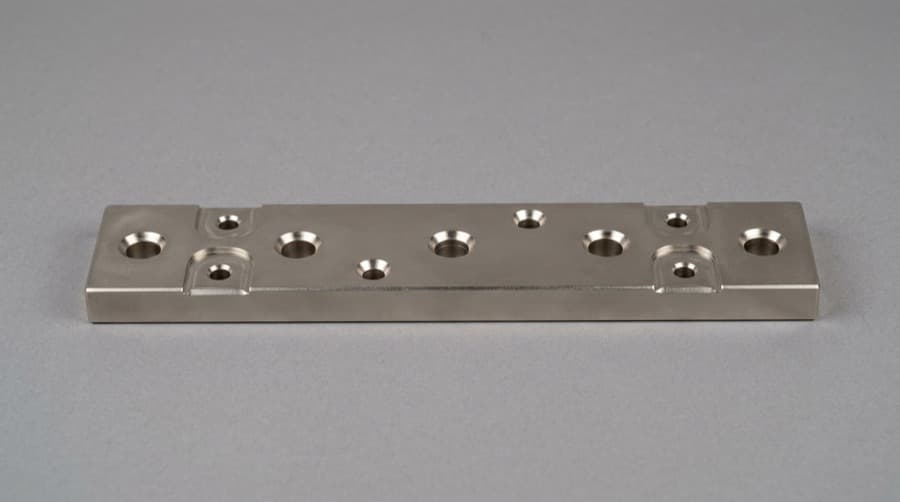
Silver and Tin Plating
The two primary plating options for copper electrical contacts. Silver is optimal for low contact resistance; tin is the RoHS-compliant, lower-cost alternative.
Silver Plating (ASTM B700)
Silver plate per ASTM B700, Grade A (99.9% Ag min), 0.0005 in minimum on contact surfacesTin Plating (ASTM B545)
Tin plate per ASTM B545, matte finish, 0.0005 in minimum, bright tin not acceptable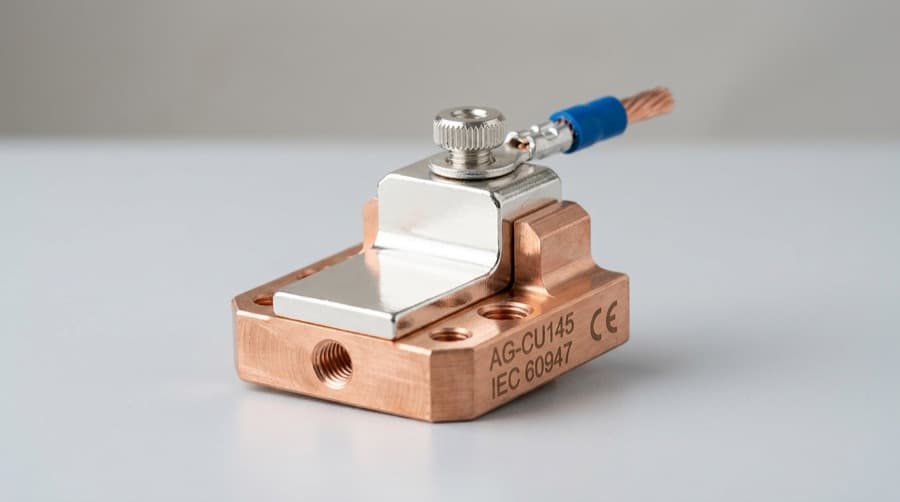
OSP — Organic Solderability Preservative
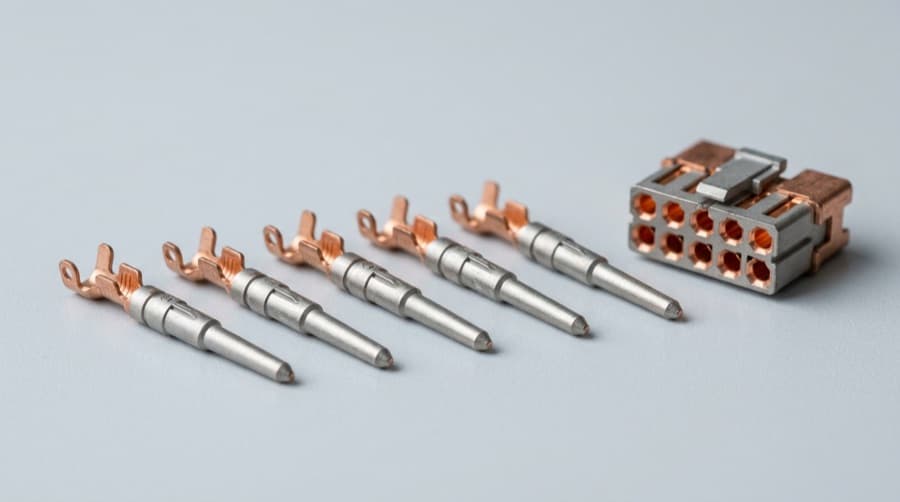
OSP is a temporary coating used where solderability must be preserved for 6–12 months. Not a permanent protective finish.
What OSP Is
A thin (0.2–0.5 µm) azole-based organic film (benzimidazole or imidazole chemistry) applied by immersion in an acidic bath. The film chelates to the copper surface and provides temporary oxidation resistance. Transparent — copper color visible through the coating.
When to Use OSP
PCB-adjacent copper components (bus bars, terminal pads) that will be reflow-soldered within 6–12 months of plating. OSP decomposes cleanly above ~428°F (~220°C) during reflow, leaving the copper surface exposed and solderable. Seal parts in moisture-barrier bags after OSP treatment.
When NOT to Use OSP
OSP is not suitable for: contact applications (no contact resistance improvement), extended storage >12 months, high-humidity environments without sealed packaging, or parts that will not be soldered (OSP provides no benefit without subsequent reflow). For permanent protection, specify ENi or silver.
Copper Parts Machined and Finished at MakerStage
MakerStage machines copper and coordinates surface finishing through our verified supplier network. Upload your drawing with the finish you need so quote-stage review can confirm availability, cost, and lead time before release.
Request a Copper CNC QuoteFinish Selection by Application
| Application | Recommended Finish | Standard | Why |
|---|---|---|---|
| High-current bus bar contact pads | Silver plate 0.0005 in | ASTM B700 | Lowest contact resistance; Ag₂O reduces under pressure |
| Low-current terminal block contacts | Tin plate 0.0005 in | ASTM B545 | RoHS compliant, solderable, lower cost than silver |
| Bus bar structural body (non-contact) | Electroless Nickel 0.0005 in | ASTM B733 | Corrosion protection, wear resistance, no conductivity requirement |
| CNC-machined copper heatsink / cold plate | Electroless Nickel 0.0005 in | ASTM B733 | Corrosion protection; ENi-P deposits have low thermal conductivity (~5–10 W/m·K) but the thin layer adds negligible thermal resistance to the copper substrate |
| PCB terminal pad (pre-reflow) | OSP per IPC-4555 | IPC-4555 | Solderability preserved 6–12 months; cleans off during reflow |
| RF connector contact (mating surface) | Silver + ENi underplate | ASTM B700 + B733 | Minimum contact resistance at RF frequencies; ENi prevents Cu migration |
| Copper fitting — cosmetic / indoor service | Electroless Nickel or bare (benzotriazole treated) | ASTM B733 or N/A | Benzotriazole provides 1–3 month short-term protection for non-critical parts |
| Copper contact requiring gold bond or wire bond | Gold flash (0.000030 in) over ENi underplate | ASTM B488 | Gold is bondable; ENi diffusion barrier prevents Cu from migrating through gold |
Related Guides in This Series
- Copper alloys for CNC machining — hub guide
- Copper 260 vs. 360 — plating adhesion comparison for brass alloys
- Copper sheet metal fabrication — where bend rules and oxidation control affect finish choice
- Complete surface finishes guide — Ra, anodizing, plating, and passivation
- Copper CNC machining capability
- RFQ checklist for copper parts
- Copper bus bar and electrical contact design
Frequently Asked Questions
Ready to Machine and Finish Your Copper Part?
CNC machined copper with surface finish coordination. Upload your drawing for quote-stage review and finish specification feedback.
Request a Copper CNC Quote