Copper Bus Bar Design for Electrical Contacts
Contact resistance, current density limits, joint geometry, and the surface finish parameters that determine whether a bus bar joint ages gracefully or fails thermally.
Most Bus Bar Failures Start at the Joint, Not the Conductor
Bus bar conductors are straightforward to design — they follow Ohm's law. Bus bar joints are where most failures occur: inadequate contact force, wrong surface finish, missing plating, or undersized contact area. This guide covers the engineering fundamentals of contact resistance, current density, joint design, and the surface finish parameters that determine long-term joint reliability.
Engineering Disclaimer
The current density values, torque specifications, and sizing guidance in this guide are general design starting points — not a substitute for validation by a qualified electrical engineer. All bus bar designs for power distribution must be verified per applicable standards (IEC 61439, UL 508A, NFPA 70) for your specific enclosure, ambient temperature, and duty cycle. MakerStage provides CNC machining services and does not provide electrical engineering, thermal analysis, or certification services.
Contact Resistance Fundamentals
Two components add to produce total contact resistance. Each has a different root cause and a different engineering lever to reduce it.
Constriction Resistance (Rc)
Two surfaces in contact do not touch uniformly — they contact only at the tips of surface asperities (the “a-spots”). Current flowing through these small contact points must converge to pass through them, creating a constricted current path with higher resistance than the bulk material.
Formula (Holm): Rc = ρ/(2a), where ρ is bulk resistivity and a is the contact spot radius. To reduce Rc: increase contact force (plastic deformation of asperities increases a), and use a soft plating (silver or tin) that deforms more readily at the asperity tips.
Film Resistance (Rf)
Oxide films, contaminants, and plating deposits between contact surfaces add series resistance. Bare copper forms Cu₂O rapidly (semiconducting, adds contact resistance); CuO is an insulator. Tin oxide (SnO₂) is also an insulator — tin plating helps if the oxide is thin enough to fracture under contact pressure.
To reduce Rf: silver plating (Ag₂O is conductive and thin enough to be displaced under pressure), increased bolt torque (fractures oxide films at asperities), and Belleville washers (maintain contact force as thermal cycling causes creep relaxation in the fastener).
| Joint Type | Typical Contact Resistance | Power Loss at 100 A (I²R) | ΔT at Joint |
|---|---|---|---|
| Bolted, bare copper, good surface prep | 0.2–0.5 mΩ | 2–5 W | 9–27°F (5–15°C) rise |
| Bolted, silver-plated, good prep | 0.05–0.2 mΩ | 0.5–2 W | 2–9°F (1–5°C) rise |
| Bolted, tin-plated, good prep | 0.1–0.5 mΩ | 1–5 W | 5–27°F (3–15°C) rise |
| Bolted, oxidized bare copper | 2–20 mΩ | 20–200 W | 90–360°F (50–200°C+) rise |
| Welded copper joint | <0.05 mΩ | <0.5 W | <2°F (<1°C) rise |
The Thermal Runaway Risk
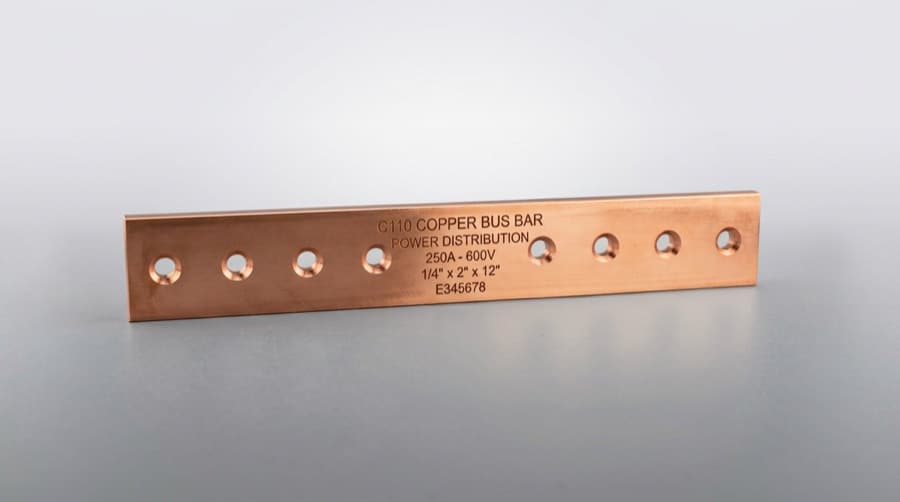
A high-resistance bus bar joint has a self-reinforcing failure mode: joint heating accelerates oxide growth, which increases resistance, which increases heating. A bolted joint with 2 mΩ resistance at 200A dissipates 80 W locally — sufficient to cause visible discoloration within days, accelerate corrosion, and potentially reach the fire-risk threshold in enclosed panels. Design to <0.5 mΩ per joint with silver plating as the non-negotiable protection.
Current Density and Cross-Section Sizing
Current density determines temperature rise in the conductor. Use the table below as a starting point, then verify with a thermal calculation for your specific geometry and enclosure.
| Cooling Method | Current Density (A/mm²) | Approx. ΔT Rise | Application Examples |
|---|---|---|---|
| Natural convection (enclosed) | 1.0–1.5 A/mm² | 54–90°F (30–50°C) | Switchgear, distribution panels, MCCs |
| Natural convection (open bus) | 1.5–2.5 A/mm² | 36–72°F (20–40°C) | Open bus duct, transformer secondary bus |
| Forced air cooling | 3.0–4.0 A/mm² | 36–63°F (20–35°C) | Drive cabinets, power electronics panels |
| Liquid cooled (cold plate) | 6.0–8.0 A/mm² | 18–36°F (10–20°C) | EV inverter bus, traction power modules |
| Short-time / pulsed duty | 4.0–6.0 A/mm² | Calculate thermal mass | Motor inrush, fault current, welding bus |
Cross-Section Sizing Example
Given: 800A continuous, natural convection, open bus, 104°F (40°C) ambient
Target J: 2.0 A/mm² (open bus, Table above)
Required A: 800A ÷ 2.0 A/mm² = 400 mm²
Standard size: 40mm × 10mm flat bar = 400 mm² ✓ (commonly stocked in C110)
Verify resistance: R = ρL/A = (1.72×10⁻⁸ × 1m) / 400×10⁻⁶ = 43 µΩ/m
Voltage drop: V = 800A × 43 µΩ = 34.4 mV/m
Power loss: P = I²R = 800² × 43×10⁻⁶ = 27.5 W/m
Accept if: ΔT <72°F (<40°C) rise (verify with convection model for bar orientation)
CNC Machine Your Copper Bus Bars at MakerStage
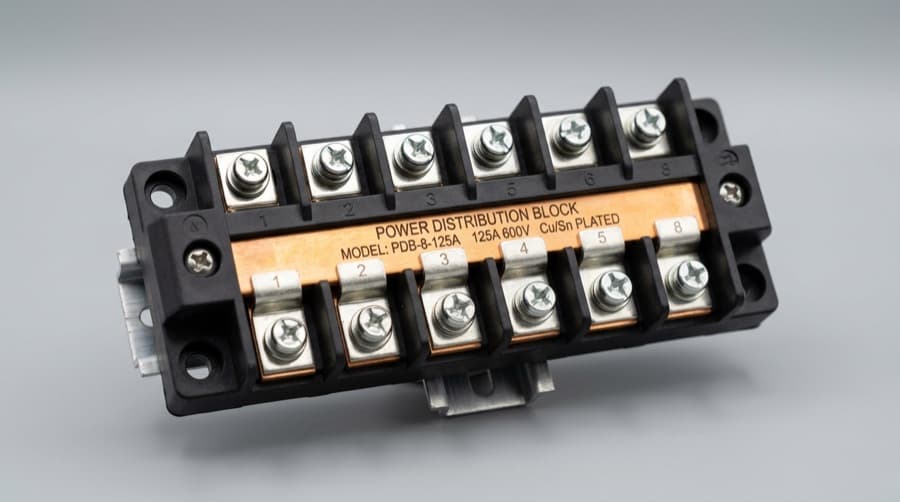
MakerStage machines C110 and C101 copper bus bars and terminal blocks. Upload your drawing and get a quote-stage review of contact surface geometry, slot features, and hole patterns before release.
Request a Copper Bus Bar QuoteJoint Geometry Design Rules
Six rules that govern a reliable bolted bus bar joint.
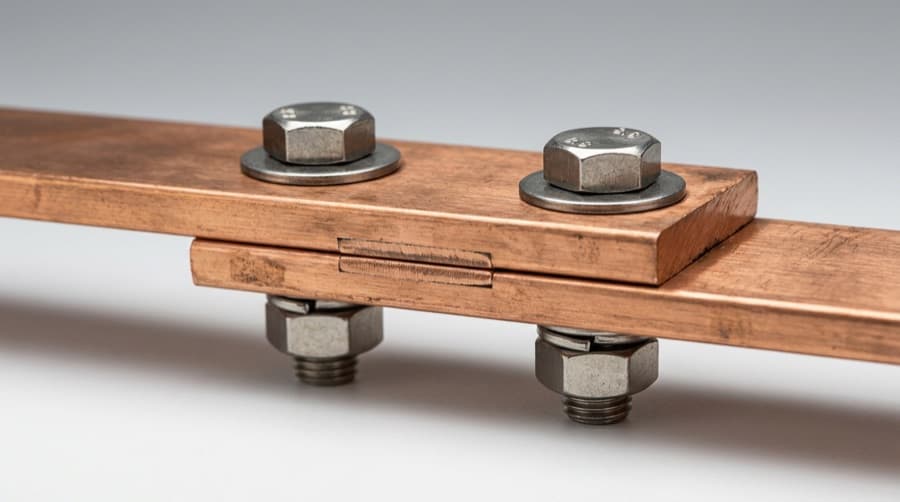
Overlap length ≥ bus bar width
The overlap at a bolted joint should be at least as long as the bus bar is wide. For a 40mm wide bar, the overlap is ≥40mm. This keeps the current density at the contact interface below 0.5 A/mm² at rated current for a 2.0 A/mm² bus bar — ensuring the joint is not the bottleneck.
Minimum 2 bolts per joint, stagger pattern
Two bolts provide redundancy (joint remains functional if one fastener loosens) and distribute clamping force more uniformly across the contact area. Stagger the bolt pattern (not inline with current flow) to avoid creating a low-resistance current channel on one side of the joint.
Use Belleville washers on all fasteners
Copper creeps under sustained load, especially above 122°F (50°C). Over 6–18 months, the fastener preload relaxes, increasing contact resistance. Belleville washers maintain a high spring rate that compensates for copper creep, sustaining contact force throughout thermal cycling.
Specify maximum torque on drawing — do not leave to assembler
Torque specification: M8 bolt, grade 8.8, dry: 22 N·m. M10, grade 8.8, dry: 44 N·m. Over-torque causes thread stripping in the insert (see Rule 05 — always use threaded inserts, never tap copper directly). Under-torque causes inadequate contact force. Specify ± 10% and use a calibrated torque wrench.
Do not tap copper — use inserts for threaded connections
Copper threads strip easily and cannot be easily repaired once damaged. For frequently disconnected joints, install helical inserts (Heli-Coil) in the copper bar during CNC machining. This provides a steel thread form in the copper base and extends service life through multiple reconnections.
Chamfer all bolt hole entrances for consistent washer contact
A standard drill-point hole with a burr at the entrance causes the washer to make line contact against the burr rather than face contact on the copper surface. Specify a 0.020–0.030 in × 45° chamfer on all fastener holes on the mating face.
Surface Finish for Conductivity and Durability
The mating surface Ra, flatness, and plating type are not cosmetic — they determine contact resistance and long-term joint reliability.
| Parameter | Specification | Why |
|---|---|---|
| Mating surface Ra | Ra 32–63 µin (0.8–1.6 µm) | Optimal for real contact area — too smooth reduces asperity contact points; too rough reduces plating coverage. |
| Mating surface flatness | ±0.002 in per foot (±0.17 mm/m) | Prevents rocking on one edge that concentrates contact on a small area. |
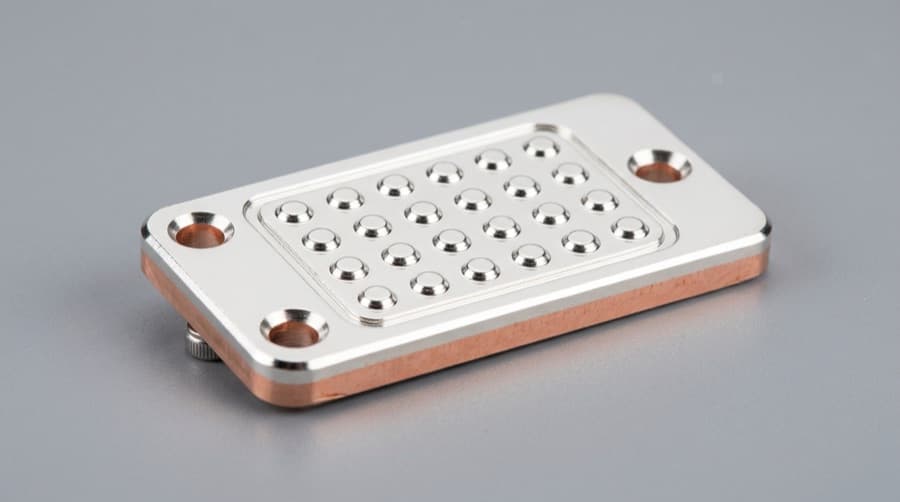
| Surface plating (preferred) | Silver per ASTM B700, 0.0005 in min | Ag₂O is thin, conductive, and displaced under contact pressure; lowest contact resistance of plateable options. |
| Surface plating (acceptable) | Tin per ASTM B545, 0.0005 in min, matte | RoHS compliant; SnO₂ oxide must be fractured by contact force — verify fastener torque. |
| Plating on non-contact surfaces | ENi per ASTM B733, 0.0003 in min | Corrosion protection on non-contact surfaces does not require contact-grade silver. |
| Post-machining cleaning | Ultrasonic clean in isopropanol before plating | Removes cutting oil and chips that prevent plating adhesion and contaminate contacts. |
Tolerance Stack-Up and Drawing Requirements
Bolt hole position (bolt clearance)
⌖ True position ⌀0.010 in | Ⓜ | A B CA 0.010 in positional tolerance on bolt holes allows the bar to float within the bushing/mount. Tighter tolerances are not necessary for bus bar assemblies and add cost.
Bar thickness (contact stack-up)
Thickness: ±0.003 inThickness tolerance controls contact stack-up height. For multi-bar assemblies (3–4 bars stacked), ±0.003 in per bar keeps total stack within ±0.012 in, which a Belleville washer can accommodate.
Mating surface flatness
⏥ Flatness 0.002 per 12 inLocalized flatness over the contact zone. For bars longer than 12 in, specify the flatness per unit length, not total.
Material and plating on drawing
Material: Copper, UNS C11000, ASTM B187, H02
Finish: Silver plate per ASTM B700, Gr A, 0.0005 in contact, 0.0003 in non-contact
Always specify plating thickness separately for contact and non-contact surfaces. Contact surfaces need full thickness; non-contact surfaces can be minimum for cost reduction.
Related Guides
Frequently Asked Questions
Ready to Machine Your Copper Bus Bar?
C110 and C101 copper bus bars and terminal blocks machined with RFQ-stage manufacturability feedback. Upload your drawing for a copper bus bar quote.
Request a Copper CNC Quote