Aluminum Anodizing: Type II, Type III & Color Options
Type II vs hard anodize, dimensional impact, design rules for threads and corners, alloy compatibility, and exact drawing callout format.
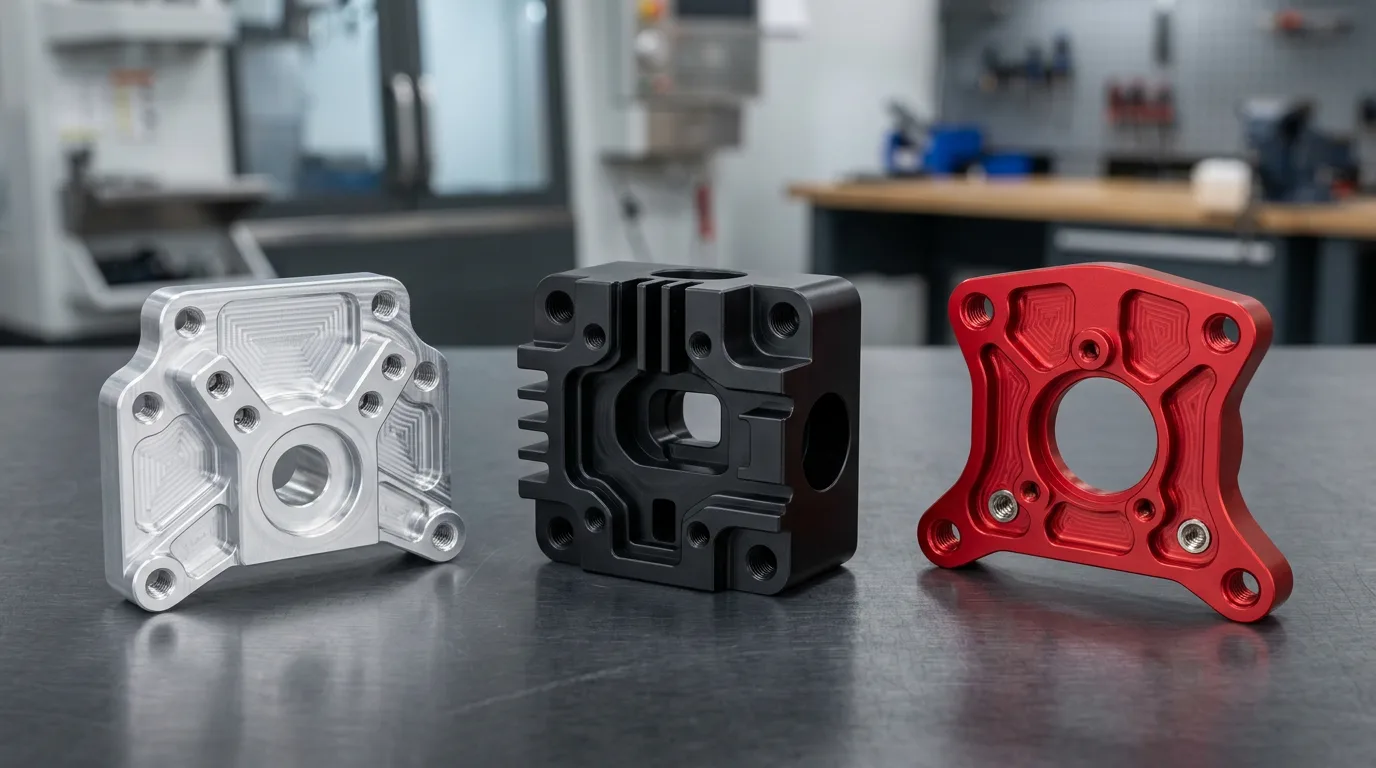
Anodizing Is Not Paint — It Is Converted Aluminum
Anodizing grows an aluminum oxide layer electrochemically from the surface itself — it cannot peel or flake like paint or plating because it is the surface. Understanding this is critical for dimensional control: the coating grows both inward (into the part) and outward, typically 50% each direction. This guide covers everything you need to correctly specify and design for anodized aluminum parts.
How Anodizing Works
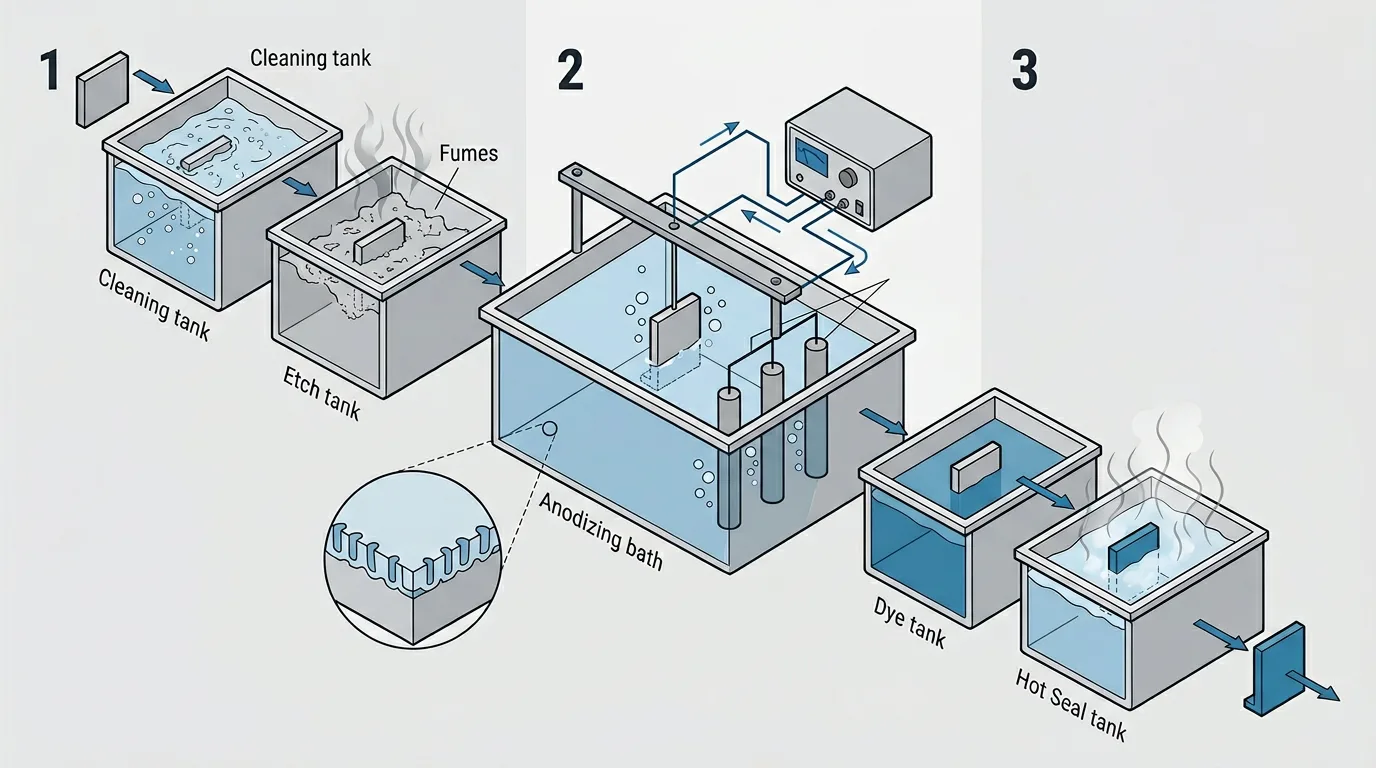
When you specify anodizing on a drawing, the part goes through a three-step electrochemical process that converts the aluminum surface into aluminum oxide (Al₂O₃) — a ceramic-like layer that is harder, more corrosion-resistant, and electrically insulating. Understanding each step matters because the process parameters you call out (type, thickness, seal method) directly control coating performance. MIL-A-8625 is the governing specification; ISO 7599 (decorative) and ISO 10074 (hard anodize) are the international equivalents.
Pre-Treatment
Part is cleaned, degreased, and typically etched in sodium hydroxide (NaOH) to remove the natural oxide layer and create a uniform matte surface. Bright dip (phosphoric + nitric acid) produces a specular (mirror) finish before anodizing.
Anodizing Bath
Part is submerged in a sulfuric acid electrolyte bath and connected as the anode. DC current passes through the bath, oxidizing the aluminum surface. Temperature and current density control coating type and thickness. Type II: 65–75°F (18–24°C), 12 ASF (amps per square foot). Type III: 28–32°F (−36–32°F (2 to 0°C)), 24–36 ASF.
Dye & Seal
The porous anodize layer absorbs dye from a hot dye bath (for Type II color anodize). Hot DI water seal (boiling deionized water) or nickel acetate seal closes the pores, trapping dye and improving corrosion resistance. PTFE seal is used for wear applications where lubricity is needed.
Pro Tip: Why Anodize Grows Both Ways
The oxide layer grows 50% inward (consuming aluminum) and 50% outward (adding to the surface). For a 0.001 in thick Type II coating, dimensions grow ~0.0005 in per surface. For a 0.002 in Type III coating, dimensions grow ~0.001 in per surface. Design your critical fits to the lower end of tolerance so anodized parts land at nominal.
Type II vs Type III: Full Comparison
When you specify anodizing on a drawing, you are choosing between two types — and the wrong choice either under-protects your part or wastes money. Type I (chromic acid) is largely obsolete for commercial parts due to environmental regulations. Below, HV refers to Vickers hardness — a measure of surface hardness where higher numbers mean harder coatings (for reference, aluminum 6061-T6 is ~HV 107, and tool steel is ~HV 600–900).
| Property | Type II (Sulfuric Anodize) | Type III (Hard Anodize) | Notes |
|---|---|---|---|
| Governing spec | MIL-A-8625 Type II | MIL-A-8625 Type III | Always cite the MIL spec on your drawing |
| Coating thickness | 0.0002–0.001 in (5–25 µm) | 0.001–0.003 in (25–75 µm) | Per-surface dimensional growth is half the total thickness |
| Vickers hardness | HV 200–300 | HV 400–600 | Type III (HV 400–600) is 3–5× harder than AISI 1018 low-carbon steel (~HV 130) |
| Surface roughness | Slight increase (~5–15% rougher) | Moderate increase; dense pore structure yields uniform texture but thicker coating increases measured Ra | Surface prep (bright dip, bead blast) dominates final Ra |
| Color options | Full spectrum (clear, black, red, blue, gold, etc.) | Limited (natural bronze/gray to black only) | Type III cannot absorb light dyes due to dense, small pores |
| Corrosion resistance | Good (250–500 hr salt spray) | Excellent (>2,000 hr salt spray) | Type III much better for outdoor/chemical exposure |
| Dielectric strength | 250–400 V/mil | 500–800 V/mil | Useful for electrical isolation in housings and heat sinks |
| Relative cost | 1× | 2–3× | Type III requires lower bath temperature and longer cycle time |
| Use when | Corrosion protection, color cosmetics, non-wear applications | Wear-critical surfaces, sliding contact, hydraulic components |
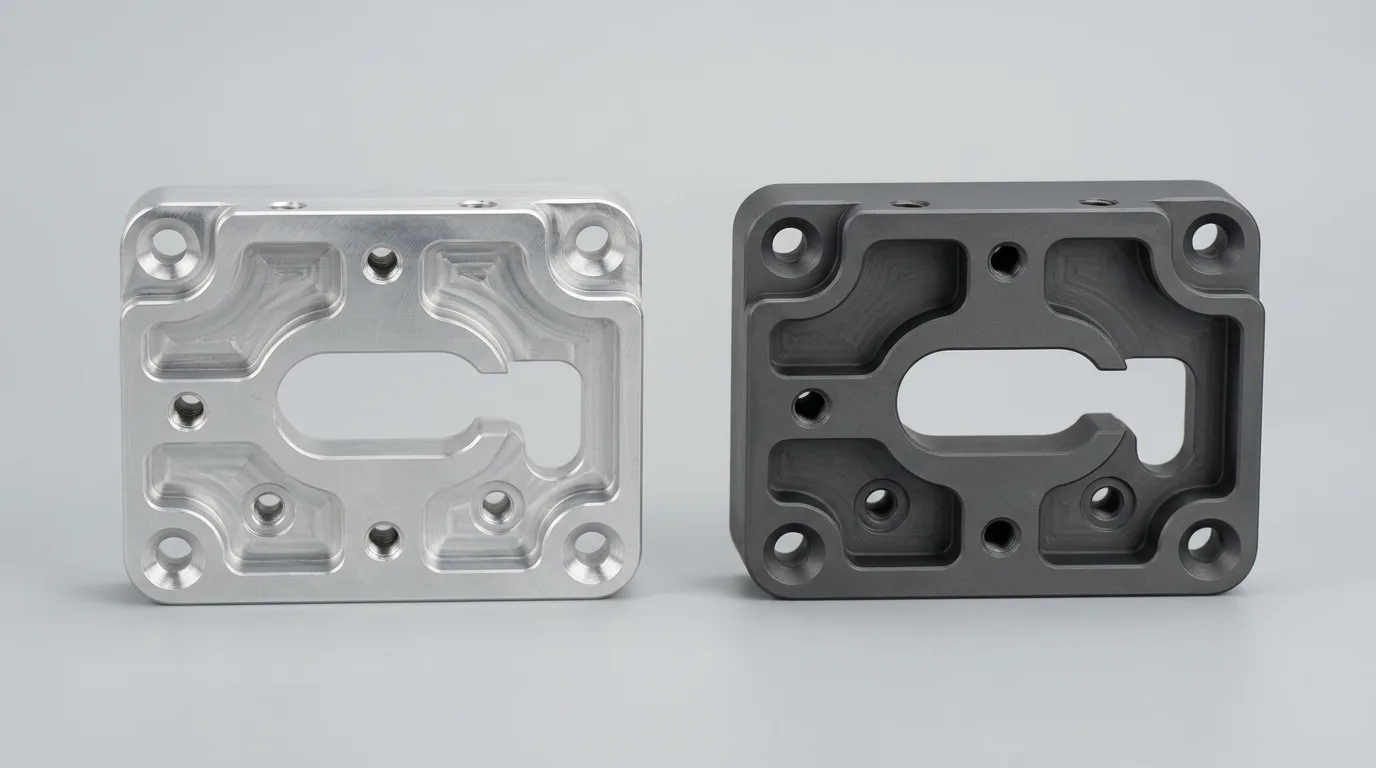
Type II and Type III Anodizing at MakerStage
MakerStage offers Type II clear and black anodize, Type II color anodize, and Type III hard anodize on aluminum programs. During quote review, we can flag maskable features, dimensional impact on tight tolerances, and alloy compatibility before machining and finishing begin.
Review CNC and Anodize QuoteAlloy Compatibility
Not all aluminum alloys produce equivalent anodize results. Alloying elements — especially copper and zinc — disrupt the oxide layer and reduce coating quality.
| Alloy | Series | Type II Quality | Type III Quality | Color Anodize? | Notes |
|---|---|---|---|---|---|
| 6061-T6 | 6xxx (Al-Mg-Si) | Excellent | Excellent | Yes — full spectrum | Most widely specified alloy for anodizing. Clear, uniform, accepts all dyes. |
| 6063-T5 | 6xxx (Al-Mg-Si) | Excellent | Good | Yes — full spectrum | Even cleaner cosmetic finish than 6061. Used for architectural extrusions. |
| 5052-H32 | 5xxx (Al-Mg) | Good | Good | Yes (limited colors) | Slightly darker clear coat due to Mg content. Good for marine applications. |
| 5083-H116 | 5xxx (Al-Mg) | Good | Acceptable | Limited | High Mg content limits color range. Used for structural marine parts. |
| 7075-T6 | 7xxx (Al-Zn-Mg) | Acceptable | Acceptable | Limited (yellowish tint) | Zinc content causes yellow-gray tint. Avoid for cosmetic color work. |
| 2024-T351 | 2xxx (Al-Cu) | Poor | Poor | Not recommended | High copper (4.4%) dissolves in anodize bath. Rough, non-uniform coating. Avoid anodizing 2024. |
| Cast alloys (A380, 356) | Cast | Poor–Acceptable | Poor | Not recommended | High Si and Fe from casting leave inclusions that appear as dark spots or pits. |
Pro Tip: Alloy Selection for Anodized Parts
If your part requires cosmetic color anodize (especially bright colors or uniform appearance), design in 6061-T6 from the start. Switching from 7075 to 6061 after a poor anodize result means a redesign and re-order cycle. The strength premium of 7075 (73 ksi (503 MPa) vs. 40 ksi (276 MPa) yield) is only worth the anodize quality tradeoff for parts where yield strength is the actual design constraint — not most housings, enclosures, and brackets.
Design Rules for Anodized Parts
Your part geometry directly affects anodize quality — sharp corners, blind holes, and threaded features all interact with the coating process in ways that cause defects if you do not design for them. These rules prevent the most common quality issues.
Sharp Corners and Edges
Issue: Anodize builds up on edges and burns or cracks at sharp inside corners. Type III hard anodize is especially sensitive.
Rule: Add minimum 0.010 in. (0.25 mm) radius on all external edges intended to be anodized. Inside corners: 0.030 in. (0.76 mm) min radius for Type III. Sharp corners on Type III parts will show thin, burned coating.
Threaded Features
Issue: Anodize coating builds up on thread flanks, reducing effective thread engagement and risking interference with mating fasteners.
Rule: Mask all threaded holes or machine threads after anodizing. If threading before anodize, open holes by 0.001–0.002 in. (0.025–0.051 mm) per surface for Type II, 0.002–0.003 in. (0.051–0.076 mm) per surface for Type III.
Blind Holes and Deep Pockets
Issue: Electrolyte and rinse water trap in blind holes, causing uneven coating and post-process white residue or staining.
Rule: Add drain holes at the lowest point of any blind feature on the part orientation during anodize. If drain holes are not acceptable, notify the anodizer so they can fixture the part for proper drainage.
Dissimilar Materials in Assembly
Issue: Stainless fasteners installed before anodizing will be damaged by the acid bath, and the anodize bath will contaminate around dissimilar metal contact.
Rule: Always anodize parts before assembly. Never anodize a sub-assembly with dissimilar metals installed.
Tight Tolerance Fits
Issue: Anodize adds 0.0001–0.0015 in per surface, pushing bore diameters under and shaft diameters over tolerance.
Rule: For features within ±0.001 in tolerance, either: (a) machine to pre-anodize limits accounting for growth, or (b) mask the feature and machine post-anodize. Mark critical dimensions clearly on the drawing.
Racking and Fixturing Marks
Issue: Parts must contact a rack for electrical connection. The contact point will have no anodize — this is unavoidable.
Rule: Specify acceptable rack contact areas on the drawing (e.g., "Rack contact acceptable in this zone"). Place them on non-critical surfaces. Discuss with the anodizer before quoting to confirm fixturing location.
Color Options & Surface Prep
The final color and finish of an anodized part depends on alloy, pre-treatment, dye, and seal type. Here is what you can realistically specify.
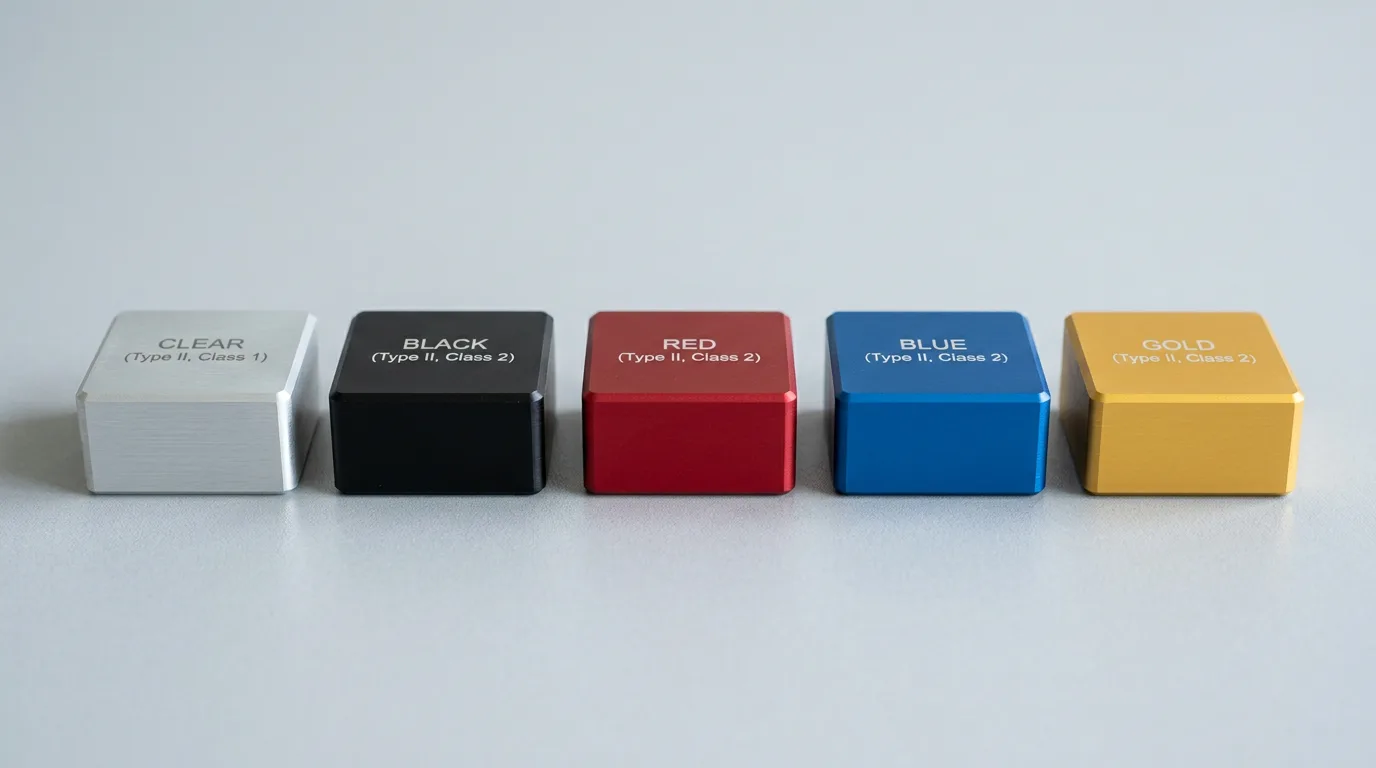
Type II Color Options
Surface Pre-Treatment Options
Color Consistency Warning
Anodize color is not perfectly repeatable between production runs without strict process controls. Alloy lot variation, bath chemistry, and dye concentration all affect the final shade. For applications requiring consistent color across multiple orders (consumer products, branded equipment), always request a first-article color approval sample and specify color limits in writing on the drawing.
Drawing Callout Format
Your drawing callout is a contractual specification — if you write "anodize, black" without a MIL spec reference, the anodizer chooses the cheapest process and you have no recourse when it does not meet your requirements. Use MIL-A-8625 as the governing spec — it is the industry standard and universally understood by anodizers.
Type II, Clear (Undyed)
Anodize per MIL-A-8625 Type II, Class 1, Clear Seal. Coat entire part unless noted.Class 1 = undyed. Class 2 = dyed. Always include seal type — hot DI water seal is standard.
Type II, Black Dye
Anodize per MIL-A-8625 Type II, Class 2 (Black Dye), Hot Seal.Specify dye color explicitly. For other colors, write the color name: "Red Dye," "Gold Dye," etc.
Type III, Hard Anodize
Hard Anodize per MIL-A-8625 Type III, Class 1, 0.001–0.002 in thick.Include thickness range. Without it, anodizers may default to 0.0005 in minimum which may be insufficient for wear applications.
Type III with PTFE Seal
Hard Anodize per MIL-A-8625 Type III, Class 1, 0.001–0.002 in thick, PTFE Impregnated.PTFE impregnation reduces COF (coefficient of friction) from ~0.60 to ~0.15, useful for sliding seals, pistons, and rail guides.
Pro Tip: Notes Block Template
Add a standard notes block to every anodized part drawing: (1) Surface finish callout, (2) Material: 6061-T6 aluminum, (3) Anodize spec with type/class/color, (4) Mask callout for critical features, (5) Rack contact acceptable zone. This prevents 90% of anodize-related quality escapes at the anodizer.
Further Reading
- Surface Finish Guide: Ra & Coatings — full surface finish comparison including powder coat, plating, and passivation.
- Aluminum 6061 vs 7075: Which Alloy Is Right for Your Part? — strength, machinability, and anodize quality comparison.
- Aluminum vs Steel: How to Choose for Your Application — when to use aluminum vs steel for your application.
- CNC Tolerances Guide — how anodize buildup interacts with dimensional tolerances.
Frequently Asked Questions
Ready to Anodize Your Aluminum Parts?
Upload your CAD file and get a CNC machining + anodize quote typically within one business day. Type II clear, black, and color anodize, plus Type III hard anodize, with quote review for masking, tolerance impact, and alloy compatibility before production starts.
Get an Anodizing Quote