CNC Machined Actuator Housings: Design Guidelines, Materials & Tolerances
Everything a robotics mechanical engineer needs to design actuator housings that survive the real world — IP-rated sealing, thermal management, bearing fits, and CNC-specific DFM rules with real numbers. For broader process trade-offs before you detail the housing, compare our CNC machining services.
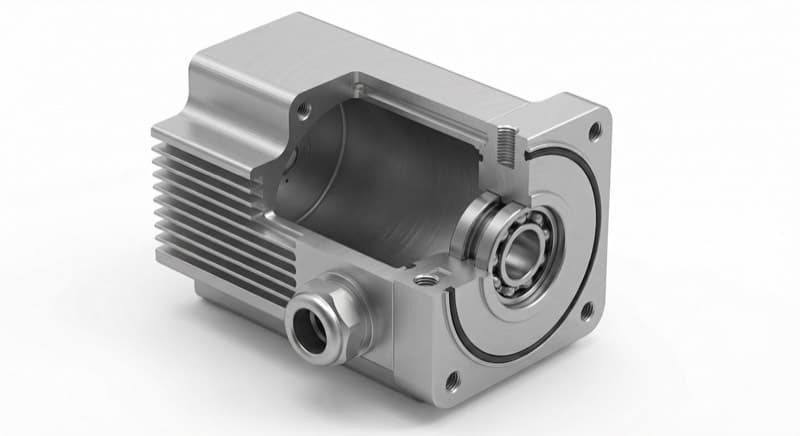
Anatomy of an Actuator Housing
Every actuator housing has six critical functional zones. Understanding what each zone does determines your tolerance, finish, and sealing specifications.
| Feature | Function | Typical Tolerance |
|---|---|---|
| Motor mounting face | Locates and constrains the motor or gearbox. Concentricity of the bore to the mounting bolt pattern is critical. | Flatness ≤0.001″, true position ±0.002″ |
| Bearing bores | Houses radial or angular-contact bearings that support the output shaft. Housing fit depends on bearing load direction and service temperature. | H7/J7/K7 by load case; 25 mm H7 = +0.021/+0.000 mm, Ra ≤32 µin (0.8 um) |
| O-ring gland | Seats the face seal or radial seal between housing halves or at cable entry. Gland dimensions set the compression ratio. | ±0.002″ on width and depth, Ra ≤63 µin (1.6 um) |
| Cable / connector port | Provides ingress for power and signal cables. Often a threaded port for PG or M-series cable glands. | Thread class per gland spec, perpendicularity ≤0.003″ |
| Mounting bosses | Threaded or through-holes for bolting the housing to the robot arm or chassis. Load path must be continuous to the structure. | True position ±0.005″; specify thread size, class, and minimum full-thread depth/engagement per fastener and load case |
| Heat-sink fins or flat pad | Conducts waste heat from the motor or driver electronics to ambient air. Fin geometry depends on airflow availability. | Flatness ≤0.002″ on thermal interface |
Material Selection for Actuator Housings
Material choice affects weight, thermal performance, corrosion resistance, and cost. Here's how the five most common options compare for actuator housing applications.
| Material | Tensile | Thermal k | Density | Machinability | Cost | Recommended Use |
|---|---|---|---|---|---|---|
| Al 6061-T6 | 45 ksi (310 MPa) | 167 W/m·K | 2.70 g/cm³ | Excellent | 1.0× | General-purpose actuator housings, thermal management priority, weldable assemblies |
| Al 7075-T6 | 83 ksi (572 MPa) | 130 W/m·K | 2.81 g/cm³ | Good | 1.5–2.0× | High-load joints, industrial-grade actuators, weight-critical arms where strength-to-weight matters more than thermal conductivity |
| Al 6063-T5 | 27 ksi (186 MPa) | 209 W/m·K | 2.70 g/cm³ | Excellent | 0.9× | Heat sink sections and extruded profiles machined to final shape when conductivity matters more than strength |
| SS 303 | 90 ksi (620 MPa) | 16 W/m·K | 8.03 g/cm³ | Good (free-machining) | 3–4× | High-machinability stainless housings, threaded features, and light washdown environments |
| SS 316L | 75 ksi (515 MPa) | 14 W/m·K | 8.00 g/cm³ | Moderate | 4–5× | Medical devices, wet robotics, and chloride or chemical exposure where 303 is not corrosion-resistant enough |
Rule of thumb: Start with 6061-T6. Only move to 7075 if FEA shows you need the higher yield strength, or to stainless steel if you need corrosion resistance beyond what Type III hardcoat anodize provides. For the full alloy-by-alloy breakdown, see our Material Selection Guide.
Sealing & IP Ratings
IP (Ingress Protection) ratings per IEC 60529 define what your housing keeps out. Here's what each rating demands from your mechanical design.
| Rating | Solid Protection | Liquid Protection | Sealing Requirement | Typical Use |
|---|---|---|---|---|
| IP40 | Objects >1 mm (wires, tools) | None | Close-fit lid, no gasket needed | Indoor lab robots, collaborative arms in clean environments |
| IP54 | Dust-protected (limited ingress) | Splash from any direction | Foam gasket or formed-in-place (FIP) seal on lid, cable glands on all penetrations | Factory floor robots, light industrial automation |
| IP65 | Dust-tight (no ingress) | Low-pressure water jets from any direction | O-ring face seal on all joints, sealed connectors (IP65+ rated), pressure-equalization vent | Outdoor ground robots, agricultural automation, food processing (washdown) |
| IP67 | Dust-tight | Temporary immersion (1 m for 30 min) | O-ring face seal + radial shaft seal, IP67-rated connectors or cable glands, and a rated membrane vent when pressure equalization is required | Underwater ROVs (shallow), field robots in rain/mud, automotive underbody actuators |
Actuator Housing O-Ring Seal and Groove
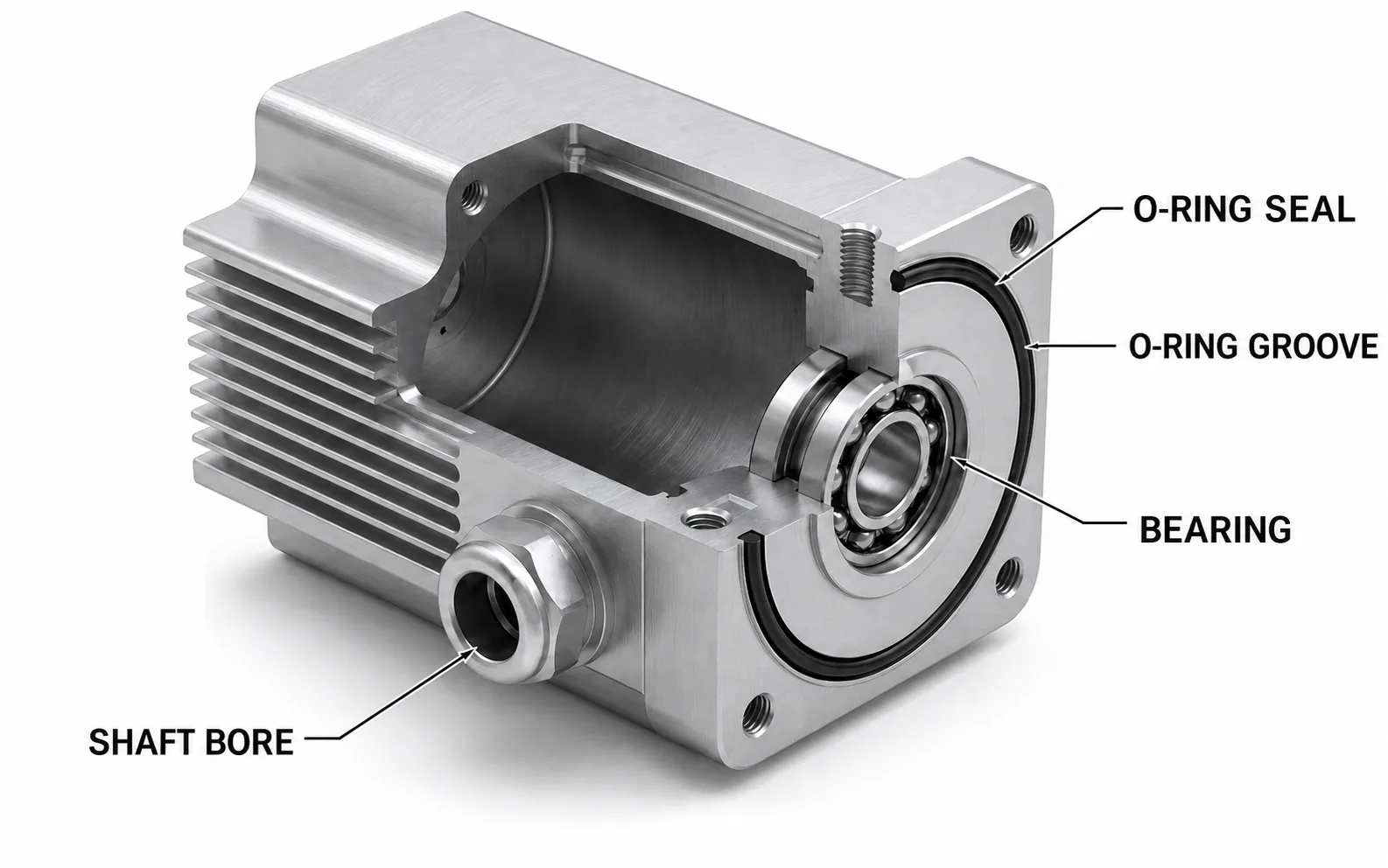
O-Ring Gland Dimensions Reference
O-ring gland dimensions determine whether your seal holds or leaks. These are the three gland types you'll encounter in actuator housings.
| Seal Type | Application | Gland Depth | Gland Width | Squeeze | Finish |
|---|---|---|---|---|---|
| Face seal (axial) | Lid-to-body joint, end cap, cover plate | 70–80% of cord Ø | 105–115% of cord Ø | 15–25% | Ra ≤63 µin (1.6 um) |
| Radial seal (bore) | Shaft seal, piston seal, bearing cap | 75–85% of cord Ø | 100–110% of cord Ø | 10–20% | Ra ≤32 µin (0.8 um) |
| Straight-thread O-ring boss (SAE J1926 / ISO 11926) | Hydraulic/pneumatic port, sensor port, service plug | Per SAE J1926 / ISO 11926 table | Per SAE J1926 / ISO 11926 table | ~20% | Ra ≤63 µin (1.6 um) |
Critical drawing note: Always add "No tool marks across seal path" to your O-ring gland callouts. A 63 µin (1.6 um) surface with scratches crossing the O-ring will leak; the same surface with parallel tool marks is more likely to seal.
Thermal Management
A sealed actuator housing is a sealed oven. Every watt your motor or driver dissipates must exit through the housing walls. Here are three strategies, from simplest to most aggressive.
Conduction to chassis (thermal pad interface)
5–15 W typicalFlat mounting face (flatness ≤0.002″), thermal interface material (TIM) between housing and chassis. Keep thermal path length short — mount the motor driver PCB directly against the housing wall.
Material note: Al 6061-T6 (167 W/m·K) is sufficient. Stainless steel is 10× worse and should be avoided if heat is a concern.
Integral fins (natural convection)
10–40 W typicalFin height 10–25 mm, spacing ≥6 mm for natural convection (≥3 mm for forced air). Fin thickness ≥1.5 mm for machinability. Orient fins vertically for natural convection.
Material note: Al 6063-T5 has 20% better thermal conductivity than 6061 — consider it for fin sections.
Forced-air cooling (fan or ducted)
30–100+ WFan mounting provisions on housing, air inlet/outlet ports, internal baffles to direct flow across hot components. Account for dust ingress — may need filtered inlet.
Material note: Any aluminum alloy. Design focuses on airflow path, not material conductivity.
DFM Rules for CNC-Machined Housings
Eight housing-specific design rules that reduce machining cost and improve quality. For general CNC DFM, see our DFM Best Practices guide.
Wall thickness: 2.5–4.0 mm minimum
Thinner walls deflect under tool pressure and vibrate during machining, causing chatter marks and dimensional drift. Below 2.0 mm, fixturing becomes the bottleneck.
Cost impact: Walls below 2.5 mm can increase machining time 30–50% due to lighter cuts and additional fixturing.
Internal corner radii ≥ tool radius (minimum R1.5 mm)
CNC end mills are round. A sharp internal corner requires EDM or multiple passes with progressively smaller tools. R1.5 mm is produced by a 3 mm or 1/8″ diameter end mill, which matches common shop tooling.
Cost impact: Sharp corners can add $50–$200 per feature in EDM or small-tool finishing.
Design for 2-setup machining
Every additional setup (re-fixturing) adds 15–30 minutes of non-cutting time plus alignment risk. Design the housing so all critical features are accessible from two opposing faces.
Cost impact: Each extra setup adds $30–$100 to the part cost. A 6-setup housing costs 2–3× more than a 2-setup design.
Pocket depth ≤ 4× pocket width
Deep, narrow pockets require long-reach tools that deflect. Deflection causes taper and poor surface finish on pocket walls — exactly where your electronics sit.
Cost impact: Deep pockets beyond 4:1 ratio may require multiple passes or custom tooling, adding 20–40% to pocket machining time.
Standardize fastener sizes
Every unique screw size requires a tool change. If your housing uses M3, M4, and M5 screws across 20 holes, that's 3 tap changes plus 3 drill changes. Standardize on M3 or M4 where loads allow.
Cost impact: Reducing from 3 fastener sizes to 1 saves 4–6 tool changes ($20–$60) per part.
O-ring glands: rectangular cross-section, not dovetail
Rectangular glands are cut with a standard end mill in one pass. Dovetail glands require a special angled cutter and precise depth control — rarely justified for static face seals.
Cost impact: Dovetail glands cost 3–5× more to machine than rectangular glands. Only use for dynamic radial seals where O-ring extrusion is a concern.
Locate cable gland ports on accessible faces
Threading a cable gland port (M16×1.5, M20×1.5, or PG threads) requires the tap to approach perpendicular to the face. Ports on angled or recessed surfaces require 4th-axis or special fixturing.
Cost impact: Cable glands on accessible flat faces are nearly free. On angled surfaces, add $30–$80 per port for fixturing.
Add alignment features (dowel pins or tongue-and-groove)
Bolts alone don't locate housing halves precisely enough for bearing alignment. Two dowel pins (H7/n6 fit) or a machined tongue-and-groove ensure repeatable assembly.
Cost impact: Dowel holes add ~$5–$10. Omitting them and dealing with bearing misalignment in the field costs far more.
Critical Tolerances for Housing Features
Not every feature needs tight tolerances. Here are the ones that do — and why. For the full tolerance reference, see our CNC Tolerances Guide.
| Feature | Tolerance | Finish | Why It Matters |
|---|---|---|---|
| Bearing bore diameter | H7/J7/K7 by load case; 25 mm H7 = 25.000/+0.021 mm | Ra ≤32 µin (0.8 um) | Fit class controls whether the outer race can float for thermal growth or must be retained against creep. Too loose = fretting. Too tight = bore distortion and reduced bearing clearance. |
| Bearing bore concentricity | ⌀0.0005–0.001″ (0.013–0.025 mm) total | Ra ≤32 µin (0.8 um) | Misaligned bores in a 2-bearing arrangement generate radial loads that reduce bearing life exponentially. |
| Motor mounting face flatness | 0.001″ (0.025 mm) over the face | Ra ≤63 µin (1.6 um) | A non-flat mounting face rocks the motor, introducing misalignment between the motor shaft and the driven axis. |
| Motor pilot bore (spigot) | H7/h6 fit (slip fit) | Ra ≤32 µin (0.8 um) | Locates the motor radially. Must be concentric to the bearing bore within ⌀0.001″. |
| O-ring gland depth | ±0.002″ (±0.05 mm) | Ra ≤63 µin (1.6 um) | Gland depth controls compression ratio. Too shallow = over-compression and O-ring damage. Too deep = under-compression and leakage. |
| O-ring gland width | ±0.002″ (±0.05 mm) | Ra ≤63 µin (1.6 um) | Controls fill ratio. Gland must have 70–85% fill to allow thermal expansion without extruding the O-ring. |
| Dowel pin holes | H7/n6 press fit (housing) or H7/h6 slip fit (mating half) | Ra ≤32 µin (0.8 um) | Provides repeatable alignment between housing halves. Press fit in one half, slip fit in the other for easy assembly. |
| Bolt hole true position | ⌀0.005″ (0.13 mm) at MMC | Standard | Ensures bolt pattern aligns with mating part without reaming at assembly. Use MMC modifier to gain tolerance bonus from clearance holes. |
Cost-saving rule: Apply tight tolerances only to the features in this table. Everything else — external walls, non-critical pockets, cosmetic surfaces — should use standard machining tolerances (±0.005″). Over- tolerancing a housing is the most common cause of unnecessary cost escalation.
Surface Finish & Corrosion Protection
Different zones of the housing need different finishes. One blanket spec wastes money or creates failures. For the full finish reference, see our Surface Finishes Guide.
Hardcoat buildup shrinks internal diameters. Machine critical bores oversized, mask them, or finish-hone after anodize to reach the final fit.
Scratches across the seal path leak. Tool marks must run parallel to the O-ring, not across it.
Type II adds minimal thickness (0.0002–0.001″). Type III adds 0.001–0.003″ — adjust external dimensions accordingly.
Black anodize is not just cosmetic on fins — the emissivity increase matters for natural convection scenarios.
Do not anodize thermal interface surfaces — anodize is a thermal insulator. Use chromate conversion coating instead.
Six Common Actuator Housing Mistakes
Specifying 7075 when 6061 is sufficient
What happens: 1.5–2× material cost, worse thermal conductivity (130 vs 167 W/m·K), worse weldability, and harder to anodize cosmetically.
Fix: Use 7075 only when stress analysis shows 6061 fails at the required safety factor. For most actuator housings under 50 kg robot payload, 6061-T6 at 3–4 mm wall thickness is more than adequate.
Anodizing thermal interface surfaces
What happens: Anodize (Al₂O₃) has thermal conductivity of ~1.5 W/m·K — 100× worse than bare aluminum. A 0.001″ anodize layer adds measurable thermal resistance at the motor-to-housing interface.
Fix: Mask thermal interface pads from anodizing. Use chromate conversion (Alodine) for corrosion protection — it adds negligible thermal resistance.
O-ring glands with tool marks across the seal path
What happens: Each scratch crossing the O-ring is a potential leak path. This is the #1 cause of IP test failures on CNC-machined housings.
Fix: Specify "no tool marks crossing the seal path" on your drawing. The machinist should use a single-pass contour cut with the tool moving parallel to the O-ring groove.
Ignoring thermal expansion of aluminum at operating temperature
What happens: A 100 mm bearing bore in 6061 grows by 0.023 mm per 18°F (10°C) rise (CTE = 23.6 µm/m·K). At 140°F (60°C) operating temp, a 72°F (40°C) delta grows the bore 0.094 mm — enough to loosen a light press fit.
Fix: Size bearing fits for operating temperature, not room temperature. For actuators that run hot (>122°F / 50°C housing temp), use a heavier interference fit or add a retention compound (Loctite 641).
No pressure equalization vent on sealed housings
What happens: Temperature swings cause internal pressure changes. A sealed housing going from 32°F (0°C) storage to 104°F (40°C) operation builds ~0.14 bar internal pressure — enough to push out O-ring seals or fatigue thin walls over thousands of cycles.
Fix: Add a Gore-Tex membrane vent (e.g., Gore PolyVent) or sintered metal breather. These equalize pressure while maintaining IP65/IP67 ratings.
Monolithic housing with no access for assembly
What happens: If bearings, electronics, and cables all enter from one opening, assembly becomes a puzzle. Field service is impossible without full disassembly.
Fix: Design housings in 2–3 pieces with a defined assembly sequence. The bearing bore side, electronics access side, and cable entry should be independently accessible.
Frequently Asked Questions
Related Resources
Ready to Machine Your Actuator Housing?
Upload your STEP file for an actuator housing quote. MakerStage can include RFQ-stage manufacturability feedback, tolerance questions, and material suggestions.
Request an Actuator Housing Quote