Copper vs. Aluminum Thermal Conductivity for Heat Sinks and Cold Plates
Copper conducts heat 2.3× better than aluminum 6061. Aluminum is 3.3× lighter and 5–10× cheaper to machine. Here is when each advantage actually matters.
The Conductivity Advantage Is Real — But Weight-Normalized, Aluminum Wins
Copper conducts heat 2.3× better than aluminum 6061 per unit length. But per unit mass, aluminum conducts 1.4× more heat than copper. This single insight — specific thermal conductivity — explains why aluminum dominates heat sinks in weight-sensitive systems, and why copper is reserved for applications where thermal density is so high that geometry can no longer compensate for lower conductivity.
Thermal Conductivity vs. Thermal Diffusivity
Two thermal properties matter for hardware design — and they tell different stories. Conductivity governs steady-state heat flow. Diffusivity governs transient thermal response.
| Property | Cu C110 (ETP) | Al 6061-T6 | Al 6063-T5 | Unit / Notes |
|---|---|---|---|---|
| Thermal conductivity (k) | 385–401 | 167–205 | 190–210 | W/m·K at 68°F (20°C) |
| Thermal diffusivity (α) | 111–117 | 68–97 | 80–85 | mm²/s — governs transient response |
| Specific heat (Cp) | 385–395 | 896–910 | 895–905 | J/kg·K — Cu requires less energy for each kelvin of temperature rise |
| Density (ρ) | 8.89–8.94 | 2.70 | 2.70 | g/cm³ |
| k / ρ (specific conductivity) | 43–45 | 62–76 | 70–78 | W·cm³/(m·K·g) — per unit mass, Al wins |
| ρ × Cp (volumetric heat capacity) | 3,420–3,530 | 2,419–2,457 | 2,415–2,445 | kJ/m³·K — Cu stores more heat per unit volume |
| CTE (coefficient thermal expansion) | 16.5–17.0 | 23.0–23.6 | 23.0–23.4 | µm/m·K — Cu closer to Si (~3), Al farther |
When to Use Conductivity (k)
Steady-state thermal design — continuous power dissipation where the system reaches thermal equilibrium. A CNC-machined cold plate cooling a 200W inverter module runs at steady state: use k to calculate ΔT across the copper or aluminum spreader layer.
When to Use Diffusivity (α)
Transient thermal design — pulse loading, duty-cycle operation, or startup transients. A motor controller that dissipates 500W for 0.1 seconds then idles: the heat spread speed (diffusivity) determines peak junction temperature. Copper spreads a heat pulse ~1.6× faster than aluminum.
Worked Example: Thermal Resistance Through a Heat Sink Base
Formula: Rth = t ÷ (k × A), where t = thickness (m), k = thermal conductivity (W/m·K), A = cross-section area (m²).
Setup: A 50 × 50 × 10 mm heat sink base plate dissipating 50 W steady-state.
Copper C110
R = 0.0187°F/W (SI result: 0.0104°C/W)
ΔT across base = 50 W × 0.0187°F/W = 0.94°F (0.52°C)
Aluminum 6061-T6
R = 0.0432°F/W (SI result: 0.0240°C/W)
ΔT across base = 50 W × 0.0432°F/W = 2.16°F (1.20°C)
Copper saves 1.22°F (0.68°C) in junction temperature through this base plate — meaningful only when your thermal margin is already thin. If your system has 27°F (15°C) of headroom, 1.22°F (0.68°C) does not justify the 3–5× cost premium. If you are at the 50 W/cm² threshold with <9°F (<5°C) of margin, it does.
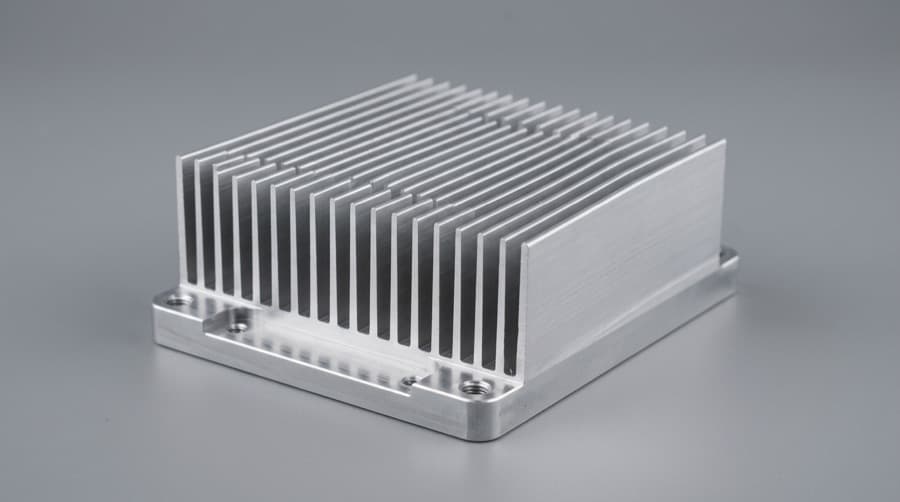
Weight and Cost Tradeoff
Copper's thermal advantage comes with a severe weight penalty and a significant cost premium. Quantify both before deciding.
3.3×
Weight Penalty
A copper cold plate of equivalent geometry weighs 3.3× more than aluminum. For a 500g aluminum heat sink, the copper equivalent is 1.65 kg. In mobile platforms, EVs, and robotics, this weight penalty must be justified by a thermal requirement that aluminum cannot meet with geometry modification.
4–6×
Raw Material Cost
Copper rod is approximately 4–6× more expensive per pound than aluminum 6061 (varies with commodity prices). For a 500g cold plate, the material cost difference alone can be $15–40. At volume, this is significant.
3–5×
Machining Cost
Aluminum 6061 has a machinability rating of ~170% vs. pure copper at 20%. Aluminum cycle times are 3–5× shorter than copper for equivalent geometry, carbide tooling lasts much longer, and surface finish is easier to achieve. Total machined part cost for copper is typically 3–5× an equivalent aluminum part.
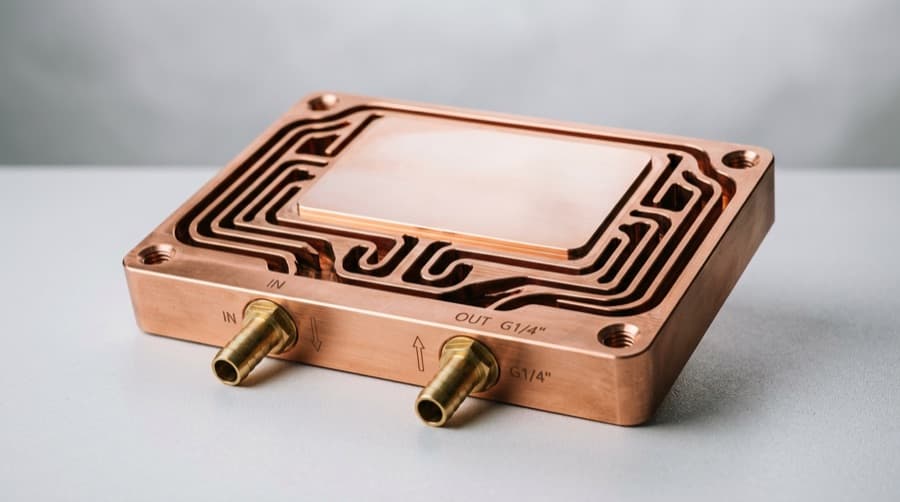
Heat Sinks vs. Cold Plates vs. Bus Bars
The optimal material depends on application type. Here is the engineering rationale for each.
| Application | Standard Choice | When to Use Copper | Key Metric |
|---|---|---|---|
| Air-cooled fin heat sink | Aluminum 6061 or 6063 | Heat flux >50 W/cm² at base or junction temperature limit is already being exceeded with aluminum geometry | Base-to-ambient θ (°C/W) |
| Liquid cold plate (single-phase) | Aluminum 6061 | High-power density IGBTs, SiC FETs where junction temperature margin is <18°F (<10°C) with aluminum; or combined bus bar + cooler function | Thermal resistance Rth (°C/W) |
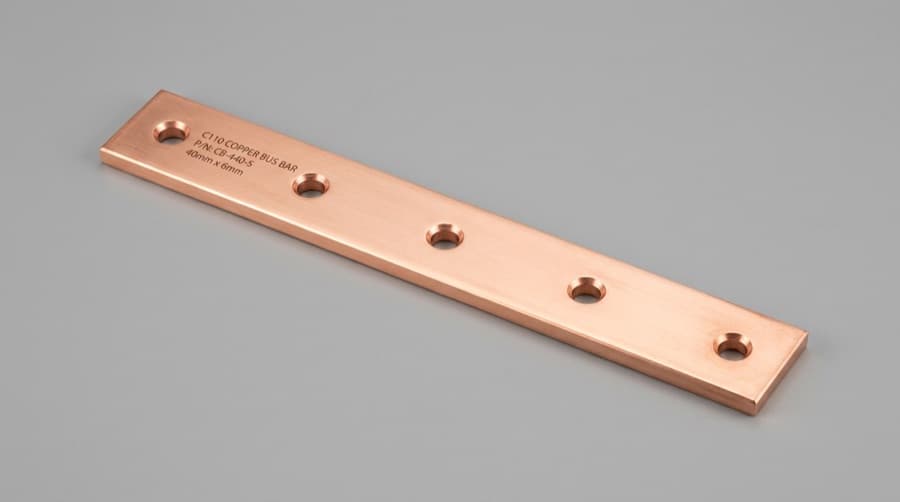
| Bus bar (current conductor) | Copper C110 or C101 | Always — brass is 26–28% IACS and aluminum 6061 is ~43% IACS vs. 100% IACS for copper. Aluminum bus bars exist for high-voltage DC at lower current density (using 1350 alloy at ~61% IACS). | Ampacity (A/mm²) |
| Heat spreader (between device and cooler) | Copper C110 | Most applications — copper spreaders are thin and the weight penalty is small. A 2mm copper spreader adds ~16g per 100cm² vs. ~5g for aluminum — worth the conductivity gain. | Spreading resistance Rsp (°C/W) |
| Vapor chamber base plate | Copper C110 | Always — vapor chambers are copper. The working fluid (water) and wick structure require copper compatibility. | Effective k (W/m·K) |
Machine Your Thermal Part at MakerStage
MakerStage machines both copper cold plates and aluminum heat sinks. Upload your CAD file for a quote-stage review that can flag deep pockets, thin walls, and features that add machining time or cost.
Request a Thermal Part QuoteHybrid Assembly Strategies
Effective thermal assemblies often combine copper and aluminum to get the benefits of both, but galvanic compatibility must be managed.
Copper spreader + aluminum finned heat sink
A CNC-machined or stamped copper base plate spreads heat from a high-flux source (e.g., SiC FET die, ~100 W/cm²) laterally, then transfers to an aluminum finned extrusion or machined body for air-cooling. The copper handles the high-flux zone; the aluminum handles the large fin area. Weight optimized: only the spreading layer is copper.
Separate with a nickel-plated copper interface or conformal TIM pad to prevent galvanic contact between copper base and aluminum body.
Aluminum liquid cold plate + copper internal insert
An aluminum cold plate body with a copper insert or copper tube pressed into a machined channel. The copper tube handles the high-conductivity fluid path; the aluminum body provides structure, mounting interfaces, and the manifold. Common in EV battery thermal management.
Use stainless steel fittings rather than copper fittings directly into aluminum manifold to minimize galvanic series span. Control coolant pH (7.0–8.5) with inhibitors.
Copper bus bar + aluminum housing
Power electronics inverters routinely use copper bus bars for current carrying with aluminum housings for the thermal path. The bus bar and housing are electrically isolated (by design) and thermally isolated by their interface geometry.
At the copper-aluminum interface, use a silver-impregnated thermal gap pad rather than direct metal-to-metal contact to eliminate galvanic corrosion risk and accommodate CTE mismatch.
Aluminum heat sink with copper vapor chamber base
High-performance CPU/GPU coolers use a copper vapor chamber as the base (maximum heat spreading) with aluminum fins for the air-cooled section. The vapor chamber spreads heat with very low spreading resistance; the aluminum fins are optimized for airside flow resistance minimization.
Vapor chambers are copper assemblies and are not CNC machinable — they are manufactured by vacuum brazing. The aluminum fin stack is press-fit or soldered to the copper base.
Material Selection Checklist
Work through this checklist in order. The first “yes” that triggers a copper recommendation is your answer.
Does the part carry electrical current (bus bar, terminal, conductor)?
YES → Use copper (C110 or C101). Aluminum 6061 bus bars require ~2.3× larger cross-section for equivalent ampacity (~43% IACS). Electrical-grade aluminum (1350 alloy, ~61% IACS) still requires ~1.6× larger cross-section.
Is the steady-state heat flux at the source interface >50 W/cm²?
YES → Evaluate copper. At high heat flux, the 2.3× conductivity advantage of copper materially reduces Rth and junction ΔT. Quantify the ΔT difference before deciding.
Is the part a heat spreader <5mm thick (where geometry cannot compensate)?
YES → Copper is preferred. Thin spreaders have limited geometric options — conductivity is the primary lever.
Is weight a primary design constraint (mobile robot, EV, portable device)?
NO constraint → Evaluate copper on thermal merit. WEIGHT CONSTRAINED → Use aluminum. Per unit mass, aluminum conducts more heat than copper.
Is the part cost-constrained and heat flux <20 W/cm² at the base?
YES → Use aluminum 6061 or 6063. Geometric optimization (more fins, forced air) will achieve equivalent thermal performance at 20–30% of copper machined part cost.
None of the above apply?
DEFAULT → Aluminum 6061. It is the correct default for most thermal management applications.
Frequently Asked Questions
Ready to Machine Your Thermal Part?
Copper cold plates and aluminum heat sinks machined with free RFQ-stage manufacturability feedback. Upload your CAD for a thermal part quote.
Request a Thermal Part Quote